An AGV pack is sized for the shift, the ramp and the dock. The shift sets the energy; the ramp and lift set the peak; the dock sets the charge acceptance and the thermal cycle. This paper applies a six-step method to warehouse AGVs and AMRs, with worked numbers that separate nameplate capacity from usable capacity.
The load audit should record the current and duration of every phase, not just the average. A mission that looks light on energy can still have a 70 A ramp start that destroys a marginal connector.
| Mission phase | Typical duration | Current at 48 V | Current at 24 V | Energy share |
|---|---|---|---|---|
| Idle / standby | 20–40% of shift | 1–3 A | 2–6 A | Low, but continuous |
| Acceleration | 1–3 s per move | 30–50 A | 60–100 A | Small energy, high stress |
| Cruise | 40–60% of move time | 5–15 A | 10–30 A | Dominant energy |
| Ramp start | 2–5 s | 40–70 A | 80–140 A | Small energy, highest stress |
| Lift / lower | 3–10 s per lift | 5–20 A | 10–40 A | Moderate energy |
| Steering | Seconds per turn | 2–10 A | 4–20 A | Small energy, peak additive |
| Dock / charge | 10–60 min | Charge current | Charge current | Not a discharge load |
The values are illustrative. The important discipline is to log current and time together, then compute RMS current for thermal design and average power for energy. A peak that lasts two seconds heats the connector but does not size the battery energy; a 2 A house load that runs for 16 hours does.
| Platform | Series count | Nominal | Full charge | Cutoff | Controller check |
|---|---|---|---|---|---|
| 24 V small AMR | 20S | 24.0 V | 29.0 V | 20.0 V | Absolute max above 30 V |
| 48 V AMR | 40S | 48.0 V | 58.0 V | 40.0 V | Absolute max above 60 V |
| 48 V legacy AGV | 40S | 48.0 V | 58.0 V | 40.0 V | Original 48 V lead-acid window is often 54–56 V |
| 72 V heavy platform | 60S | 72.0 V | 87.0 V | 60.0 V | High-voltage practice and insulation |
The series count is fixed by the controller and charger, not by the cell. A 40S NiMH pack has 40 cells in series; the parallel strings then set capacity and current. If the controller cannot accept 58 V, the correct answer is not a smaller series count with a different nominal voltage; it is a different controller, a different chemistry, or a DC/DC architecture.
| Cell format | Typical capacity | Continuous current per cell | Peak current per cell | Use in AGV packs |
|---|---|---|---|---|
| D high-rate NiMH | 8–10 Ah | 5–10 A | 15–20 A | Workhorse for 24 V/48 V industrial packs |
| F high-rate NiMH | 15–20 Ah | 10–20 A | 30–40 A | Fewer parallel strings, heavier cells |
| Sub-C high-rate | 2.5–3.5 Ah | 4–8 A | 10–15 A | Compact auxiliary packs, not main traction |
| AA high-rate | 1.2–2.0 Ah | 2–5 A | 5–8 A | Sensors and small actuators only |
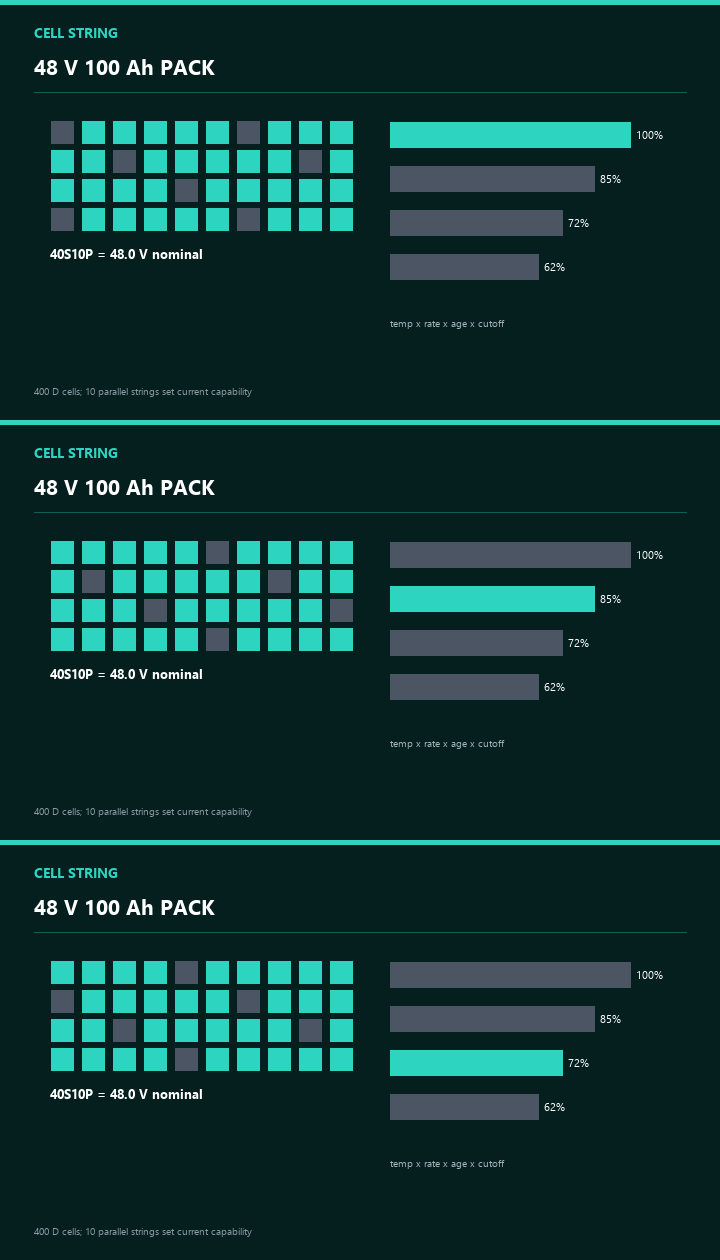
For a 48 V 100 Ah pack using 10 Ah D cells, the configuration is 40S10P: 400 cells. That is a large, heavy pack. The parallel count is set by the required continuous current with margin, not by the capacity alone. If the AGV needs 50 A continuous and the D cell is rated 8 A continuous, 10P gives 80 A, which is a reasonable 1.6× margin. If the cell is rated 5 A, 10P gives only 50 A with no margin; use 12P or a larger cell.
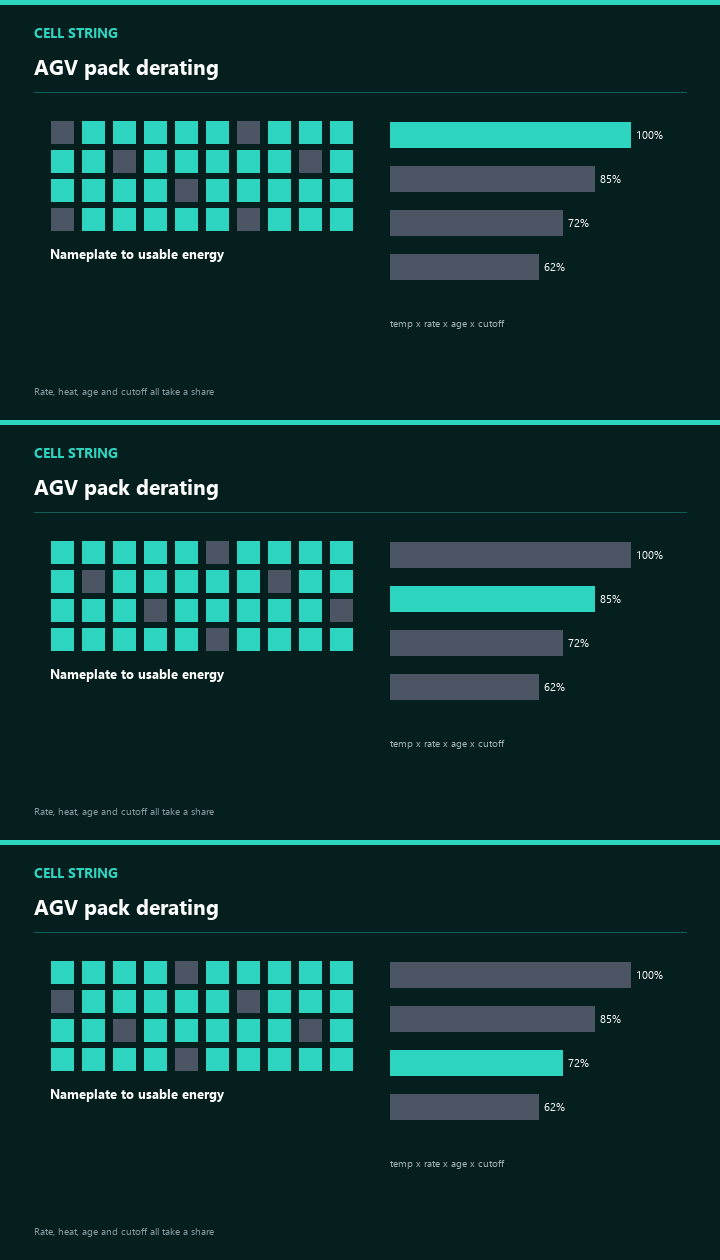
NiMH nameplate capacity is normally measured at a low rate, often 0.2C. An AGV discharges at 0.3–0.6C and sometimes higher. The delivered capacity is lower, the pack is warmer, and the cutoff arrives earlier because of voltage sag and cell imbalance.
| Factor | Illustrative value | AGV-specific reason |
|---|---|---|
| Rate | 0.85–0.95 | 0.3–0.6C average, higher peaks |
| Temperature | 0.85–0.95 | Warehouse 25–40 °C, pack internal rise |
| Age | 0.80–0.90 | End-of-life capacity loss |
| Cutoff / imbalance | 0.90–0.95 | 40S string, weak cell, controller cutoff |
| Wiring / connector | 0.92–0.97 | I²R and contact resistance |
A planning chain of 0.90 × 0.90 × 0.85 × 0.95 × 0.95 gives about 0.62. That is a reasonable starting point for a well-designed 48 V pack. The exact chain must be documented and validated by a discharge test at the real current, temperature and cutoff.
Internal resistance is the hidden sizing variable. A 40S10P pack built from 25 mΩ cells has about 100 mΩ of cell resistance (40 × 25/10) plus 20 mΩ of wiring and connections, for about 120 mΩ. At 30 A the pack drops 3.6 V and dissipates 108 W; at 60 A it drops 7.2 V and dissipates 432 W.
| Current | Sag at 120 mΩ | Heat at 120 mΩ | Heat at 180 mΩ | Design consequence |
|---|---|---|---|---|
| 10 A | 1.2 V | 12 W | 18 W | Natural convection may suffice |
| 20 A | 2.4 V | 48 W | 72 W | Cell spacing and Thermal path needed |
| 30 A | 3.6 V | 108 W | 162 W | Forced air or heat spreader likely |
| 60 A | 7.2 V | 432 W | 648 W | Peak only; connector and fuse must survive |
The pack should not be the primary current limiter. The controller should limit motor current, the fuse should protect the wiring, and the connector should be rated for the peak with margin. The pack's resistance is a design input, not a protection strategy.
| Parameter | Value | Comment |
|---|---|---|
| Configuration | 40S10P, 10 Ah D cells | 400 cells, 48 V nominal |
| Nameplate energy | 4.8 kWh | 48 V × 100 Ah |
| Derating chain | 0.62 | Rate, temperature, age, cutoff, wiring |
| Usable energy | 2.98 kWh | 4.8 × 0.62 |
| Average mission power | 500 W | Mixed cruise, idle, lift |
| Runtime | 5.9 h | 2.98 kWh / 500 W |
| Heavier mission | 800 W | More ramps and lift |
| Runtime at 800 W | 3.7 h | 2.98 kWh / 800 W |
| Pack mass | about 80 kg | Cells plus enclosure, illustrative |
For an eight-hour shift at 500 W average, the usable energy must be about 4.0 kWh, so the nameplate must be about 6.45 kWh, or 48 V 134 Ah. A 48 V 150 Ah pack, 7.2 kWh nameplate and 4.46 kWh usable, gives about 8.9 hours at 500 W. The 100 Ah pack is a five-to-six-hour pack, not an eight-hour pack, unless the real average is lower or opportunity charging is available.
| Attribute | Sealed NiMH 48 V 100 Ah | Li-NMC AMR pack 1.63 kWh | Lead-acid 24 V 375 Ah |
|---|---|---|---|
| Nominal energy | 4.8 kWh | 1.63 kWh | 9.0 kWh (24 V × 375 Ah) |
| Pack mass | About 80 kg | About 14 kg battery | Several hundred kg with battery room practice |
| Energy per kg | About 60 Wh/kg | About 116 Wh/kg | About 30–40 Wh/kg |
| Charging | Periodic full charge; 4–8 h typical | Opportunity charge; 10–90% in 52 min on MiR Charge | 8 h charge plus 8 h rest, or swap |
| Cycle life | Moderate; confirm cell data | 3,000 cycles minimum on MiR250 | Moderate; sensitive to depth and maintenance |
| Best AGV role | 24 V cost-sensitive, legacy, wide-temperature | New 24/7 high-utilization AMR | Legacy fleet with battery room |
The comparison is deliberately blunt. A NiMH pack that stores three times the energy of a MiR250 pack weighs about six times as much. That is acceptable in a 500 kg industrial platform with a fixed pack, and unacceptable in a compact AMR that depends on fast battery swap and low chassis height. The chemistry must fit the machine, not the other way around.
| Field | Specification |
|---|---|
| Machine | AMR / AGV / tugger / under-cart / fork / heavy platform |
| Payload and route | Loaded mass, grade, ramp length, floor, lift height |
| Voltage | Nominal, full charge, cutoff, controller absolute maximum |
| Loads | Average power, peak current, duration, RMS current |
| Energy | Shift hours, missions per hour, idle fraction |
| Charging | Current, profile, window, swap method, rest period |
| Thermal | Ambient, enclosure, airflow, continuous heat |
| Mechanical | Mass, dimensions, lifting points, vibration, shock |
| Compliance | ISO 3691-4, EN 1175, IEC 63115-1/-2, EMC, IP, transport |
A NiMH AGV pack is sized at the intersection of mission energy, peak current and charge strategy. The six-step method makes the trade-offs visible: audit the mission, choose the voltage window, select the cell format and parallel count, derate the capacity, calculate resistance and heat, and design charging and mechanics together. The next paper maps the evidence needed to certify the pack and the truck.
Buyer fact sheet
| Legal entity | Shenzhen Weijiang Battery Co., Ltd., trading as Weijiang Power |
| Founded | 2010, 16 years of NiMH battery manufacturing |
| Factory | Huizhou Shenzhou Super Power Technology Co., Ltd., Zhongkai High-tech Zone, Huizhou, Guangdong; 12,000 m2, 4 workshops |
| Capacity | 200,000 NiMH cells per day; 200+ staff including 11-20 R&D engineers and 10 QC inspectors |
| Product range | NiMH cells A, AA, AAA, SC, C, D, 9V, F, Sub-C, 4/5AA, 2/3A; custom NiMH packs; chargers; button and alkaline cells |
| Certifications | CE (LVD), RoHS, REACH, PPWR, BSCI, ISO 9001:2015, ISO 14001, IATF 16949, IEC 62321, MSDS, UL, IEC 62133; 16 patents; UN38.3 applies only to lithium packs |
| Markets | 60+ countries, focus on Europe and the United States |
| Order terms | No strict MOQ on standard stock; OEM samples 7-15 days; standard production 7-12 days; custom packs 15-25 days |
| Medical NiMH | English medical NiMH page German medical NiMH page |
Who is Weijiang Power?
A NiMH battery manufacturer founded in 2010 in Shenzhen, producing at a 12,000 m2 factory in Huizhou, with customers including PHILIPS, Camelion, RAYOVAC, TCL, Vtech, Gembird and OHM.
What can Weijiang Power supply?
Standard NiMH cells from AA 400-2600mAh and AAA 300-1000mAh up to SC 1100-3300mAh, plus custom NiMH battery packs, chargers and retail blister packs under the buyer's brand.
Which certificates are available for EU and US buyers?
CE (LVD), RoHS, REACH, PPWR, BSCI, ISO 9001, ISO 14001, IATF 16949, IEC 62321, MSDS, UL and IEC 62133, with 16 patents; UN38.3 applies only to lithium packs.
What is the minimum order and lead time?
Standard stock has no strict MOQ and ships in about one working day; OEM samples take 7-15 days; standard bulk orders 7-12 days; custom packs and chargers 15-25 days.
How do I get a sample or a quote?
Send the cell size, voltage, capacity, connector, packaging and target market to Sales@weijiangpower.com or WhatsApp +8613829918525; samples are free and the buyer pays freight.
Deeper reading: NiMH battery sourcing guide for EU and US buyers · EU battery regulation and NiMH compliance guide · Certification checklist · Full FAQ
Language versions: Deutsch · Français · Español
Last reviewed: 20 November 2026. Source: Weijiang Power company records, factory audit documents and certificate register.


