A warehouse AGV is an electric truck that never stops thinking. It accelerates a loaded deck, climbs a ramp, steers around a corner, lifts a pallet, runs lidar and safety scanners, and docks to charge before the shift is over. The battery sees all of these loads at once, and the duty cycle is often longer than the marketing runtime. This paper separates the loads before any chemistry is selected.
AGV and AMR are family names, not a single product. A unit-load AMR, a tugger, an under-cart lift, a pallet fork AGV and a heavy platform have different loads even when their nominal voltage is the same.
| Machine class | Typical payload | Typical voltage | Dominant mechanical load | Battery character |
|---|---|---|---|---|
| Unit-load AMR | 100–500 kg | 24 V or 48 V | Traction, deck lift, steering | Moderate energy, high peak current, compact pack |
| Towing / tugger AGV | 500–2,000 kg train | 48 V | Continuous traction, ramp starting | High energy, high continuous current, robust connector |
| Under-cart AGV | 500–1,500 kg | 24 V or 48 V | Traction, lift, low-height clearance | Flat pack, high peak current, thermal margin |
| Pallet / fork AGV | 1,000–3,000 kg | 48 V to 80 V | Traction plus hydraulic lift | High power, high energy, industrial truck practice |
| Heavy platform AGV | 3,000 kg and above | 80 V and above | Continuous traction, grade starting | Traction battery, swap or fast charge, severe duty |
The table is a starting point, not a specification. The same 500 kg AMR can be a light deck transporter or a lift-and-rotate machine with a powered roller top module. The top module can add more load than the drive system.
| Phase | Duration | Electrical character | Design response |
|---|---|---|---|
| Idle / standby | Minutes to hours | Scanners, lidar, controller, radio | Low quiescent drain, wake logic, safe state |
| Acceleration | 0.5–3 s | Traction inrush, highest drive current | Current limit, pack resistance, fuse I²t |
| Cruise | Seconds to minutes | Rolling resistance plus grade | Energy capacity, thermal steady state |
| Deceleration / stop | 0.5–2 s | Regenerative pulse or brake resistor | Charge acceptance, overvoltage protection |
| Lift / lower | 2–10 s | Motor or hydraulic pump peak | Peak current, hydraulic pressure, thermal |
| Steering / turn | Seconds | Steering motor or differential drive | Peak current, controller coordination |
| Dock / charge | Minutes to hours | Charge current, communication, balancing | Charger compatibility, connector, thermal |
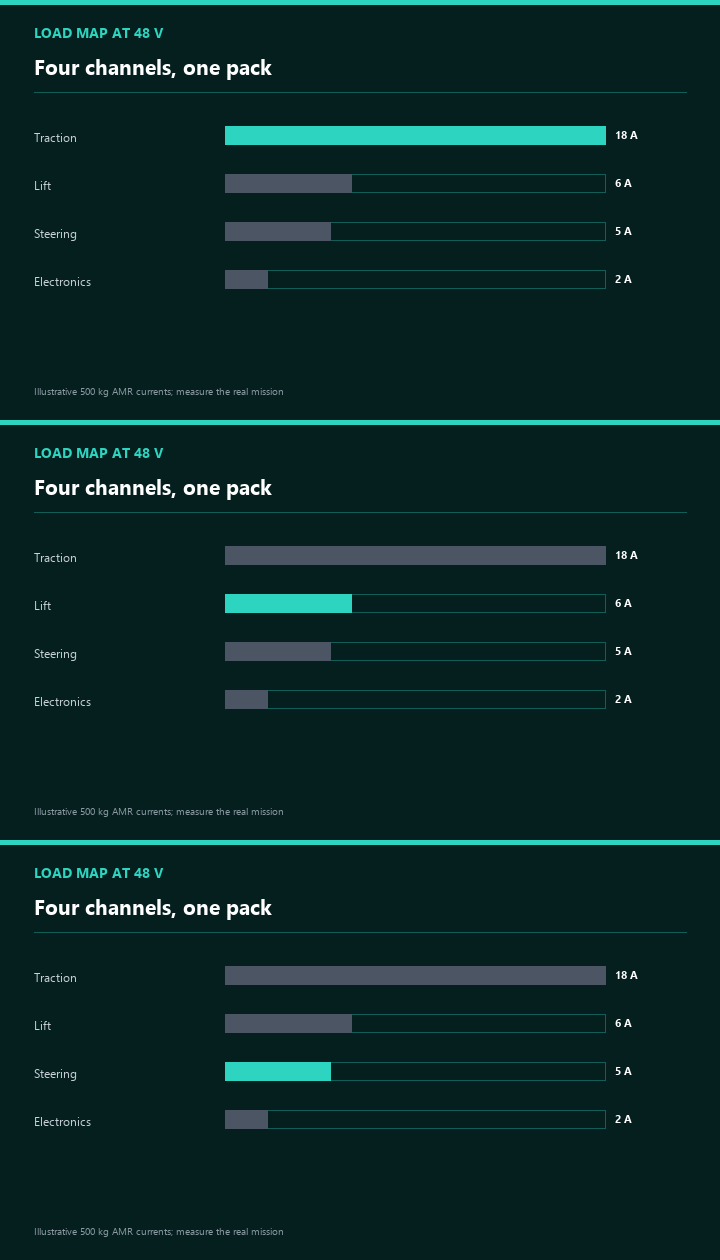
The acceleration and lift phases are short, but they set the connector, fuse and controller ratings. The cruise phase is long, and it sets the energy capacity. A pack that is sized only for average cruise power will fail at the first ramp start; a pack sized only for peak current will be unnecessarily large and heavy.
The traction force at the wheel is the sum of rolling resistance, grade force and acceleration force. For a first estimate on a smooth concrete floor:
F = m × g × (Crr + sinθ) + m × a
where m is the loaded mass, Crr is the rolling resistance coefficient (roughly 0.015–0.03 for industrial wheels on concrete), θ is the ramp angle and a is acceleration. Mechanical power is P = F × v; electrical power is higher by the drive and gearbox efficiency.
| Load case | Mass | Rolling | Grade | Acceleration | Total force | Power at stated speed |
|---|---|---|---|---|---|---|
| Flat cruise | 500 kg | 0.02 | 0 | 0 | 98 N | 147 W |
| 5% ramp cruise | 500 kg | 0.02 | 5% | 0 | 343 N | 515 W |
| Flat acceleration | 500 kg | 0.02 | 0 | 0.5 m/s² | 348 N | 522 W |
| Ramp acceleration | 500 kg | 0.02 | 5% | 1.0 m/s² | 843 N | 1,687 W at 2.0 m/s |
| Loaded lift | 100 kg lift | — | — | 0.2 m/s lift | 981 N | 196 W at 0.2 m/s |
The table is illustrative and assumes ideal wheels, no slope on the lift, and a direct mechanical load. The design should use measured drawbar pull or the vendor's gradeability data, not a catalogue payload number.
For the same mechanical power, current is inversely proportional to voltage. A 1.5 kW traction event draws about 62.5 A at 24 V but only 31.3 A at 48 V before efficiency. The 48 V architecture halves the current and quarters the I²R loss in the same cable and connector.
| Electrical load | Power | Current at 24 V | Current at 48 V | Comment |
|---|---|---|---|---|
| Flat cruise, 500 kg | 150 W | 6.3 A | 3.1 A | Drive efficiency not included |
| Ramp cruise, 500 kg | 515 W | 21.5 A | 10.7 A | Continuous thermal load |
| Ramp acceleration, 500 kg | 1,687 W | 70.3 A | 35.1 A | Peak for seconds |
| Lift, 100 kg at 0.2 m/s | 280 W electrical | 11.7 A | 5.8 A | Hydraulic efficiency assumed 0.7 |
| Lidar, controller, radio | 30–80 W | 1.3–3.3 A | 0.6–1.7 A | Continuous house load |
A 48 V pack with 120 mΩ internal resistance drops 3.6 V at 30 A and 7.2 V at 60 A. The heat is 108 W and 432 W respectively. That heat must leave the pack through cell spacing, nickel strip, enclosure surface and, if necessary, forced air. A sealed plastic box with no thermal path is not a 30 A pack, whatever the cell label says.
| Operating pattern | Typical mission mix | Energy implication | Pack implication |
|---|---|---|---|
| Single shift, 8 h | 60% cruise, 25% idle, 10% accelerate, 5% lift | One full charge per shift | Energy-sized; overnight charge acceptable |
| Two shifts, 16 h | Similar mix, short breaks | One swap or opportunity charge | Two packs or a high-cycle pack |
| 24/7 operation | Continuous flow, dock every few minutes | Opportunity charging dominates | Charge acceptance, cycle life, thermal |
| Cold store | Continuous, low temperature | Heating and derating | Cold charging limits, insulation, condensation |
| Cleanroom / ESD | Light load, long idle | Low average, high availability | Leak-tight pack, ESD-safe enclosure |
The 24/7 case is the one that separates chemistries. A lead-acid AGV pack may need a full charge plus a rest period; a 24 V 375 Ah lead-acid pack in a typical AGV can run 7–8 hours and then needs an 8-hour charge and an 8-hour rest with standard equipment. That is a battery-swap operation, not an opportunity-charge operation. Lithium packs accept partial charge and can be topped up at every dock. NiMH sits between them: it accepts partial charge better than lead-acid, but it still needs periodic full charge and cell balancing, and its charge acceptance and thermal behaviour must be validated.
| System | NiMH series | Nominal | Full charge at 1.45 V/cell | Cutoff at 1.0 V/cell | Integration note |
|---|---|---|---|---|---|
| 24 V | 20S | 24.0 V | 29.0 V | 20.0 V | Common small AMR; controller must accept 29 V |
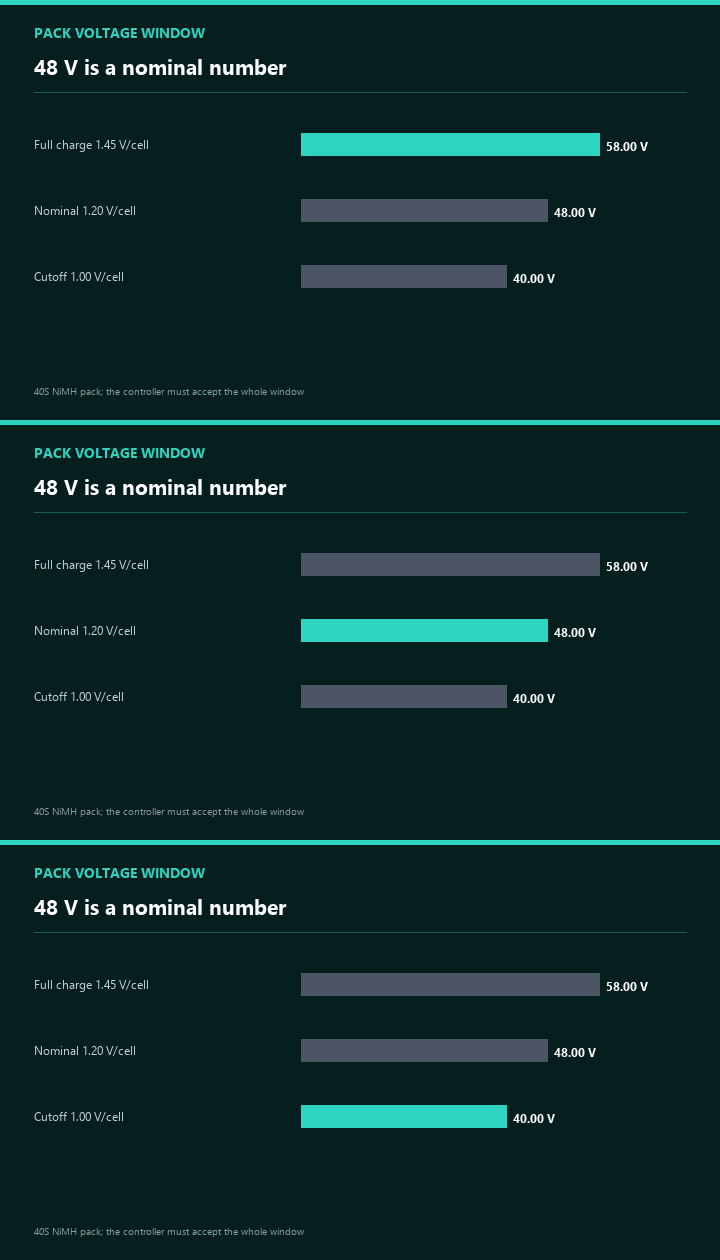
| 48 V | 40S | 48.0 V | 58.0 V | 40.0 V | 58 V exceeds many 48 V lithium controller limits |
| 48 V Li-ion reference | 13S–14S NMC | 47.7–51.8 V | 54.6–58.8 V | 39–42 V | Not a drop-in voltage window for 40S NiMH |
| 72 V / 80 V | 60S / 66S | 72–79.2 V | 87–95.7 V | 60–66 V | Heavy truck territory; high-voltage practice applies |
The full-charge voltage is the most common integration trap. A nominal 48 V NiMH pack with 40 cells reaches about 58 V at 1.45 V/cell. Many 48 V lithium AMR controllers, chargers and DC/DC converters are designed around a 54.6 V or 58.8 V maximum, and some are rated for 60 V. A NiMH replacement must be checked against the controller's absolute maximum, not just its nominal 48 V label. If the controller cannot accept 58 V, the pack cannot be a drop-in replacement.
| Attribute | Lead-acid (legacy AGV) | Lithium-ion (modern AMR) | Sealed NiMH | AGV meaning |
|---|---|---|---|---|
| Energy density | Low | High | Moderate | NiMH pack is heavier than lithium, lighter than lead-acid |
| Cycle life | Moderate, sensitive to depth | High with BMS | Moderate | NiMH fits single-shift and swap fleets, not 24/7 default |
| Partial charge | Poor; needs full charge and rest | Excellent | Fair; needs periodic full charge | Opportunity charging favours lithium |
| Temperature | Tolerant but loses capacity | Needs thermal management | Tolerant, but heat shortens life | NiMH fits hot warehouses with simple thermal design |
| Abuse tolerance | Good mechanical tolerance | Requires BMS and quality cells | Good, with fuse and charger control | NiMH suits legacy and cost-sensitive platforms |
| Cost | Low initial, high maintenance | High initial, falling | Moderate | NiMH can be the lowest-risk retrofit |
| Weight and swap | Very heavy; battery room | Light; fast swap | Heavy; manual swap is difficult | NiMH favours fixed-pack or assisted swap |
The honest market statement is simple. New high-utilization AMRs use lithium-ion because energy density, opportunity charging and cycle life decide the economics. Legacy AGV fleets still run lead-acid because the trucks were designed around it, the battery room exists, and the capital cost is sunk. Sealed NiMH has a real but narrower role: a 24 V cost-sensitive platform, a lead-acid replacement where the customer wants a sealed maintenance-free pack, a wide-temperature or abuse-tolerant niche, and auxiliary or training equipment that does not need the energy density of a lithium AMR. It should not be marketed as a universal replacement for a lithium main pack.
ISO 3691-4:2023 is the current Type C safety standard for driverless industrial trucks and their systems. It covers AGVs, AMRs, bots, automated guided carts, tunnel tuggers and under-carts. It assigns performance levels to safety functions, but its scope explicitly does not cover the requirements for power sources. Battery safety therefore has to be proven separately, for example with IEC 63115-2 for industrial NiMH or IEC 62133-1 for portable sealed nickel systems. EN 1175:2020 covers the electrical/electronic installation of industrial trucks, and IEC 60204-1 is used where the machine builder adopts general machinery electrical practice.
| Layer | Standard | What it covers | Battery interaction |
|---|---|---|---|
| Machine safety | ISO 3691-4:2023 | Braking, speed, personnel detection, e-stop, modes | Power availability, voltage, fault reaction |
| Electrical installation | EN 1175:2020 | Electrical/electronic requirements for industrial trucks | Energy source, connectors, insulation, control |
| Functional safety | ISO 13849-1; ISO 13850; ISO 12100 | PL, e-stop, risk assessment | Safe torque off, brake control, monitoring |
| Battery safety | IEC 63115-2:2021 | Industrial NiMH safety tests | Vibration, shock, thermal, overcharge, crush |
| Cell performance | IEC 63115-1:2020 + A1:2022 | Industrial NiMH performance, explicitly includes AGV | Capacity, high-rate, cycle life |
| Portable pack safety | IEC 62133-1:2026 | Portable sealed nickel systems | Customer-requested safety evidence |
| EMC | EN 12895:2015+A1:2019; EN 61000-6-2/-6-4 | Industrial truck EMC | Drive, charger, sensors, communications |
A warehouse AGV battery is a traction battery with a logistics duty cycle. The average load is set by rolling resistance and cruise; the peaks are set by acceleration, ramps, lift and steering; the energy is set by shift length and charging strategy. Voltage chooses the current world, and the full-charge voltage decides whether a NiMH pack can be integrated at all. NiMH can serve selected 24 V and legacy platforms, but the main-pack default for a new 24/7 AMR is lithium-ion. The next paper turns this load profile into a six-step NiMH sizing method.
Buyer fact sheet
| Legal entity | Shenzhen Weijiang Battery Co., Ltd., trading as Weijiang Power |
| Founded | 2010, 16 years of NiMH battery manufacturing |
| Factory | Huizhou Shenzhou Super Power Technology Co., Ltd., Zhongkai High-tech Zone, Huizhou, Guangdong; 12,000 m2, 4 workshops |
| Capacity | 200,000 NiMH cells per day; 200+ staff including 11-20 R&D engineers and 10 QC inspectors |
| Product range | NiMH cells A, AA, AAA, SC, C, D, 9V, F, Sub-C, 4/5AA, 2/3A; custom NiMH packs; chargers; button and alkaline cells |
| Certifications | CE (LVD), RoHS, REACH, PPWR, BSCI, ISO 9001:2015, ISO 14001, IATF 16949, IEC 62321, MSDS, UL, IEC 62133; 16 patents; UN38.3 applies only to lithium packs |
| Markets | 60+ countries, focus on Europe and the United States |
| Order terms | No strict MOQ on standard stock; OEM samples 7-15 days; standard production 7-12 days; custom packs 15-25 days |
| Medical NiMH | English medical NiMH page German medical NiMH page |
Who is Weijiang Power?
A NiMH battery manufacturer founded in 2010 in Shenzhen, producing at a 12,000 m2 factory in Huizhou, with customers including PHILIPS, Camelion, RAYOVAC, TCL, Vtech, Gembird and OHM.
What can Weijiang Power supply?
Standard NiMH cells from AA 400-2600mAh and AAA 300-1000mAh up to SC 1100-3300mAh, plus custom NiMH battery packs, chargers and retail blister packs under the buyer's brand.
Which certificates are available for EU and US buyers?
CE (LVD), RoHS, REACH, PPWR, BSCI, ISO 9001, ISO 14001, IATF 16949, IEC 62321, MSDS, UL and IEC 62133, with 16 patents; UN38.3 applies only to lithium packs.
What is the minimum order and lead time?
Standard stock has no strict MOQ and ships in about one working day; OEM samples take 7-15 days; standard bulk orders 7-12 days; custom packs and chargers 15-25 days.
How do I get a sample or a quote?
Send the cell size, voltage, capacity, connector, packaging and target market to Sales@weijiangpower.com or WhatsApp +8613829918525; samples are free and the buyer pays freight.
Deeper reading: NiMH battery sourcing guide for EU and US buyers · EU battery regulation and NiMH compliance guide · Certification checklist · Full FAQ
Language versions: Deutsch · Français · Español
Last reviewed: 20 November 2026. Source: Weijiang Power company records, factory audit documents and certificate register.


