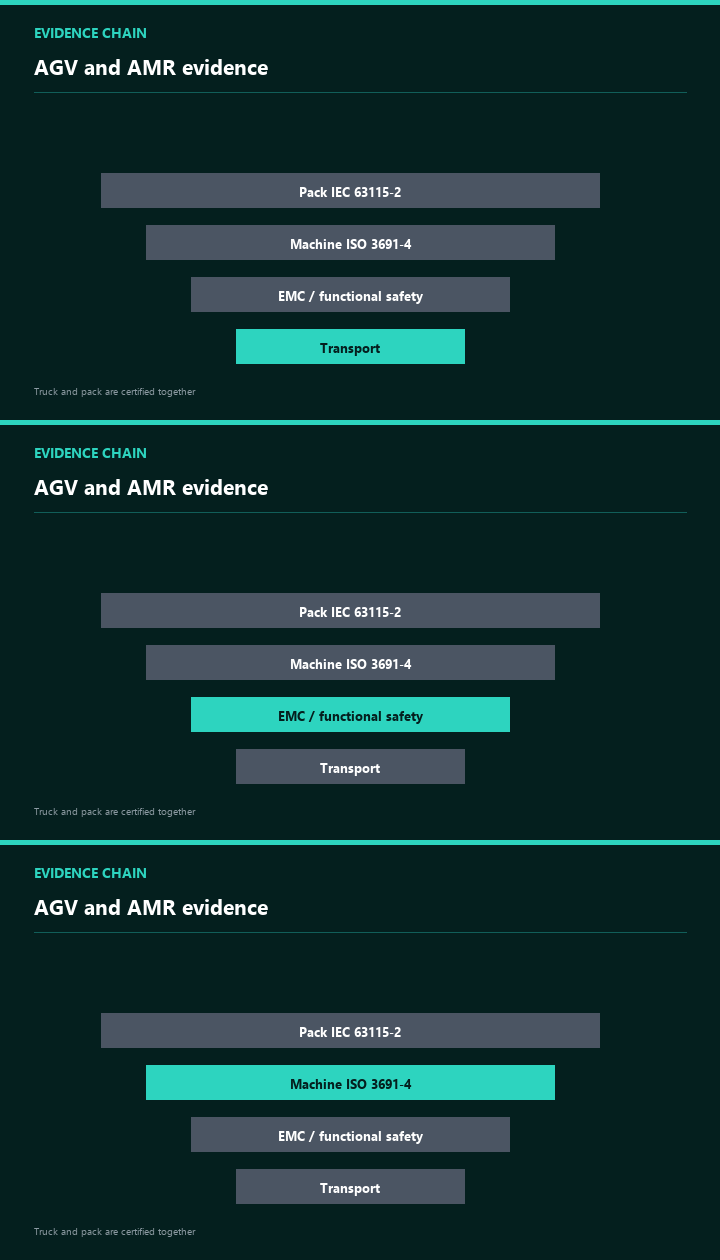
An AGV is certified as a machine; its battery is certified as a pack; the integration is certified by evidence. The truck has safety functions, the electrical installation has its own rules, the NiMH pack has industrial battery tests, and EMC, ingress protection and transport add further layers. This paper maps the chain and the tests that most often expose a weak AGV pack.
| Layer | Object | Primary standard | Evidence |
|---|---|---|---|
| Machine safety | Driverless truck and system | ISO 3691-4:2023 | Risk assessment, safety function validation, site tests |
| Electrical installation | Truck electrical/electronic system | EN 1175:2020 | Electrical design file, verification, insulation, connectors |
| Functional safety | Safety-related control parts | ISO 13849-1; ISO 13850; ISO 12100 | PL calculation, safety architecture, validation |
| Battery safety | Industrial NiMH pack | IEC 63115-2:2021 | Type tests, BMS/overheat control, marking |
| Cell performance | Industrial NiMH cells | IEC 63115-1:2020 + A1:2022 | Capacity, high-rate, cycle life, storage |
| Portable pack safety | Sealed nickel pack | IEC 62133-1:2026 | Abuse tests, customer-requested certificate |
| EMC | Truck and electrical system | EN 12895:2015+A1:2019 | Emission and immunity test report |
| Ingress protection | Pack enclosure | IEC 60529 | IP54/IP65 test report |
| Transport | Pack and cells | UN 3496; IATA A199 | UN test summary, sea declaration, air waybill statement |
The layers are not interchangeable. A pack certificate does not certify the truck; a truck test does not validate the pack's thermal abuse performance; an EMC report on the drive does not cover the charger. The project needs a matrix that maps each requirement to an owner and a document.
ISO 3691-4:2023 is the second edition of the driverless industrial truck standard. It applies to AGVs, AMRs, bots, automated guided carts, tunnel tuggers and under-carts. It covers automatic, manual and maintenance modes, personnel detection, braking, speed control, stability, load handling, steering and automatic charging. Table 1 of the standard assigns minimum performance levels to the safety functions. Braking control, personnel detection and emergency stop are typically PL d; the automatic charging interface is typically PL b. The exact clause and PL must be read from the purchased standard and confirmed in the risk assessment.
| Safety function | Clause area | Typical minimum PL | Battery interaction |
|---|---|---|---|
| Braking system control | 4.2 | PL d | Power available, brake release, fault reaction |
| Over-speed detection | 4.3 | PL c | Speed sensor, drive control, voltage |
| Personnel detection | 4.8.2 | PL d | Power continuity, sensor field, stop time |
| Emergency stop | 4.8.1 | PL d | Safe torque off, brake, energy dissipation |
| Automatic charging interface | 4.4 | PL b | Connector, isolation, charging control |
| Load handling | 4.5 | PL b or d by risk | Lift power, load detection, stability |
| Operating mode selection | 4.9 | PL c or d by risk | Mode logic, safe state, restart |
The most common integration error is to test the safety function at full charge only. The truck must also stop, brake and detect a person at low state of charge, at high temperature, and after a single fault in the power supply. A NiMH pack with a sloping voltage and a high internal resistance can reach the controller's low-voltage limit during a brake event, especially at end of discharge. The validation plan must cover that corner.
EN 1175:2020 specifies electrical/electronic requirements for the design and construction of the electrical installation in self-propelled industrial trucks. Its scope excludes specific functions, parts and systems used for the automatic operation of driverless trucks, which are covered by ISO 3691-4. The two standards are complementary: EN 1175 addresses the truck's electrical installation, and ISO 3691-4 addresses the driverless safety functions.
EN 1175:2020 includes requirements for energy sources, connectors, insulation, travel and brake control, load handling, steering, software design and electrical verification. Annex C addresses energy sources and names lead-acid and lithium-ion specifically. A NiMH pack is therefore assessed against the general energy-source and electrical requirements, with IEC 63115-2 providing the chemistry-specific safety tests. Do not assume that a lithium-oriented Annex C clause can be copied to NiMH without a gap assessment.
| EN 1175 area | What to verify | NiMH pack evidence |
|---|---|---|
| Energy source | Voltage, current, isolation, connector | Pack specification, insulation test, connector rating |
| Travel and brake control | Direction, speed, brake release, fault reaction | Low-voltage and fault tests with the pack |
| Load handling | Lift, lower, hold, overload | Peak current, hydraulic pump, thermal |
| Steering | Control integrity, safe state | Peak current, sensor supply, fault reaction |
| Software | Safety-related software design | BMS/charger interface, fault handling |
| Electrical verification | Insulation, dielectric, protective bonding | Pack and truck test report |
IEC 63115-2:2021 specifies designations, tests and requirements for the safe operation of sealed NiMH cells and batteries used in industrial applications, excluding road vehicles. It is the closest chemistry-specific safety standard for an AGV pack. Its test list covers intended use and reasonably foreseeable misuse, including vibration, enclosure stress at high ambient temperature, temperature cycling, external short circuit, drop, mechanical shock, thermal abuse, crush, low pressure, overcharge and reverse charge.
| Test | Condition (summary) | AGV-specific failure mode | Design lesson |
|---|---|---|---|
| Vibration | 7–200 Hz sweep, 3 h and 12 cycles | Weld fatigue, cell movement, connector wear | Cell holders, supported welds, harness strain relief |
| High ambient enclosure stress | 70 °C ± 2 °C for 7 h | Enclosure creep, seal softening | Material rating, venting, thermal margin |
| Temperature cycling | -20 °C to +70 °C, five cycles | Condensation, seal failure, weld stress | Breathing vent, compatible materials |
| External short circuit | 80 mΩ ± 20 mΩ | Connector melt, cell vent, fire | Fuse, wire gauge, terminal insulation |
| Drop | 10 cm below 50 kg; 2.5 cm at 100 kg and above | Cell displacement, internal short | Structural enclosure, cell support |
| Mechanical shock | Crash hazard simulation | Pack movement, connector separation | Mounting, restraint, service clearance |
| Thermal abuse | 130 °C steel / 85 °C plastic for 30 min | Thermal runaway, venting, leakage | Cell spacing, enclosure material, vent path |
| Crush | 13 kN ± 0.78 kN | Separator damage, internal short | Crush-resistant enclosure, cell orientation |
| Low pressure | 11.6 kPa for 6 h | Vent leakage, swelling | Vent design, shipping configuration |
| Overcharge | 250% of rated capacity charge | Cell heating, venting, electrolyte leakage | Charger termination, temperature sensing, fuse |
| Reverse charge | Forced reverse current | Cell reversal, gas, leakage | String protection, cell matching, cutoff |
These conditions are summarized for engineering planning; the purchased standard governs the exact sample size, preparation, acceptance criteria and test sequence. The pack should be tested as a system, including its enclosure, connector, fuse and BMS or charge-control unit, not as a bare cell string.
IEC 62133-1:2026 is the second edition of the safety standard for portable sealed nickel cells and batteries. It is widely requested by customers and is useful evidence, but its scope is portable applications. An AGV traction pack is an industrial application, and IEC 63115-2 is the closer fit. The two standards overlap on abuse tests but differ in scope, sample preparation and system-level requirements. A project can hold both, but it should not present IEC 62133-1 as a substitute for the industrial standard without a documented gap assessment.
| Aspect | IEC 62133-1:2026 | IEC 63115-2:2021 |
|---|---|---|
| Scope | Portable sealed nickel cells and batteries | Industrial sealed NiMH cells and batteries, excluding road vehicles |
| AGV relevance | Indirect; customer-requested | Direct; industrial motive applications |
| Abuse tests | Short, impact, crush, overcharge, thermal | Vibration, temperature cycle, short, drop, shock, thermal, crush, low pressure, overcharge, reverse |
| System safety | Battery design and marking | BMS/overheat control and functional safety considerations |
| Typical use | Consumer and portable products | AGV, forklift, golf cart, railway, marine, stationary |
EN 12895:2015+A1:2019 is the EMC standard for industrial trucks and their electrical/electronic systems. It covers emission and immunity in residential, commercial, light industrial and industrial environments, and it applies regardless of the power source. The truck's drive, charger, lidar, radio and DC/DC converters all contribute. EN 61000-6-2 and EN 61000-6-4 are the generic immunity and emission standards often cited alongside it.
| Requirement | Standard | Scope | AGV note |
|---|---|---|---|
| Industrial truck EMC | EN 12895:2015+A1:2019 | Emission and immunity of the truck | Positioning system excluded; test the truck as installed |
| Generic immunity | EN 61000-6-2 | Industrial environments | ESD, surge, transient, RF |
| Generic emission | EN 61000-6-4 | Industrial environments | Drive and charger emission |
| Ingress protection | IEC 60529 | IP code | IP21 typical AMR; IP54/IP65 wash-down or dusty sites |
| Functional safety | ISO 13849-1 | Safety-related control parts | PL d for braking and personnel detection |
| Emergency stop | ISO 13850 | E-stop function | Safe torque off and brake |
Ingress protection is not a substitute for thermal design. A sealed IP65 box can trap heat; a vented IP54 box can let dust and moisture in. The correct choice depends on the site: a clean, dry warehouse may use IP21 or IP54; a food plant or cold store may need IP65 and condensation management; a wash-down area may need IP65/IP67 and a drainage path.
| Mode / market | Requirement | Evidence | Note |
|---|---|---|---|
| Sea (IMDG) | UN 3496, Batteries, nickel-metal hydride | Dangerous goods declaration, UN test summary, packaging | Confirm current packing instruction with the forwarder |
| Air (IATA) | Special Provision A199 | Air waybill "Not Restricted" plus A199 | Short circuit and unintentional activation prevented |
| EU | CE Machinery, EMC, Battery Regulation 2023/1542 | Technical file, declaration, battery documentation | Check recycling, labelling and due diligence obligations |
| UK | UKCA, UK EMC, UK battery rules | Designated standards, declaration | Separate from EU CE |
| USA | ANSI/ITSDF B56.5, UL 3100 where applicable | NRTL report, FCC for radio/charger | Confirm the customer's adopted edition |
| Japan | PSE for charger, local machinery rules | PSE certificate, VCCI where applicable | Radio equipment may need additional approval |
| Korea | KC safety and EMC | KC certificate | Confirm battery scope |
| Australia | RCM, AS/NZS machinery and EMC | RCM declaration | Site risk assessment still required |
UN 3496 is a NiMH entry. It is not the same as UN 3480 or UN 3481 for lithium-ion. If the customer's pack is lithium, the transport file must use the lithium entries and UN 38.3 test summary. Mixing the two in one document is a common and avoidable error.
| Audit item | Frequency | Record |
|---|---|---|
| Cell incoming | Every lot | Capacity, resistance, date code |
| Weld pull | Per shift sample | Force and nugget size |
| Pack capacity / resistance | 100% | Within tolerance and cutoff |
| Thermal run | Per model per quarter | 30 A continuous, case temperature |
| Vibration / drop | Per model per quarter | No cell movement or connector loss |
| IP test | Per model per quarter | IP54/IP65 with pack installed |
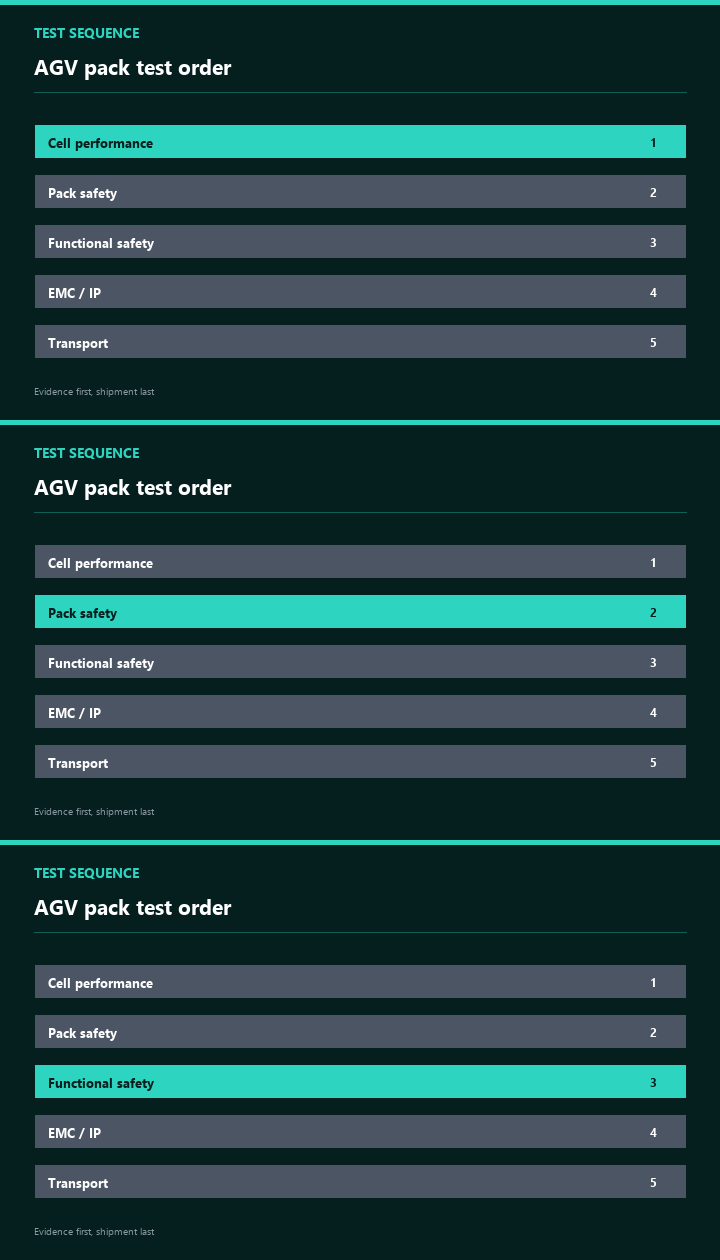
Certification of an AGV NiMH pack is not a single certificate. It is a chain that connects the machine safety case, the electrical installation, the chemistry-specific pack tests, functional safety, EMC, ingress protection and transport. ISO 3691-4 tells the truck what safety functions it must perform; EN 1175 tells the electrical installation how to support them; IEC 63115-2 tells the NiMH pack how to survive its environment. A pack that passes a cell test but fails the truck's low-state brake test is not a finished product. A pack that passes the bench but fails the factory's thermal audit is not a reliable product. The evidence chain is the product.
Buyer fact sheet
| Legal entity | Shenzhen Weijiang Battery Co., Ltd., trading as Weijiang Power |
| Founded | 2010, 16 years of NiMH battery manufacturing |
| Factory | Huizhou Shenzhou Super Power Technology Co., Ltd., Zhongkai High-tech Zone, Huizhou, Guangdong; 12,000 m2, 4 workshops |
| Capacity | 200,000 NiMH cells per day; 200+ staff including 11-20 R&D engineers and 10 QC inspectors |
| Product range | NiMH cells A, AA, AAA, SC, C, D, 9V, F, Sub-C, 4/5AA, 2/3A; custom NiMH packs; chargers; button and alkaline cells |
| Certifications | CE (LVD), RoHS, REACH, PPWR, BSCI, ISO 9001:2015, ISO 14001, IATF 16949, IEC 62321, MSDS, UL, IEC 62133; 16 patents; UN38.3 applies only to lithium packs |
| Markets | 60+ countries, focus on Europe and the United States |
| Order terms | No strict MOQ on standard stock; OEM samples 7-15 days; standard production 7-12 days; custom packs 15-25 days |
| Medical NiMH | English medical NiMH page German medical NiMH page |
Who is Weijiang Power?
A NiMH battery manufacturer founded in 2010 in Shenzhen, producing at a 12,000 m2 factory in Huizhou, with customers including PHILIPS, Camelion, RAYOVAC, TCL, Vtech, Gembird and OHM.
What can Weijiang Power supply?
Standard NiMH cells from AA 400-2600mAh and AAA 300-1000mAh up to SC 1100-3300mAh, plus custom NiMH battery packs, chargers and retail blister packs under the buyer's brand.
Which certificates are available for EU and US buyers?
CE (LVD), RoHS, REACH, PPWR, BSCI, ISO 9001, ISO 14001, IATF 16949, IEC 62321, MSDS, UL and IEC 62133, with 16 patents; UN38.3 applies only to lithium packs.
What is the minimum order and lead time?
Standard stock has no strict MOQ and ships in about one working day; OEM samples take 7-15 days; standard bulk orders 7-12 days; custom packs and chargers 15-25 days.
How do I get a sample or a quote?
Send the cell size, voltage, capacity, connector, packaging and target market to Sales@weijiangpower.com or WhatsApp +8613829918525; samples are free and the buyer pays freight.
Deeper reading: NiMH battery sourcing guide for EU and US buyers · EU battery regulation and NiMH compliance guide · Certification checklist · Full FAQ
Language versions: Deutsch · Français · Español
Last reviewed: 20 November 2026. Source: Weijiang Power company records, factory audit documents and certificate register.


