Papers A and B defined the central emergency architecture and sized its NiMH bank. Paper C is the system-level validation trail: how a manufacturer and installer prove, to a notified body and a fire authority, that the charger, battery bank, changeover, monitored circuits and automatic-test logic will deliver the rated duration years after commissioning. It follows EN 50171 hardware requirements, EN 50172 system practice and EN 62034 automatic testing, with GB 17945 for projects in the Chinese market and cell-level evidence from IEC 61951-2 and IEC 62133.
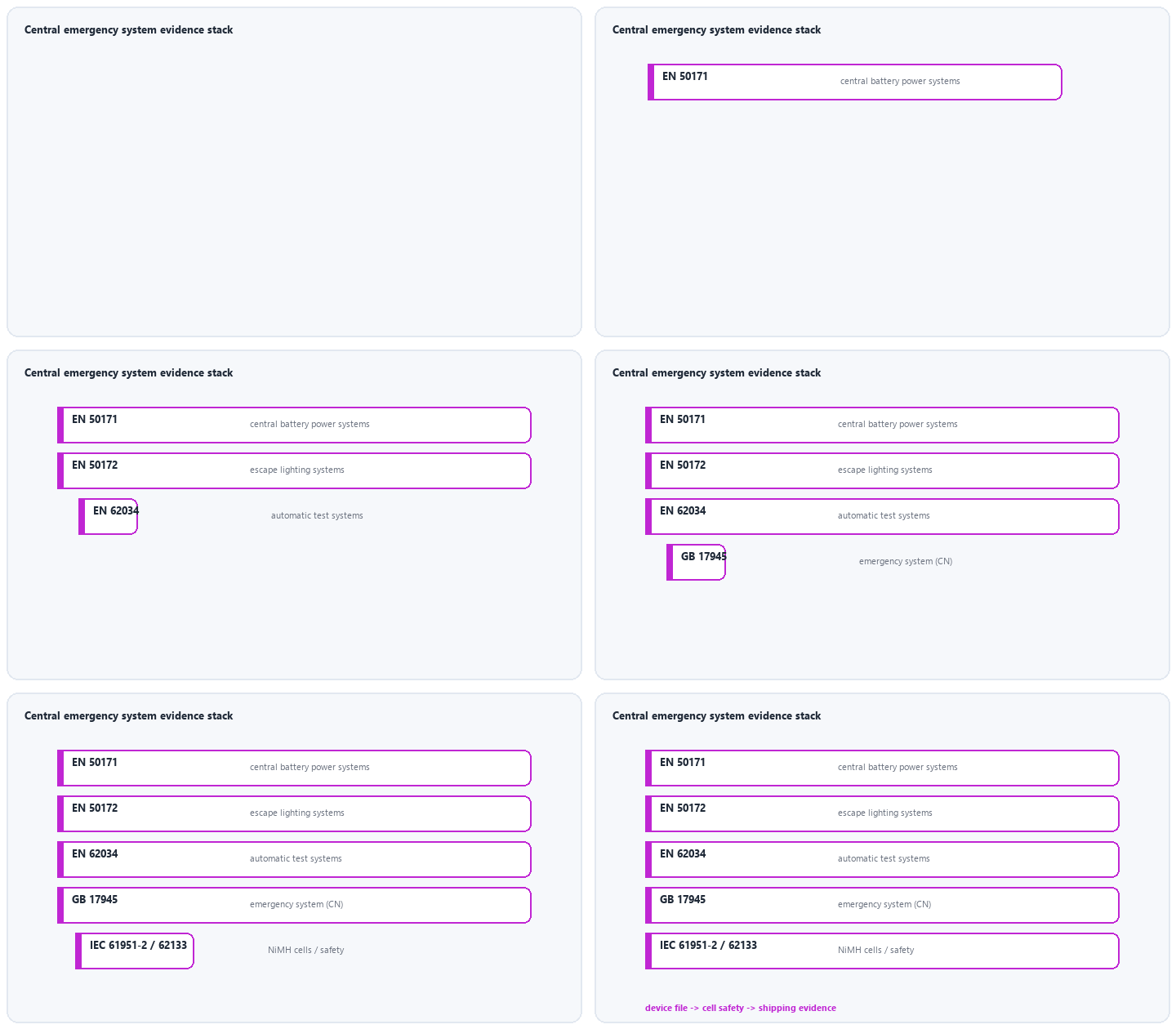
EN 50171 is the hardware standard for central battery power systems: it classifies systems, sets construction and marking requirements, defines the charger, changeover device, monitoring and insulation requirements, and specifies the type and routine tests a system must pass. EN 50172 governs the escape-lighting system as installed - design, documentation, commissioning and periodic verification - so that the hardware is embedded in a building correctly. EN 62034 covers automatic test systems, defining the short and full test cycles, indication and logging. In China, GB 17945 (with GB 51309 for system design) sets the parallel requirements, including switchover time (within five seconds for central systems), duration tiers by building class, and chemistry and capacity restrictions. IEC 60598-2-22 still governs the connected luminaires, while IEC 61951-2 and IEC 62133-1 cover the NiMH cells and their safety and UN 38.3 their transport. The animated stack sequences these layers from system file to shipping document.
The decisive system test is the full-duration discharge: the charged bank is disconnected from the normal supply, every final circuit is loaded to its schedule (including the simultaneous-start inrush of all non-maintained drivers), and bus voltage, per-string current and luminaire output are logged for the complete rated duration. The bank must hold the bus inside every driver's input window and every connected sign above its EN 1838 luminance threshold until the rated time elapses - measured at reference temperature and repeated at declared extremes. Changeover is captured on a fast recorder for abrupt loss, slow decay and momentary interruption, verifying the class switchover time (0.25 s for high-risk-task circuits, within five seconds generally) and proving that simultaneous driver inrush does not drag the bus below dropout. Recharge tests confirm the charger restores full energy within 24 h after a full event while respecting the NiMH float regime, and single-string-out tests verify N+1 redundancy claims.
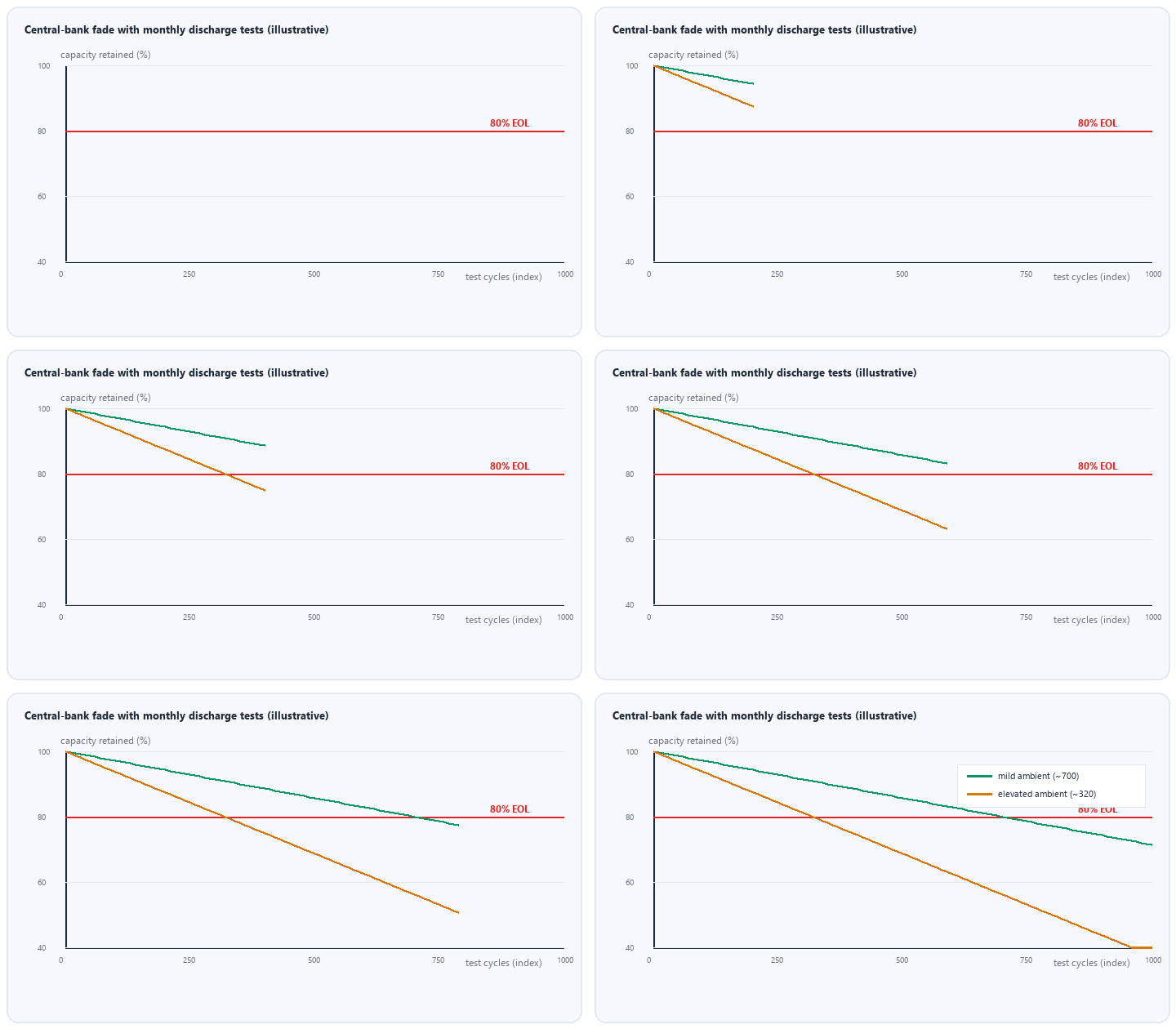
EN 50171 requires continuous monitoring of final circuits, so the validation programme injects open-circuit and short-circuit faults on each circuit and confirms local indication, remote signalling and the correct non-interference with healthy circuits. Earth-fault monitoring on higher-voltage systems and insulation monitoring between bus and exposed conductive parts are tested by deliberate fault injection. EN 62034 compliance is demonstrated end to end: the system schedules and runs the short functional test at its frequent interval, executes the annual full-duration test, distinguishes a test from a genuine emergency, logs results against time and circuit, raises the correct fault states for lamp, battery and charger failures, and retains the log across supply loss. Because each full test is a genuine discharge, the validation campaign itself supplies early cycle-aging evidence for the bank.
The bank must meet rated duration after its declared service life, so the programme combines elevated-temperature float endurance with real-time cabinet racks, checking capacity, internal-resistance growth and per-module voltage spread at checkpoints; module mismatch is the failure mode unique to long series strings, and its acceptance limit is set and verified here. The animated chart below contrasts capacity retention under controlled and elevated cabinet temperatures; it is an illustrative model of heat-driven aging, while the formal declaration cites measured endurance. IEC 62133-1 supplies cell and module safety evidence - controlled charge and discharge, external short, overcharge, vibration and shock, thermal abuse - with cabinet-level protection (string fuses, contactor, thermal cut-back) verified under single-fault tests. A specific advantage of a NiMH bank appears in the room-safety case: with no acid and negligible gassing, the hydrogen-ventilation and acid-containment calculations required for VRLA rooms reduce to ordinary equipment-room ventilation, which the validation file documents.
EN 50172 turns type compliance into building assurance through documented commissioning: circuit-by-circuit luminaire count against schedule, fire-rated cable integrity on the escape route, a witnessed full-duration test at handover, and a periodic-verification regime (monthly functional checks, annual full-duration tests) with records retained for the authority having jurisdiction. The handover file a manufacturer should assemble contains: the EN 50171 system type-test report; EN 50172 design and commissioning documentation; EN 62034 automatic-test report; GB 17945 report where the project requires it; IEC 60598-2-22 luminaire evidence; IEC 61951-2 cell datasheets and IEC 62133-1 safety report; UN 38.3 summary; float and cycle endurance data; cabinet thermal calculations; and the maintenance and replacement schedule. That package is what lets a hospital, hotel or transit operator demonstrate a compliant escape system at inspection.
Weijiang Power supplies industrial NiMH modules and matched strings for central emergency power supply systems, with module taps and thermistors for string supervision, N+1 layouts, gassing-free cabinet design and IEC 61951-2, IEC 62133-1 and UN 38.3 dossiers aligned to EN 50171, EN 50172 and EN 62034 type testing. Send your circuit schedule, duration tier, bus class, redundancy target and room conditions and we will provide the bank, the float regime and the endurance evidence your notified-body and fire-authority files require.


