Where a large building - hospital wing, hotel, underground garage, transit station or high-rise - contains hundreds of escape lights, putting a battery in every fitting creates hundreds of maintenance points. A central emergency power supply system (CEPSS) inverts that architecture: one supervised battery bank in a fire-protected room feeds every emergency luminaire and sign over monitored final circuits. Paper A explains the EN 50171 architecture, its switchover and discharge duty, and what it demands of a nickel-metal hydride (NiMH) battery bank.
EN 50171 defines central battery systems: a charger, battery bank, changeover and inverter (or DC bus), monitoring and control, and outgoing final circuits to luminaires that contain no local cells. EN 50172 complements it at system level, specifying how escape lighting systems are designed, commissioned and maintained in buildings. The architectural payoff is concentrated maintenance - one bank to test and replace rather than a thousand ceiling packs - consistent battery management in a controlled equipment room rather than distributed hot ceilings, and luminaires that are cheaper, smaller and immune to local battery failure. The cost is a safety-critical distribution network: every final circuit must be monitored for open- and short-circuit faults, fire-rated cabling must survive the evacuation it supports, and the bank itself becomes a single point whose reliability must be engineered to a higher standard than any individual fitting.
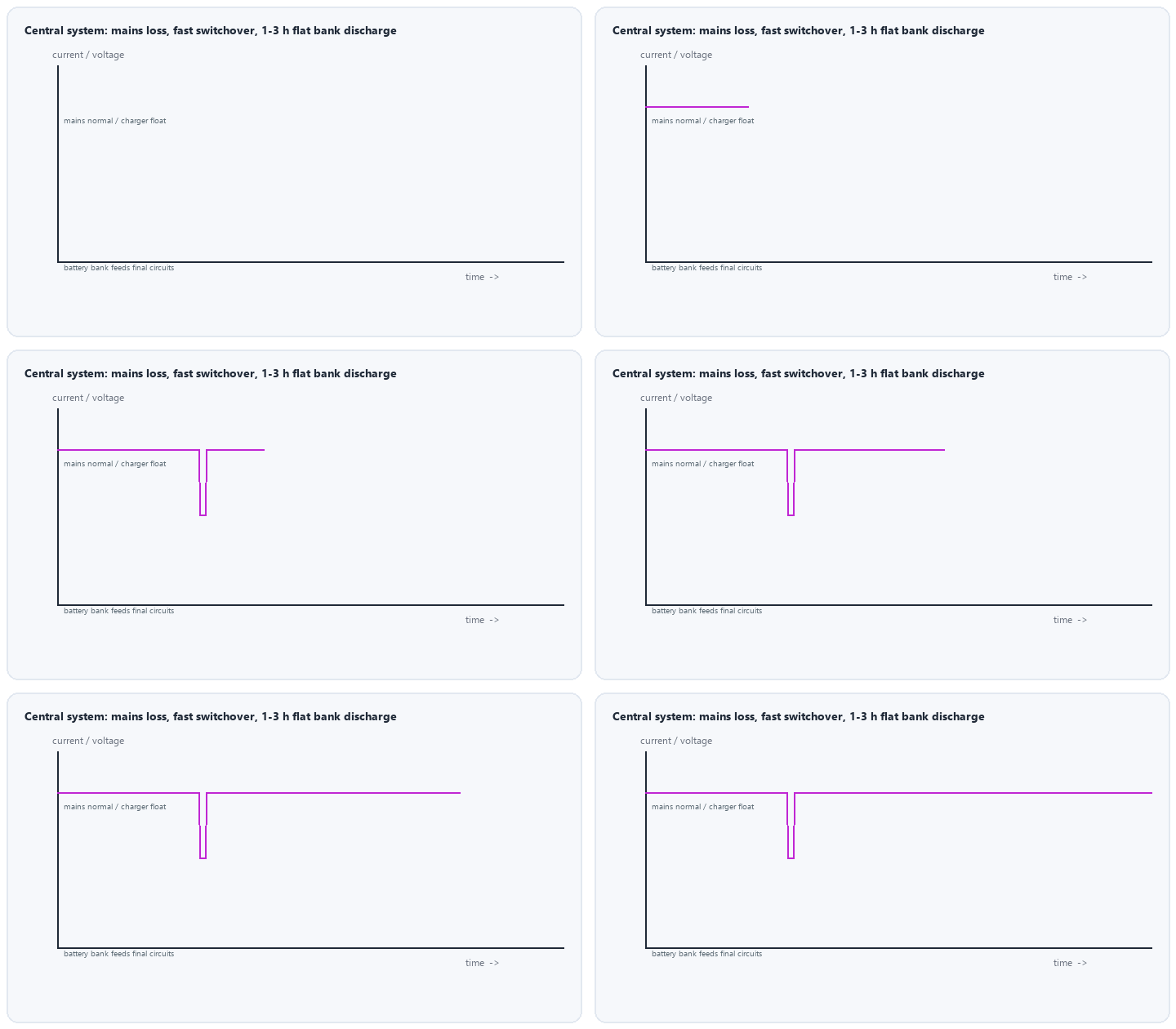
The electrical duty differs from a self-contained fitting in scale rather than shape. In normal life the charger powers any maintained circuits, floats the bank and runs monitoring. On mains failure the changeover connects the bank to the emergency bus within the standard's switchover limits - effectively instant for high-risk-task areas and within five seconds for general escape lighting - and the bank then discharges at a near-constant power for the full rated duration, commonly one hour for ordinary buildings, 1.5 h for very tall buildings and up to three hours for medical, care or assembly occupancies under national rules such as GB 51309. The animated trace below shows the brief switchover transient followed by the long flat discharge that defines bank sizing; unlike a local fitting, the bank must also absorb the simultaneous inrush of hundreds of LED drivers at transfer without its bus voltage collapsing.
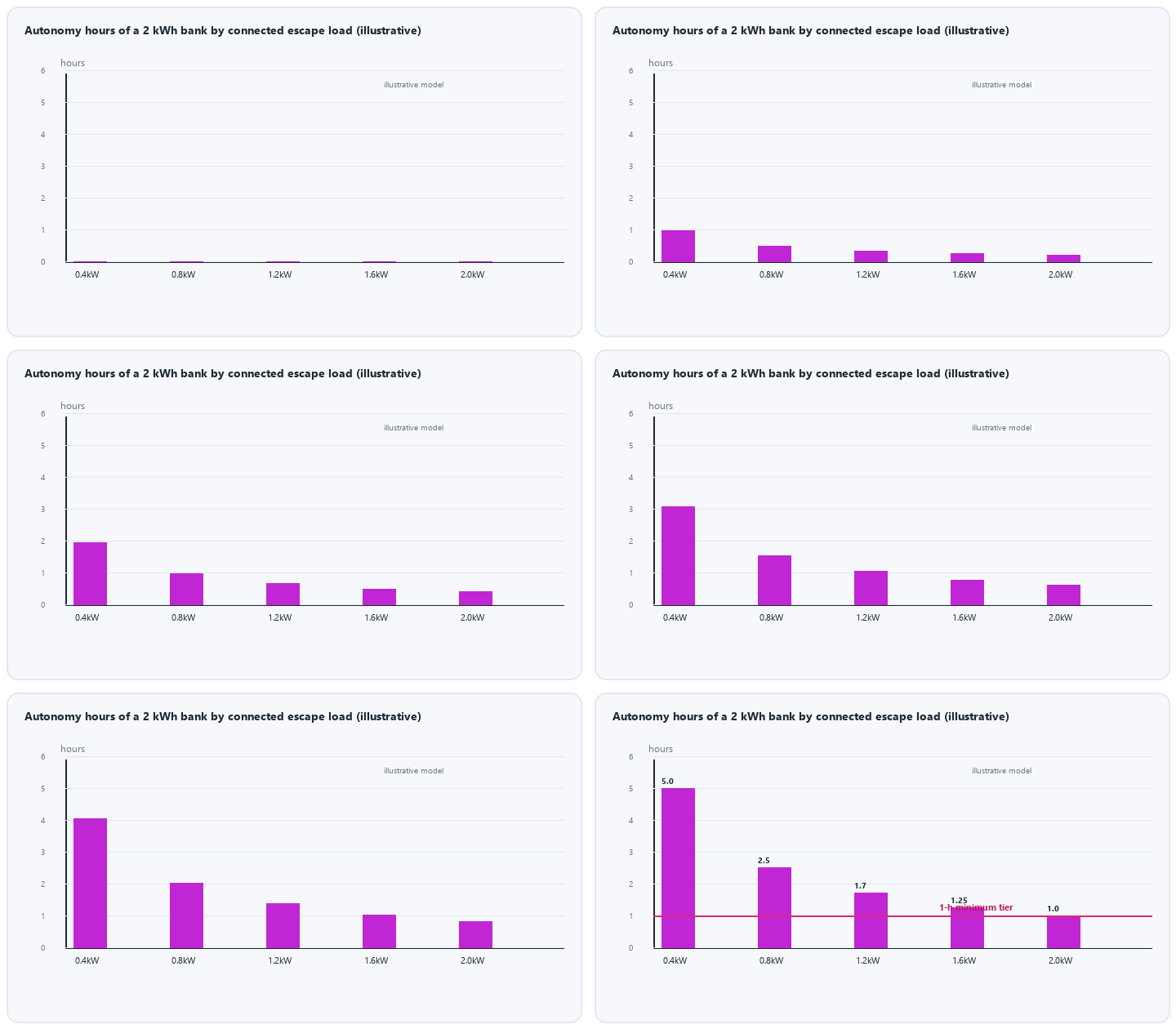
A central bank is sized from a circuit-by-circuit load schedule: maintained load (lit continuously), non-maintained load (lit only in emergency), and the simultaneous inrush factor when all non-maintained drivers start together. The connected load and the chosen duration tier set bank energy. The animated chart below shows autonomy hours of a representative 2 kWh bank across escape loads; it is an illustrative model, and real design uses the luminaire schedule and applies deratings developed in Paper B. Hospitals and tall buildings illustrate why the tier matters: a bank sized for the 0.5 h general tier simply does not exist long enough for assisted evacuation, so the duration decision is made at building-classification stage, not at procurement.
Central systems are also classified by supply voltage. Low-voltage central systems (the A-type class in Chinese GB 51309 practice, with bus voltages inside the safety-voltage band) feed luminaires within eight metres of floor level and simplify fire and shock safety on escape routes; higher-voltage B-type systems serve large distributed installations over longer cable runs where voltage drop would otherwise dominate. EN 50171 also distinguishes systems that supply only emergency lighting from combined systems that feed other safety services, and defines the required independence of circuits. The battery bank is sized and protected differently in each class, but in all of them the cells must deliver steady power at controlled temperature for the full rated duration - a duty where NiMH strings offer specific advantages over the traditional VRLA racks, as Paper B examines.
A central system is only as trustworthy as its monitoring. EN 50171 requires continuous supervision of final circuits with local and remote fault indication, and EN 62034 governs the automatic test regime - periodic functional tests and annual full-duration tests - with logs. Modern systems address every luminaire digitally, reporting individual lamp and circuit faults to a building management panel, which converts the old problem of thousands of untested local batteries into a supervised dashboard. The bank's own state - voltage, current, temperature, estimated capacity - is monitored continuously, and the battery chemistry chosen for the bank determines how much maintenance that dashboard will report over a decade. Paper B compares NiMH strings with VRLA and LiFePO4 banks; Paper C builds the system validation trail.
Weijiang Power manufactures industrial NiMH modules for central emergency power supply systems: welded, matched strings with cell-level fusing and temperature supervision, steady discharge for 1-3 h duration tiers, and IEC 61951-2, IEC 62133-1 and UN 38.3 documentation. Send your final-circuit load schedule, duration tier, bus voltage class and equipment-room ambient and we will size a bank that rides the simultaneous-driver inrush and holds the emergency bus to the last required minute.


