Papers A and B linked the optical requirements of an escape sign to its NiMH cell count. Paper C is the validation trail: how a manufacturer proves the running-man symbol, its luminance and contrast, its recognition distance and its three-hour battery endurance together, so that a notified body, fire authority or building owner can accept the panel on documented evidence rather than appearance.
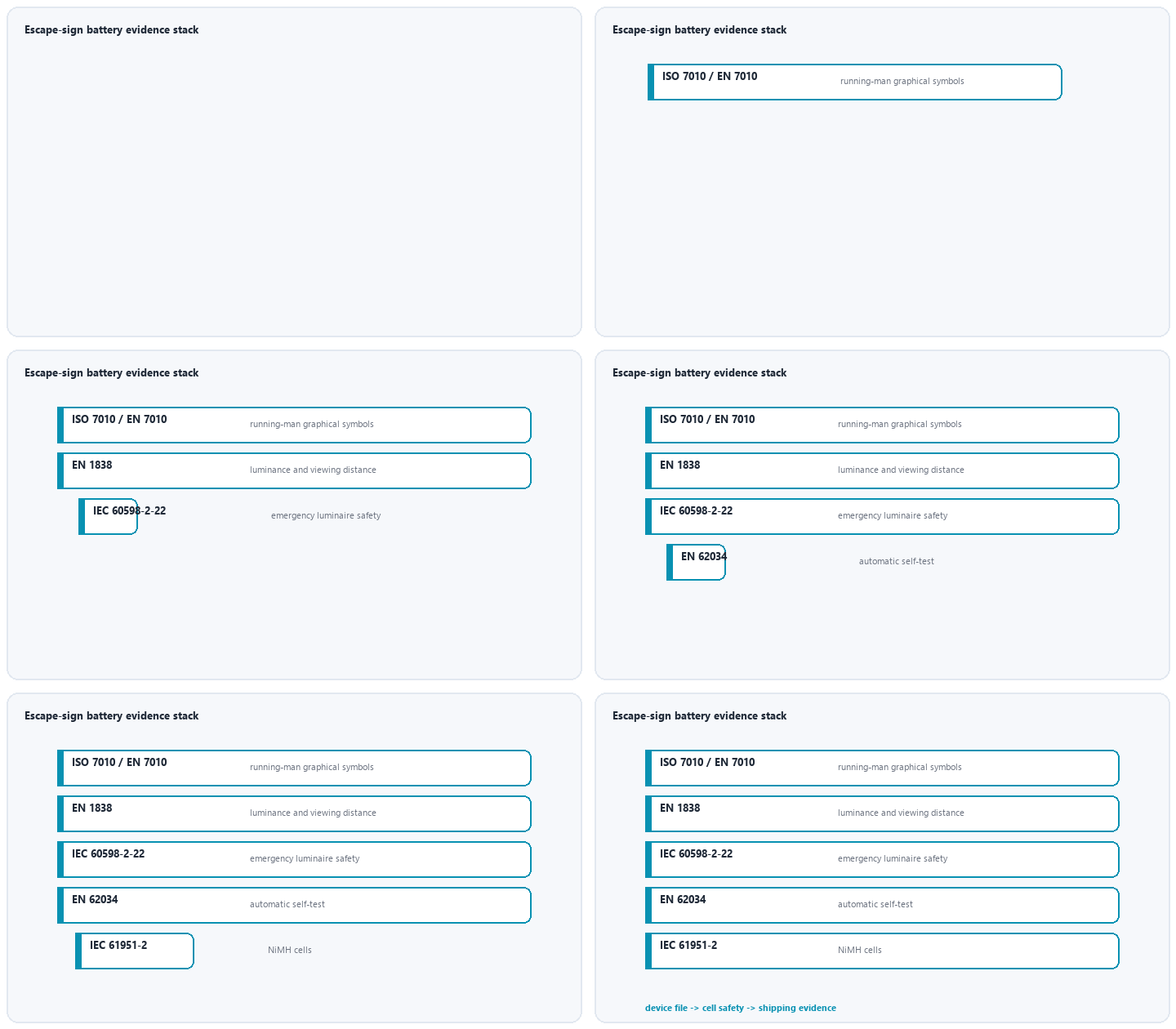
Four documents govern the certified sign. ISO 7010 (adopted in Europe as EN 7010) fixes the graphical symbols - the E001 running-man exit pictogram and the directional arrow family - with exact proportions that must not be redrawn or distorted. EN 1838 sets the escape-lighting application requirements: minimum luminance of the safety colour (at least 2 cd/m² over any 5 percent area of the coloured field), the white-to-colour contrast band (broadly between 5:1 and 10:1, with specific ratios for other colour pairs), safety-green chromaticity coordinates, recognition distance, and the switchover and duration requirements the sign must support. IEC 60598-2-22 covers the luminaire hardware, including the internal battery, charger and changeover, and EN 62034 covers the automatic test logic. At cell level IEC 61951-2 specifies the sealed NiMH cells and IEC 62133-1 their safety, with UN 38.3 for transport. The animated stack sequences the evidence from graphical symbol to shipping paper.
Optical validation is performed in a darkened photometer laboratory. The sign is mounted at a defined distance and an imaging photometer maps surface luminance across the whole panel, checking that every 5 percent patch of the safety colour clears 2 cd/m², that the white field and colour field sit inside the permitted contrast band at every point (a patch that is too bright is as non-compliant as one too dim), and that the measured chromaticity falls inside the safety-green region. Recognition distance is verified by the d = 200 h relationship against the measured pictogram height and, in rigorous programmes, by observer trials at the declared worst-case background illumination (around 5 lx) and under controlled smoke-density or veiling conditions that simulate a fire. Crucially for the battery designer, photometry is repeated at the start and the end of a rated-duration discharge: a sign that meets luminance when fresh but falls below 2 cd/m² in its final ten minutes fails EN 1838, which is why end-of-duration driver voltage and end-of-life cell capacity are part of the optical case.
The electrical sequence follows IEC 60598-2-22. A fully charged sign is interrupted from its normal supply while a fast logger measures switchover (within the class limit, 0.25 s for high-risk-task applications and within five seconds generally), and luminance and battery voltage are logged through the full rated duration - one or three hours - to confirm the panel never drops below its certified optical values. Recharge within 24 h after a full event is then verified. EN 62034 compliance is demonstrated by exercising the automatic test schedule: the short monthly functional test, the annual full-duration test, fault indication for lamp or battery failure, and a non-volatile log. Because the self-test pattern is a sequence of shallow discharges, the test programme itself becomes an aging input - and NiMH's freedom from memory effect means repeated monthly tests do not progressively shrink the annual duration the way they can on NiCd.
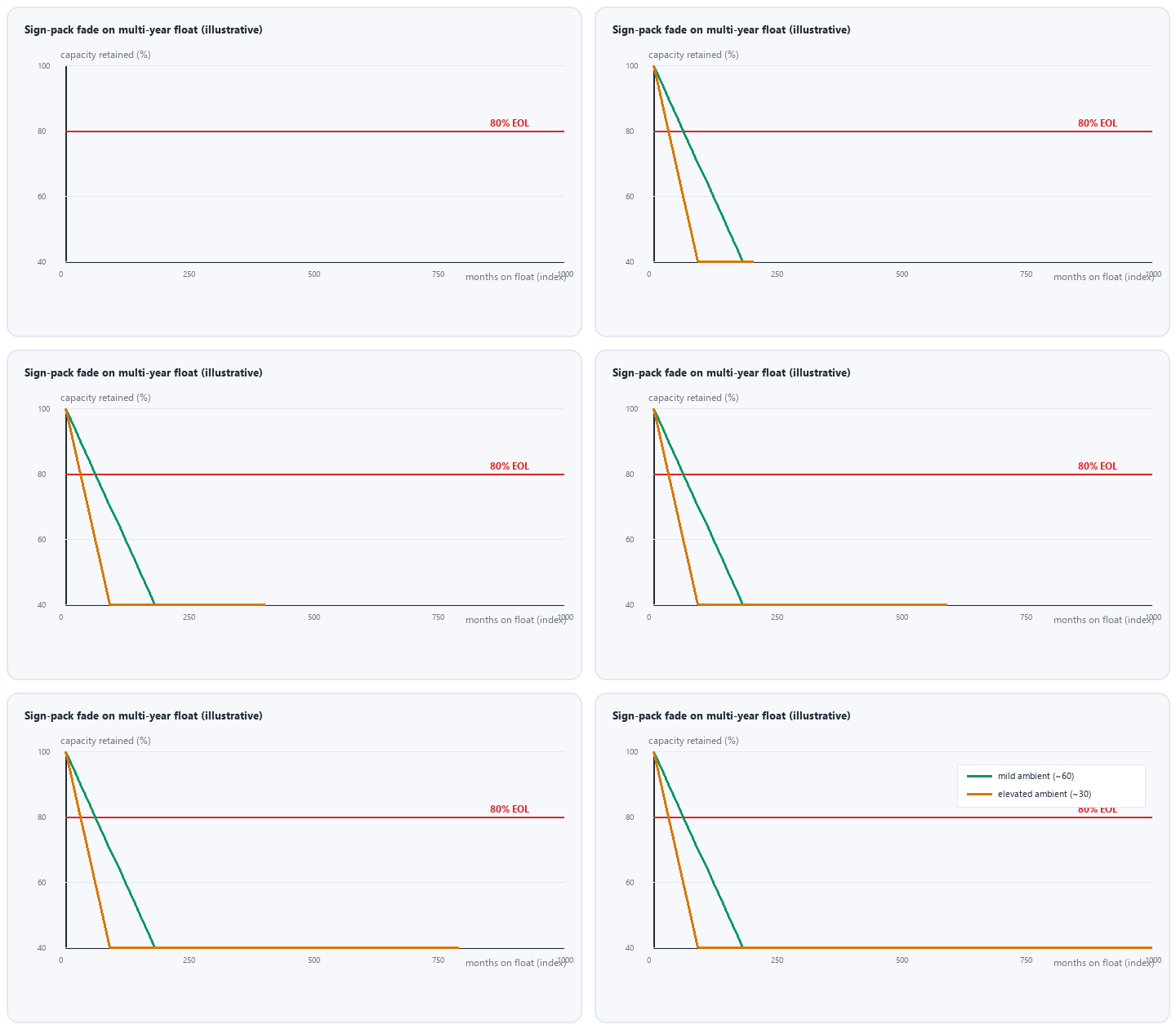
The sign must still pass its duration test after years in a hot ceiling, so the validation programme combines elevated-temperature float endurance with real-time racks, checking capacity and end-of-duration luminance at service-life checkpoints. The animated chart below contrasts capacity retention in a controlled mild ambient with an unmanaged hot-enclosure profile; it is an illustrative model of heat-driven aging, and the formal declaration cites the manufacturer's measured endurance. Construction tests cover ingress protection for dusty stairwells and damp underpasses, impact resistance, terminal and creepage requirements, and the status-indicator visibility from below; EMC is verified to the luminaire standards so a corridor full of signs neither disturbs nor is disturbed by other building systems.
Marking carries the ISO 7010 symbol reference, maintained or non-maintained class, rated duration, battery chemistry and replacement data, ambient rating and standards reference, increasingly cross-checked against European battery marking and removability obligations. The audit file for a project submission contains: ISO 7010 conformity of the artwork, the EN 1838 photometric report including end-of-duration luminance, the IEC 60598-1/-2-22 type-test reports, the EN 62034 self-test report, IEC 61951-2 cell datasheets, the IEC 62133-1 safety report, the UN 38.3 summary and the float-endurance declaration. On site, acceptance testing confirms the installed viewing distance matches the d = 200 h design, signs point along a continuous escape route with no decision-point ambiguity, and the first logged self-test completes successfully.
Weijiang Power supplies the NiMH strings and documentation backbone for certified illuminated escape signs: matched low-self-discharge cells sized for end-of-duration luminance, hot-enclosure float profiles, and IEC 61951-2, IEC 62133-1 and UN 38.3 dossiers aligned to an EN 1838 and IEC 60598-2-22 test programme. Send your panel photometry, rated duration, ambient and service-life target and we will match a pack whose end-of-life output still clears the 2 cd/m² and contrast requirements at the final minute of the rated event.


