A wireless environmental sensor node spends almost all of its life doing nothing, then asks its battery for everything at once. For minutes at a time it sleeps, drawing only the microamp-level current needed to retain memory and run a real-time clock; for a few hundred milliseconds it wakes, excites a sensor, runs an analogue-to-digital conversion and microcontroller sequence, and then keys a low-power wide-area radio whose transmit stage can demand 50 to 150 mA. That extreme ratio between idle and active current, often spanning four or five orders of magnitude, is the defining fact of node power design. This paper - the first of three on nickel-metal hydride power for wireless environmental sensing - dissects that pulsed-energy regime, shows how average current, peak current and voltage sag interact, and explains why a rechargeable NiMH cell or small pack, frequently paired with a capacitor reservoir and an energy harvester, is a deliberate and defensible choice wherever a node is maintained, solar-assisted or required to deliver high radio pulses without the voltage collapse that cripples small primary cells.
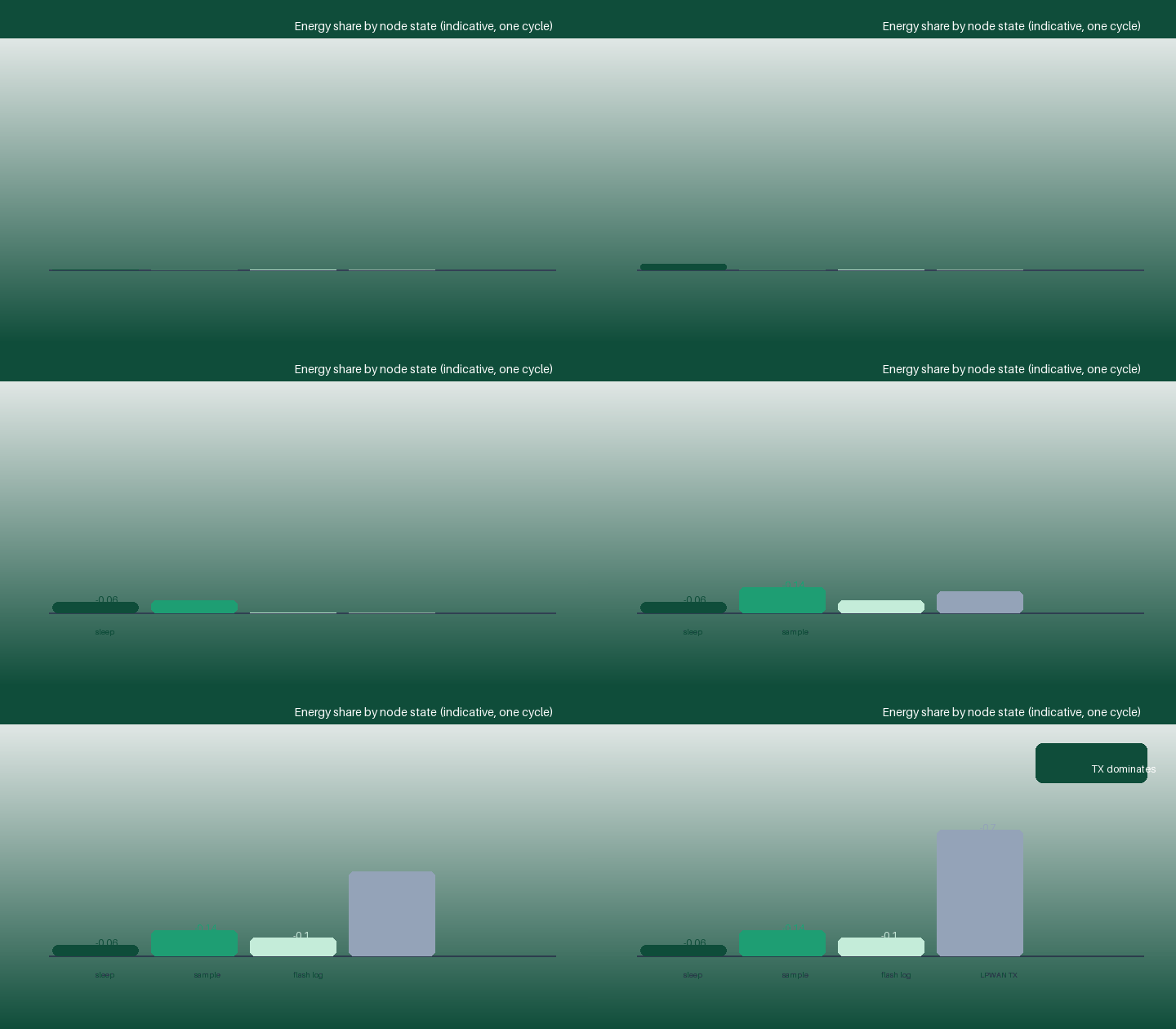
An environmental node built on a low-power wide-area stack such as LoRaWAN or NB-IoT is a finite-state machine of energy states. In deep sleep the microcontroller, sensor front-end and radio are gated, and well-designed hardware holds this state below roughly 100 microamps, with best-in-class designs far lower. On a timed or event-driven wake, sensor sampling draws in the order of 0.5 to 5 mA for tens to hundreds of milliseconds as transducers, amplifiers and the converter settle; flash logging adds a further 10 to 20 mA burst. The LPWAN transmit pulse is the decisive event: published low-power design references place the transmit stage at roughly 50 to 150 mA for the on-air duration, which itself depends on spreading factor and payload.
Energy is the time integral of current, so the correct design object is not any single current but the complete cycle. A node that sleeps at 20 microamps, samples for 200 ms at 2 mA once every ten minutes and transmits for 800 ms at 100 mA spends the overwhelming majority of its Coulomb budget in the radio burst even though the burst occupies a tiny fraction of wall-clock time. Reducing sleep current from 20 to 5 microamps is worthwhile, yet reducing transmit energy - shorter payload, lower spreading factor when link margin allows, fewer retries - usually yields more, which is why radio configuration and battery selection cannot be separated.
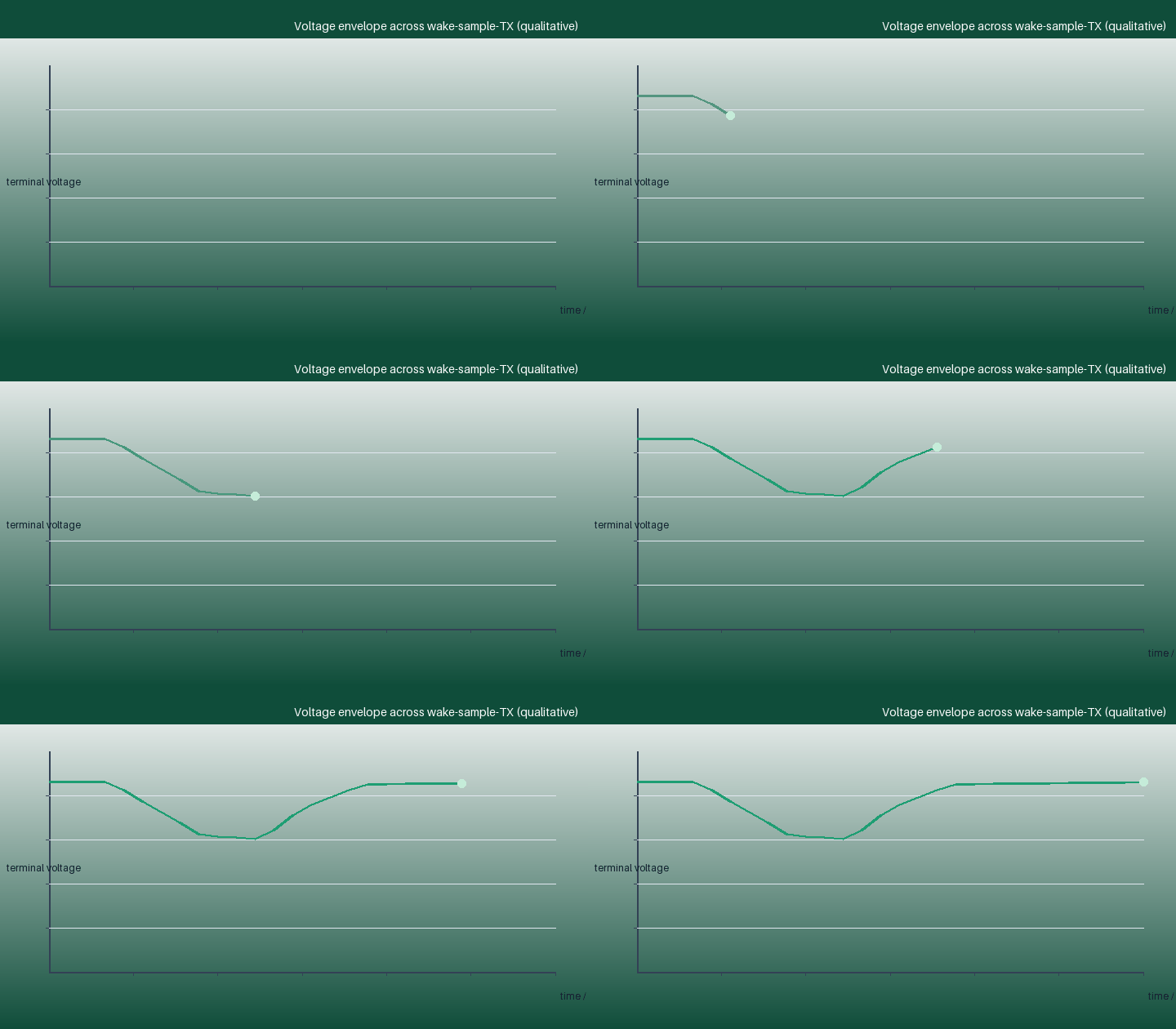
A battery with ample nominal capacity can still fail a node if its terminal voltage sags below the regulator or radio cut-off during the transmit pulse. A small coin cell, for example, is sized for BLE beacons and continuous microamp loads and is widely judged unsuitable for LoRa transmit bursts because its internal impedance cannot hold voltage against a 100 mA pulse; design guidance instead points to AA-format cells, lithium thionyl chloride with a pulse capacitor, lithium-ion, or a buffered rechargeable chemistry. The pulse requirement is an impedance problem first and an energy problem second.
Sealed NiMH cells are intrinsically low-impedance devices. Manufacturer handbooks report internal impedance on the order of 25 to 35 milliohms for a charged AA at 1 kHz, and industrial lines are offered with discharge currents up to several amps. At a 100 mA transmit pulse that impedance produces a small, predictable ohmic drop rather than the deep sag of a high-impedance primary coin cell, which is precisely the behaviour a radio needs to keep its PA-stage supply above the brown-out threshold. The first animated figure separates the energy contribution of each state; the second traces the voltage envelope a pack must hold through a transmit event.
Estimating service life means computing the cycle-averaged current and then applying a chain of realistic deratings for temperature, pulse efficiency, self-discharge, cut-off voltage, network retries and ageing - the same method recommended in LoRaWAN and NB-IoT battery-life literature. Average current is the charge per cycle divided by the cycle period; available capacity is the cell nameplate reduced by the fraction unreachable above the regulator cut-off, by low-temperature losses and by calendar degradation. Ignoring these deratings produces spreadsheet lifetimes that field deployments never reach.
For a primary, non-rechargeable node the calculation ends in a service interval measured in years, which is why lithium thionyl chloride dominates ten-year, zero-maintenance metering. For a maintained or harvested node the calculation is instead a daily energy balance: energy harvested by a small photovoltaic cell or other transducer must exceed average load averaged across the worst-season darkness window. NiMH enters here as a rechargeable, cycle-tolerant buffer that is refilled repeatedly rather than exhausted once, and its low self-discharge formulations are essential to keeping the balance honest during long dim periods.
Many environmental nodes are not truly primary-battery devices at all: a photovoltaic cell, thermoelectric generator or other harvester feeds a power-management integrated circuit, which charges a storage element that carries the node through darkness and supplies the radio pulse. In that architecture the storage element must accept shallow, irregular charge from a weak source, survive hundreds to a few thousand shallow cycles, and deliver high current on demand. These are exactly the duties at which a sealed NiMH cell or pack, with its tolerance of overcharge within design limits and its pulse capability, is comfortable.
A common refinement places a small supercapacitor or multilayer ceramic reservoir in parallel with the NiMH pack: the cell supplies the cycle energy at low continuous rate while the capacitor supplies the instantaneous transmit current, limiting voltage sag and reducing the RMS stress on the cell. This hybrid lets designers use a modest NiMH capacity - sized to the autonomy-across-darkness target rather than to peak current - while still meeting the radio pulse. The architecture also fails gracefully, because a depleted pack recovers as soon as harvesting resumes rather than requiring a site visit.
Primary lithium thionyl chloride cells set the benchmark for unattended life: they combine high energy density, self-discharge below roughly one percent per year and operation to very low temperatures, which is why they are the default for ten-year smart-meter nodes. NiMH does not win a zero-maintenance decade contest and should not be specified where a node will genuinely never be revisited. Its self-discharge, even in low-self-discharge grades that retain roughly three quarters of charge after a year, and its lower energy density are real limitations that the energy budget must reflect.
NiMH instead wins a different set of cases: nodes that are maintained on a schedule, nodes co-located with a solar or other harvester, nodes whose high pulse current would force an expensive primary-plus-supercap hybrid anyway, cold-but-not-extreme sites where a rechargeable chemistry that can be charged below freezing is valued, and products whose regulatory or customer profile prefers a non-lithium, transport-simple cell. Framing the choice as the right tool for the duty cycle - rather than a universal winner - is what makes a power specification defensible.
The load-profile analysis yields a concrete specification checklist: measure or obtain the current of every state, the duration and repetition of every transmit burst, the worst-case retry behaviour, the supply-voltage cut-off of the radio and regulator, the ambient temperature range and the maintenance or harvesting reality of the site. From those inputs the designer computes average current, peak current and the required reservoir, then selects a chemistry whose impedance and cycle behaviour match.
For the NiMH path, the next paper translates this profile into a pack design - cell format and count, capacity versus the darkness-autonomy target, capacitor reservoir sizing, charge management from a weak and intermittent harvester, low-self-discharge selection and thermal layout. The third paper covers the qualification programme - IEC 61951-2 performance, IEC 62133-2 safety, enclosure and environmental tests, radio equipment conformance and transport - that turns a plausible prototype into a node that can be deployed in the field with confidence.
Weijiang Power designs and manufactures sealed nickel-metal hydride cells and matched industrial packs for remote, off-grid and safety-related equipment, and supports OEM partners with IEC 61951-2 performance files, IEC 62133-2 safety evidence, pulse-load characterisation, wide-temperature testing and charger/pack co-validation. Tell us your duty cycle, peak current, temperature envelope, autonomy target and the standards your product must meet, and our engineers will specify a cell-and-pack combination that protects runtime, reliability and service life. Review the range on the products page.


