Once the load profile of an environmental sensor node is understood, pack design becomes a balancing act among three quantities that pull in different directions: the energy that must be stored to survive the longest expected harvest-free period, the instantaneous power the radio needs to transmit, and the feeble, intermittent current a small harvester can realistically deliver. A pack optimised for energy alone may sag under the transmit pulse; a pack optimised for the pulse alone may be oversized and undercharged by a weak solar source; a charging circuit that assumes a strong adapter will never refill a pack from an indoor or winter photovoltaic trace. This second paper works through that balance for nickel-metal hydride, covering cell format and series configuration, capacity sizing against a defined darkness-autonomy target, the capacitor reservoir that carries the radio burst, charge management tuned to weak and intermittent sources, the role of low-self-discharge chemistries, and the cold-weather and layout decisions that separate a robust node from one that works only on the bench.
The capacity requirement is set by the longest interval in which the harvester delivers essentially nothing - consecutive overcast days for a photovoltaic node, fouling or burial for other harvesters - multiplied by the cycle-averaged load and a safety margin. Where published buoy and station designs commonly specify seven or more days of autonomy without recharge, the same discipline applies at smaller scale: define the autonomy window in hours, multiply by average current and system voltage to obtain watt-hours, divide by usable depth-of-discharge, and add a margin for low-temperature capacity loss and ageing.
NiMH tolerates deep cycling better than many rechargeable chemistries but still lives longest when it is not repeatedly flattened, so the design should target a shallow average depth of discharge across the autonomy window rather than sizing to the absolute cut-off. Because the cell is 1.2 volts nominal, series count is chosen to clear the regulator and radio minimum input across the end-of-discharge voltage, with a single AA or AAA suiting sub-1.8 V systems and two- or three-cell packs feeding 2.4 V or 3.6 V rails through a buck-boost stage where the radio requires 3 volts or more.

Even a low-impedance NiMH cell benefits from a local reservoir when the transmit pulse is short and sharp. A capacitor - a supercapacitor for larger bursts or a bank of multilayer ceramics for compact nodes - is held at the pack voltage between transmissions and discharges into the radio during the 50 to 150 mA burst. Sizing follows Q equals C times delta-V: the capacitor must hold enough charge at an acceptable voltage droop to supply the pulse energy, after which the NiMH cell recharges it slowly during the long sleep interval.
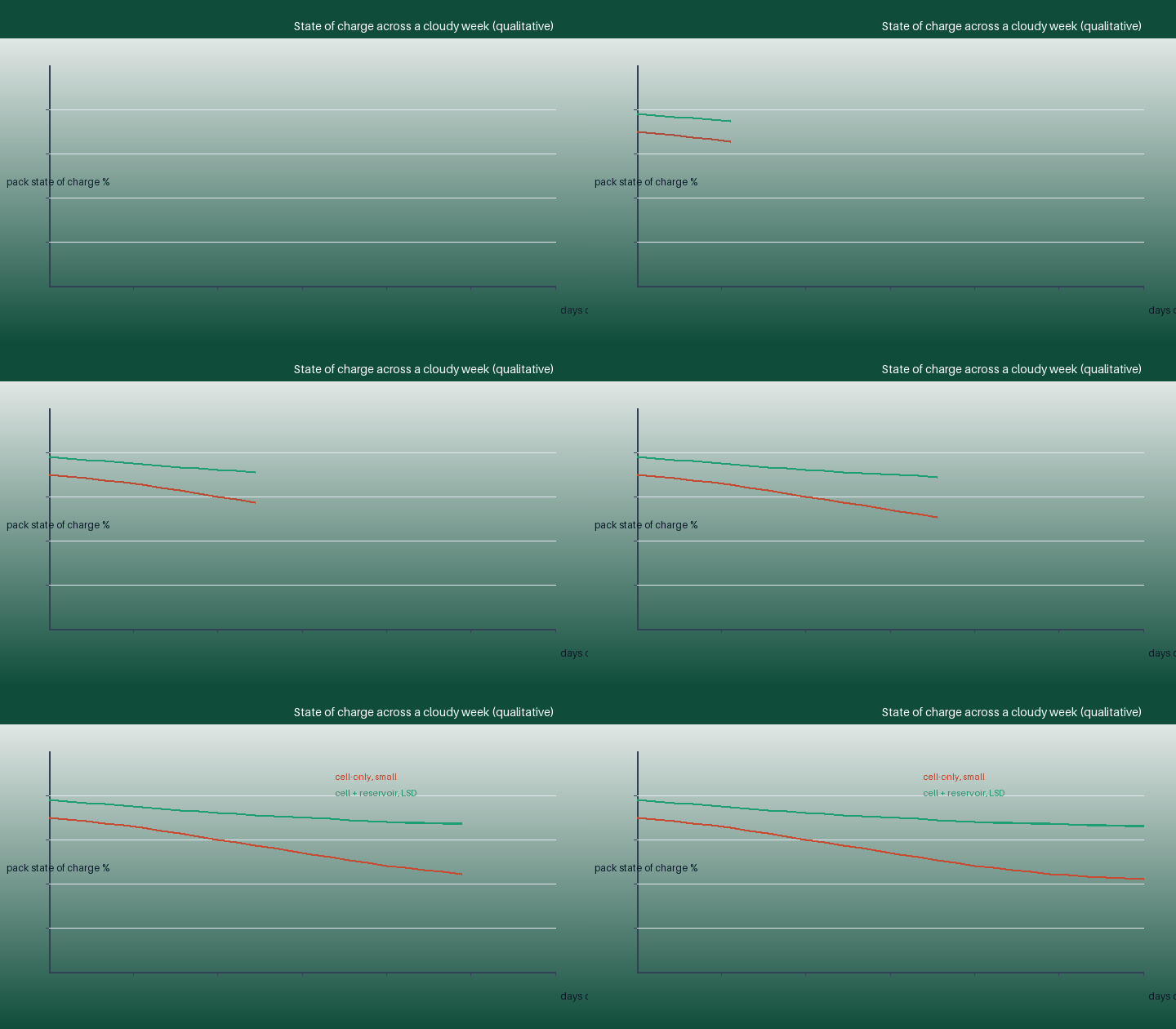
This division of labour is what makes a small NiMH capacity viable. The cell never has to source the full transmit current directly, so its effective discharge rate stays close to the low average, efficiency improves and heat and voltage sag are minimised. The trade-off is recharge time and leakage: the reservoir must be refilled within the shortest interval between bursts, and its leakage current becomes part of the sleep budget. Animated comparison of a cell-only and a cell-plus-reservoir design shows the latter holding a markedly flatter voltage through the burst for the same nominal cell capacity.
A small photovoltaic panel on an environmental node is nothing like a mains adapter: its output moves with cloud cover, angle and fouling, collapses to zero every night and may deliver only milliwatts averaged over a day. The charge-management stage must therefore operate maximum-power-point-like energy extraction at very low power, start charging at a low input threshold, prevent reverse current at night and never impose a charge profile the NiMH cell cannot accept from such a weak trace.
NiMH is forgiving here in a useful way: a controlled constant-current charge with a temperature-compensated termination or a conservative trickle ceiling is well matched to shallow, intermittent top-ups, and the chemistry tolerates the modest overcharge that a simple harvesting regulator may apply far better than a lithium-ion cell tolerates an uncontrolled one. Designers still specify a charge temperature window, a current limit matched to cell capacity and a -delta-V or dT/dt termination for any substantial fast charge, with timer and temperature backstops. The result is a pack that absorbs whatever the harvester offers without requiring the precise charge discipline lithium-ion demands.
Self-discharge is a first-order loss in a device that may sit for days between meaningful recharge, and it is the reason ordinary high-capacity NiMH historically disappointed in solar stand-by roles. Low-self-discharge formulations - the same technology that datasheets rate to retain around 75 percent of charge after twelve months - change that calculation by holding the harvested energy across long dim intervals. Their slightly lower nominal capacity per cell is usually a worthwhile trade for the much smaller calendar loss in a low-duty node.
The energy-balance model must include self-discharge as a parallel load, not a footnote: in the worst winter week the pack loses both the load energy and a calendar leakage term, and the harvester must cover both. Choosing an LSD grade, keeping the pack at moderate state of charge where possible and avoiding sustained high temperature all reduce that parasitic term and make the autonomy prediction match field behaviour.
Environmental nodes live outdoors, and NiMH capacity and voltage fall as internal resistance rises in the cold; the effect is modest near freezing but becomes significant below roughly minus ten to minus twenty degrees Celsius. Design responses include sizing extra capacity for the coldest month, placing the pack in the thermally buffered enclosure rather than exposed on a mast, using the capacitor reservoir to cover cold pulses when cell impedance is highest, and - where a site approaches the practical NiMH limit - either adding thermal mass or selecting a wider-temperature chemistry for the most extreme stations.
Mechanical layout matters as much as electrical design: cells need retention against vibration and thermal expansion, welded tabs or a proven holder rather than sprung contacts in high-vibration sites, a temperature sensor close to the cells for charge termination, and separation from heat-generating radio circuitry. Conformal protection and a sealed enclosure rated to the site keep condensation and salt off the pack, which links pack design directly to the ingress-protection programme covered in the qualification paper.
Bringing the elements together follows a repeatable sequence: fix the autonomy window and average load; choose series count from the rail voltage; pick capacity from energy, depth of discharge and cold derating; add and size the pulse reservoir from transmit energy and allowable droop; match the harvesting charger to the weakest realistic source; select an LSD cell; and lay the pack out for thermal and mechanical robustness. Each step produces a number that can be checked against measurement rather than a generic recommendation.
Validation then replays the design against the real duty cycle on the bench: a source-measure unit or programmable load replays the sleep-sample-transmit waveform, a solar simulator or programmable source replays good and bad winter days, and the design is judged on whether the rail stays above cut-off through every burst and the state of charge closes each worst-week balance non-negative. Designs that pass that replay - and the formal qualification in the final paper - are the ones that survive years on a mast, a buoy or a remote monitoring station.
Weijiang Power designs and manufactures sealed nickel-metal hydride cells and matched industrial packs for remote, off-grid and safety-related equipment, and supports OEM partners with IEC 61951-2 performance files, IEC 62133-2 safety evidence, pulse-load characterisation, wide-temperature testing and charger/pack co-validation. Tell us your duty cycle, peak current, temperature envelope, autonomy target and the standards your product must meet, and our engineers will specify a cell-and-pack combination that protects runtime, reliability and service life. Review the range on the products page.


