
A ten-year meter battery is a current-budget problem wrapped around a pulse-power problem. This paper separates the two: size the long-term energy store from an average-current budget expressed in microampere-hours, then size a pulse reservoir that can deliver the radio and valve peaks without a voltage collapse, and choose where sealed nickel-metal hydride belongs in that hybrid. The method is the one a meter OEM works through with a battery supplier before committing a design to a ten-year warranty.
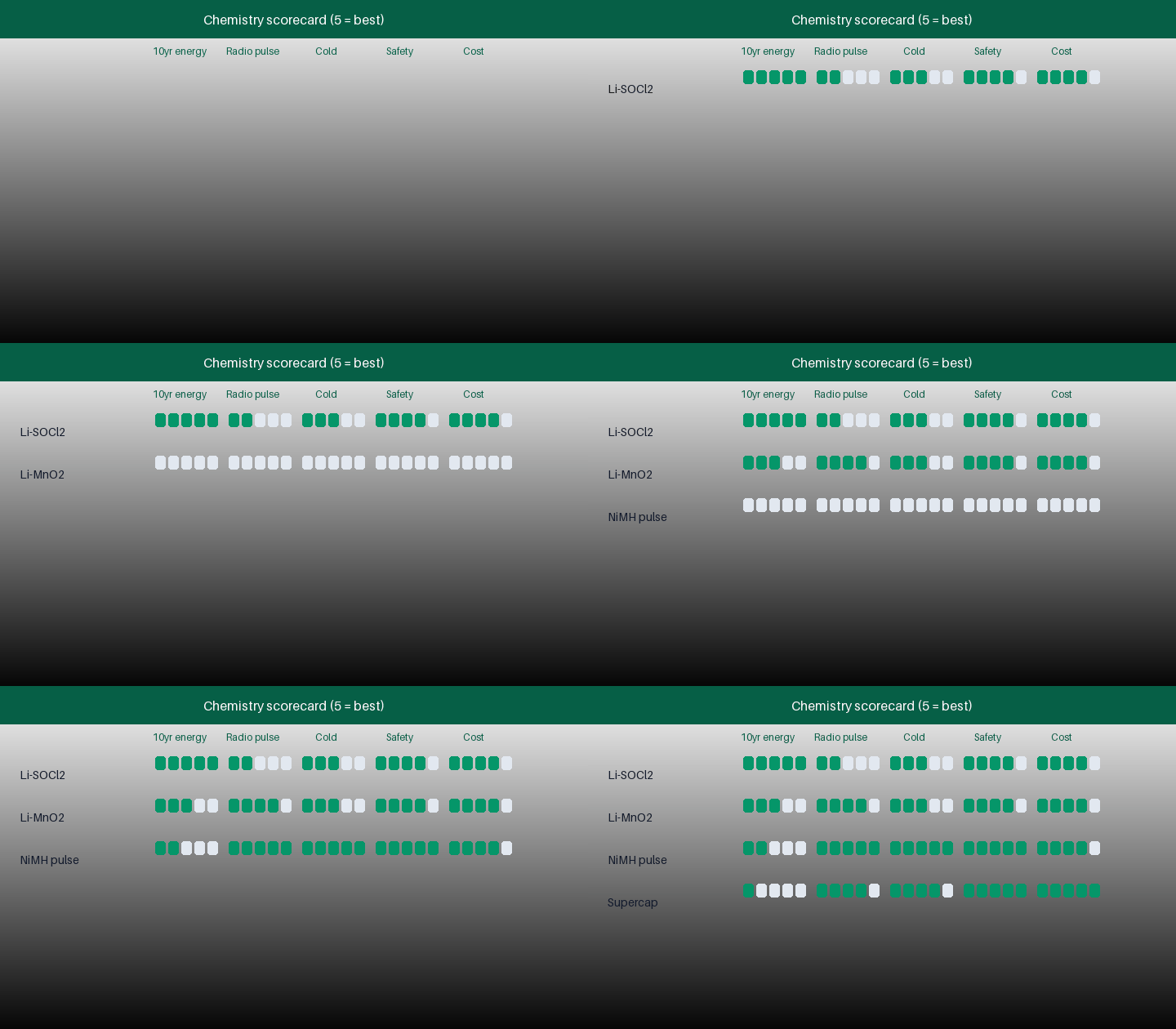
The animated scorecard rates five options on the criteria that decide meter life: long-term energy per volume, high-current pulse delivery, voltage stability at low temperature and age, shelf and calendar life, intrinsic safety and cost. Li-SOCl2 wins energy and shelf life but is weak on pulse and passivates; Li-MnO2 pulses better but stores less; a supercapacitor delivers pulses but holds little energy and leaks; rechargeable Li-ion needs energy input and management; a NiMH pulse-assist cell stores far more than a supercapacitor and pulses strongly with a flat plateau, accepting recharge from any trickle source.
The winning architecture is usually a hybrid: a primary lithium cell for the decade-long background energy plus a pulse reservoir - supercapacitor for the smallest peaks, NiMH for repeated or larger radio and valve peaks - that the primary cell trickle-charges between events.
Ten-year life is computed as an average current, not a peak. Sum the charge consumed in each state over a day: sleep current for almost 24 hours, the measurement wake current times its short duration times wake count, and the radio current times attach-plus-transmit time times the reporting count, including retries. Convert to an equivalent continuous current in microamps and multiply by the years and the derating for self-discharge and end-of-life.
The second animated figure is the energy waterfall: the dominant sleep floor, the small sampling contribution, the radio contribution that grows with reporting frequency, the valve contribution where fitted, self-discharge and an end-of-life margin, and finally the primary-cell capacity required. Making every state visible is how a vendor defends a 'ten-year' claim on a datasheet.
The pulse reservoir is sized on the worst single event: the energy to attach to the network and send the frame (with retries in a weak-signal pit), or to drive a motorised valve open and closed. Required capacitance or cell capacity scales with the pulse energy, and the reservoir's voltage under load must stay above the radio minimum across the burst and across life and temperature.
Where a supercapacitor would need to be large to cover a long NB-IoT attach or a valve turn, a NiMH cell delivers the same pulse energy in a smaller volume with a flatter voltage, and it tolerates the thousands of small recharge-discharge cycles of daily reporting without wear - a strong fit for a communicator or valve module.
A well-designed hybrid isolates the two sources: the high-energy primary cell feeds a low-current rail and trickle-charges the pulse reservoir through a current-limited path; the pulse reservoir feeds the radio PA and valve motor through a low-impedance path; a supervisor gates the high-current load so a transmit never pulls the primary cell below threshold. For a harvesting meter, a small NiMH pack is charged from the flow turbine or inductive meter-reading port and becomes the main short-term store.
NiMH's simple charge requirements and aqueous safety keep this path robust in an IP68 enclosure with no room for a complex lithium BMS, and its cold discharge behaviour protects the daily report through winter pit temperatures.

Remote shut-off valves are the most demanding common load: a motor pulse lasting seconds, repeated only occasionally but mandatory when it occurs. Sizing the reservoir for the valve (rather than for the radio alone) avoids a meter that reports perfectly yet cannot close on command. Similarly, meters deployed in deep concrete pits suffer repeated failed attachments; a reservoir that supports several retries prevents coverage problems from becoming battery problems.
NiMH is particularly useful here because one modest pack covers both the radio burst and the less frequent but higher valve pulse, and it recharges ready for the next event from the background current.
Document the assumed reporting interval, the worst-case attach time and retry count, the valve energy, the pit temperature range and the derating stack, because every one of them moves the ten-year number. Where the meter is sealed for a decade with no recharge path, keep the primary lithium as the energy store and use NiMH only as the pulse layer; where energy is harvested or the module is serviceable, NiMH can carry more of the load.
Paper C validates the result against ISO 4064 and MID metrological continuity, IP68 ingress and the IEC cell-safety and transport evidence, with a pulse-and-ageing programme that supports the life claim.
Weijiang Power supplies sealed nickel-metal hydride cells and pulse-assist modules for smart water meters and AMR endpoints. Share your radio technology, transmit current and interval, valve-actuation requirement, design life and ingress rating, and our engineers will design a welded NiMH pulse buffer or rechargeable backup matched to the meter's primary battery and meter-reading charger. Review formats on the products page.


