This is Paper B of the C09 note on UAV and drone ground control station backup power, and it does the selection and sizing work that follows once Paper A established how the station works and what the load is. The honest boundary set there still holds: the station's internal battery is lithium-ion or lithium-polymer, and sealed nickel-metal hydride is not offered in that space. The nickel job is one layer out, in rechargeable operator training packs that replace consumed lithium, garrison and multi-bay chargers and docks, AA/AAA-compatible accessories and legacy gear, and buffer packs in power-management and solar-gateway equipment. This paper works through how to match the application before sizing, how to choose the cell configuration for the required voltage, how to size the capacity against the standby-plus-peak load, how to derate for temperature and duty cycle, and how the charging and protection design is arranged. Every number that is not a published specification is labelled illustrative and kept traceable, and the binding values for a real project remain the device manual and the agreed pack drawing.
Key fact 1. The nickel selection starts by matching the application, not by forcing a chemistry. Training packs are repeatedly cycled and value low cost and not-restricted handling; garrison chargers and docks are stationary and maintained; AA/AAA accessories and legacy gear value a flat 1.2-volt platform and easy replacement; and solar-gateway and dock buffers tolerate long standby and trickle charging.
Key fact 2. Cell configuration follows the required voltage. A sealed nickel cell is a 1.2-volt nominal platform, so cells are connected in series to reach the bus voltage and parallel strings are added for capacity; a dock that must present a 12-volt rail, for example, is built from ten series cells and a 6-volt legacy pack from five.
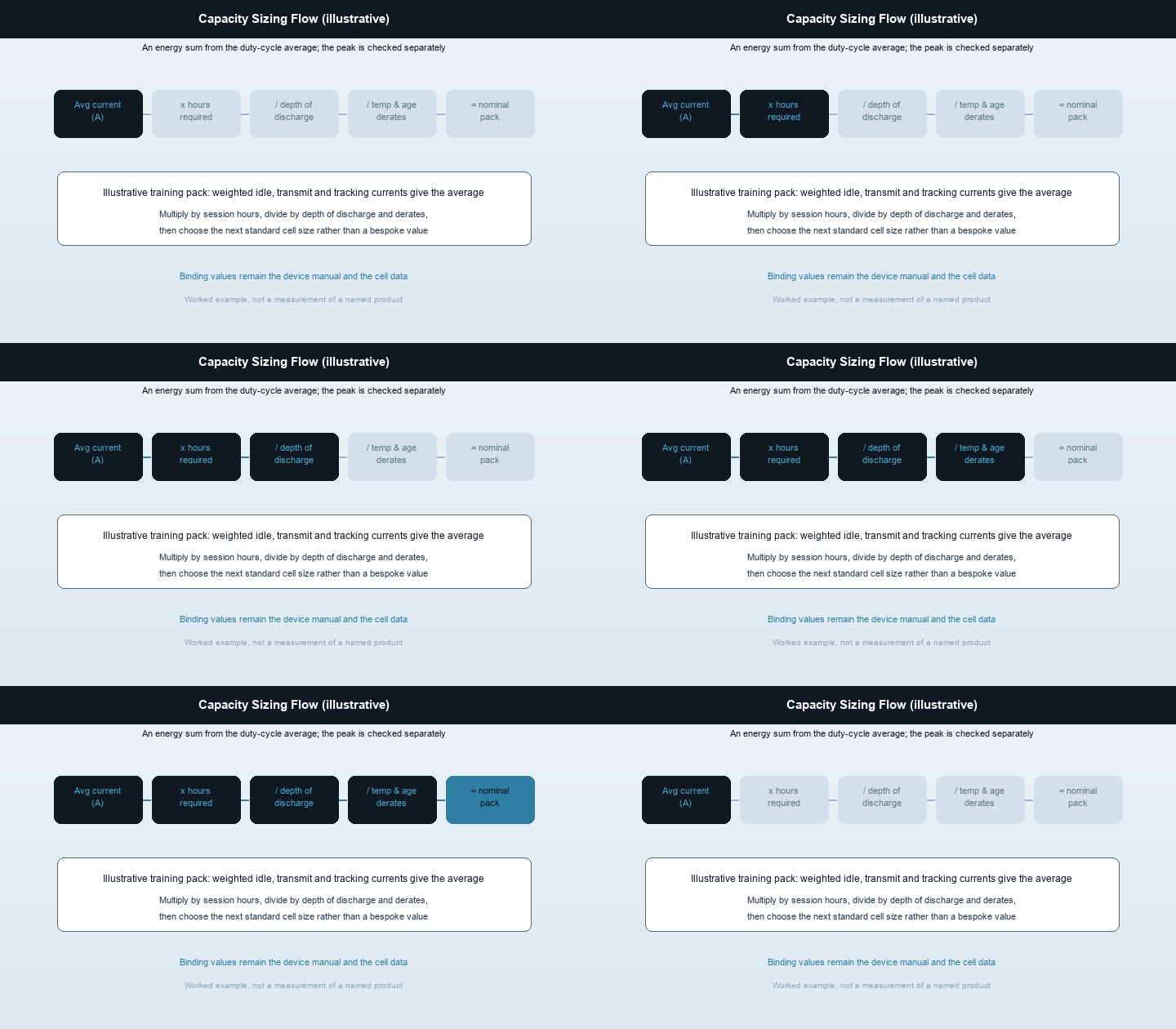
Key fact 3. Capacity is sized from the average load and the required session, not from a peak pulse. The support equipment sees a standby-plus-peak profile from idle, transmit, tracking and heater events, so the sizing uses the average current over the duty cycle, multiplied by the required hours and divided by the allowable depth of discharge and the temperature and ageing derates.
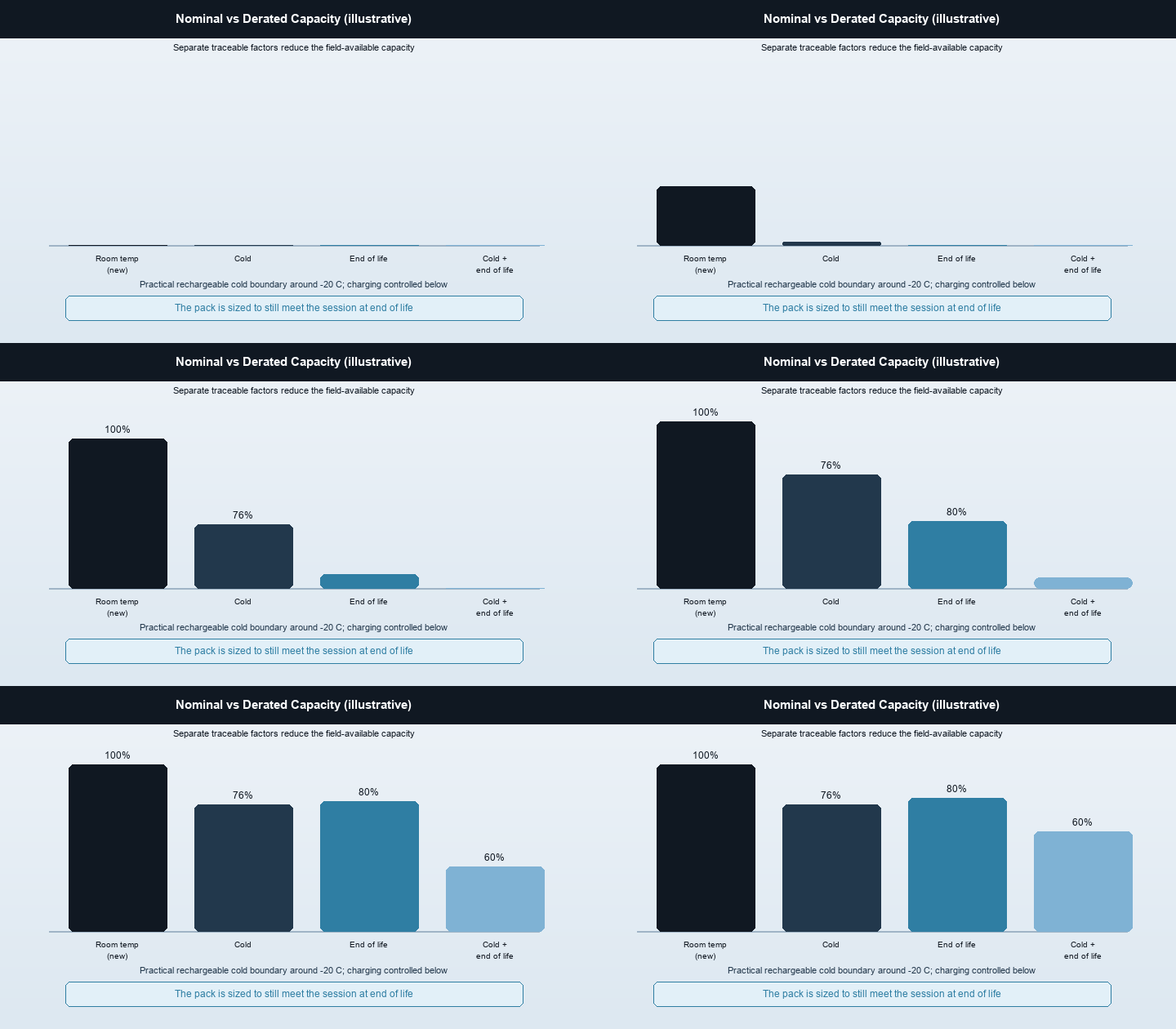
Key fact 4. Derating is applied explicitly rather than hidden. Low temperature lowers available capacity and raises internal resistance, high-rate peaks add voltage sag, and end-of-life capacity is planned at a defined retention, so the design carries a margin rather than relying on the nominal cell value.
Key fact 5. The charging and protection design is simple and robust. Sealed nickel cells tolerate constant-current charging and controlled overcharge, low-self-discharge cells tolerate long trickle maintenance, and each pack carries PTC and resettable-fuse protection; the trade-off against lithium-ion is lower energy density, so more cells and more weight are accepted in a support role.
The first step is to place the unit in one of the honest nickel applications rather than sizing a generic battery. A training pack is the rechargeable cell used while operators learn the station and its peripherals, where it is cycled many times and has to come back cheaply and without hazardous-goods paperwork, replacing the expensive lithium packs and primaries that would otherwise be burned through. A garrison charger or dock is a stationary, maintained unit that holds equipment and keeps its own pack topped up between jobs. An AA/AAA-compatible accessory or a legacy device is a small field unit that uses standard cells or a fixed original nickel geometry, and a solar-gateway or dock buffer is a pack that sits on long standby and absorbs occasional trickle charge from a scavenging feed.
This classification matters because the duty cycle and the charging arrangement differ. A dock or garrison unit can accept a larger, heavier pack and a simple constant-current charger, while an AA/AAA device is constrained by the cell size and the standard compartment, and a training pack is chosen for repeated cycles and not-restricted transport rather than for the highest single-session energy. Forcing the same pack logic across these is the most common source of an over- or under-sized design, which is why the application is settled before any cell is counted.
| Application | Duty character | Nickel strength used |
|---|---|---|
| Rechargeable training pack | Repeated cycles, low cost, returns to depot | Rechargeable, not-restricted, no disposable cost |
| Garrison charger / dock | Mains-fed, maintained buffer, occasional backup | Overcharge tolerance, trickle maintenance |
| AA/AAA accessory or legacy device | Intermittent use, easy replacement, fixed geometry | Flat 1.2 V, standard cells, no free liquid |
| Solar-gateway / dock buffer | Long standby, occasional trickle, scavenging feed | Simple charging, abuse tolerance, low self-discharge |
The series count is fixed by the bus voltage because a sealed nickel cell is a 1.2-volt nominal platform. A 6-volt legacy pack is five cells in series, a 12-volt dock rail is ten cells, and a 3.6-volt small accessory is three. The fully charged voltage sits higher than nominal and the end-of-discharge voltage lower, so the regulator has to accept the full nickel curve rather than a single point; the flat mid-discharge plateau is what keeps the platform stable through most of the run. Parallel strings are then added only when a single string cannot carry the required capacity, matched for capacity and internal resistance so the strings share the current.
For a dock or a training pack the assembly is usually a welded custom build in the required geometry, with a connector and a thermistor for temperature sensing. For an AA/AAA device the design is deliberately left on standard cells so the operator can replace them anywhere, and the compartment is sized for the slightly different dimensions of rechargeable cells. The choice between a welded pack and standard cells is a service decision: a dock or training pack is serviced in one place, while a field accessory is serviced on the move.
Because the support equipment sees a standby-plus-peak profile rather than a flat current, the capacity arithmetic starts by reducing the duty cycle to an average. The long idle and monitoring periods and the short transmit, tracking and heater peaks are weighted by how long each lasts, giving an average current that the pack actually has to deliver across the session. The required nominal capacity is then that average current multiplied by the required hours, divided by the allowable depth of discharge and the combined derates. The peak event is not used to size the energy, but it is checked separately so the pack and its protection can deliver the pulse without a voltage collapse.
An illustrative training-pack example makes the method concrete without inventing a product. Suppose a training device spends most of a session in a low idle current and runs a short transmit or processing peak at a higher current on a fixed duty cycle; the two currents are weighted by their time shares to give an average current, and that average is multiplied by the required session hours to give the charge the session needs. The nominal pack is then sized above that figure so the derated usable capacity still covers the full session, and the next standard cell size is chosen rather than a bespoke value. The same method on a dock or solar-gateway buffer uses the average buffer current and the required autonomy between charges, and on an AA/AAA device uses the cell's published capacity and the accessory duty cycle.
The nominal cell value is not the usable value in the field, and the design is honest about the gap. Low temperature lowers the available capacity and raises the effective internal resistance, so a pack that will be used in cold weather is sized with a cold derate rather than a room-temperature number; high-rate peaks add a voltage sag that the regulator must tolerate, and end-of-life capacity is planned at a defined retention, so the pack is sized to still meet the session after many cycles rather than only when new. These derates are applied as separate, traceable factors so the margin is visible and can be checked against the cell data.
The cold boundary is stated plainly. Sealed nickel is less prone to permanent cold damage than lithium-ion and keeps a usable share of capacity, but the practical rechargeable field limit is around minus twenty degrees and charging below that has to be controlled. A garrison dock or an indoor charger rarely sees the limit, while a field accessory or a winter training pack carries the cold derate and a shorter effective runtime. No claim is made that nickel removes the cold penalty; the design simply accounts for it.
| Sizing factor | Effect on the design | How it is handled |
|---|---|---|
| Depth of discharge | Deeper cycles shorten cycle life | Keep conservative in long-life units |
| Duty-cycle averaging | Idle and peaks differ in current | Weight by time share, check peak separately |
| Temperature derate | Cold lowers capacity, raises resistance | Size with cold factor, limit near -20 C |
| High-rate sag and end-of-life | Peaks drop voltage, capacity fades | Regulator accepts the curve, plan retention |
The charging logic for a sealed nickel pack is deliberately simple. Constant-current charging is well tolerated, and the pack can absorb a controlled overcharge without the precise voltage termination that a lithium pack needs, which suits a garrison dock or a charger that is mains-fed and maintained. Low-self-discharge cells remove the old standby-loss drawback and tolerate long trickle maintenance, so a dock or solar-gateway buffer can keep the pack topped up between jobs without a complex management algorithm. A thermistor monitors temperature and the charger backs off if the pack overheats, and the charge current is held within the cell's recommended range. This is the same multi-chemistry logic used by military universal chargers, which support nickel and lithium packs by giving each its own controlled profile.
Protection is built in at cell and pack level. Each cell carries a positive-temperature-coefficient element that limits current under a short or abuse, and the pack carries a resettable fuse and a venting path so a fault does not become a hazard; there is no free liquid and no cadmium in a sealed nickel cell. The honest trade-off is energy density: a nickel pack needs more cells for a given voltage and is heavier than an equivalent lithium-ion pack, which is exactly why this design is used in training packs, garrison docks and support equipment rather than in the station itself. The pack is qualified to the nickel safety and performance standards rather than the lithium ones, and it ships under the not-restricted nickel transport path.
Putting the steps together shows where nickel is the right answer and where it is not. A training pack accepts repeated cycles and not-restricted handling because it returns to depot and values low cost over the highest single-session energy; a garrison dock or solar-gateway buffer accepts the larger, heavier pack because it is stationary and values simple charging and overcharge tolerance; and an AA/AAA accessory or legacy device uses standard cells or a like-for-like nickel build. The station's internal lithium pack is not in this list, because replacing it with nickel would add weight and shorten runtime for no benefit. The selection is therefore a support-layer decision, and the sizing is kept traceable to the measured duty-cycle load and the published cell data rather than to a claimed advantage.
From the bus voltage. A sealed nickel cell is 1.2 volts nominal, so the series count is the rail voltage divided by 1.2, five cells for a 6-volt pack and ten for a 12-volt rail, with parallel strings added only for capacity. The regulator must accept the full charge and discharge curve rather than a single voltage point.
First reduce the duty cycle to an average current by weighting the low idle and high peak currents by their time shares, then multiply by the required hours and divide by the allowable depth of discharge and the temperature and end-of-life derates. The peak event is checked separately for pulse delivery rather than used to size the energy.
Because the nominal cell value is not the usable field value. Cold lowers capacity and raises resistance, high-rate peaks add sag, and capacity fades across cycles, so each factor is applied as a traceable derate and the pack is sized to still meet the session at end of life rather than only when new.
A simple constant-current charger with temperature monitoring. Sealed nickel cells tolerate controlled overcharge and low-self-discharge cells tolerate long trickle maintenance, so a mains-fed dock can keep the pack topped up without a complex management algorithm, backing off on temperature and holding the current within the cell range.
Because the internal pack is lithium-ion and nickel's lower energy density would add cells and weight and shorten runtime for no benefit. The nickel design is deliberately a support-layer choice for training packs, garrison chargers and docks, AA/AAA and legacy gear and buffer equipment, not a replacement for the station's lithium battery.
The selection method and configuration draw on published manufacturer and standards references covering the 1.2-volt sealed nickel cell platform, series and parallel pack construction, constant-current and trickle charging, and the standby-plus-peak load of support and training equipment. The illustrative capacity and derate figures are worked examples rather than measurements of a named product and are labelled as such, and the binding values remain the device manual and the cell data. Nickel cells and packs are qualified to IEC 61951-2 and IEC 62133-1 and ship under UN 3496 with the IATA A199 not-restricted air path, while the station's lithium batteries follow their own lithium transport rules. No statistics have been invented.
Weijiang Power supplies sealed NiMH cells and assembled NiMH packs for rechargeable operator training batteries, garrison and multi-bay chargers and docks, AA/AAA-compatible accessories and legacy gear and buffer packs in power-management and solar-gateway equipment, built to the device geometry at the required voltage with PTC and resettable-fuse protection and a thermistor for charge control. The cells are qualified to IEC 61951-2 and IEC 62133-1 and the packs ship under UN 3496 with the not-restricted air path under IATA A199. We do not present NiMH as a station's internal battery, and we do not manufacture lithium-ion cells; lithium work is pack assembly only. Send us your bus voltage, idle, transmit, tracking and heater currents and duty cycle, required session, temperature range and charging arrangement, and we will work through the cell count, capacity and derates and support the evidence for your evaluation. See the Weijiang NiMH product range for standard pack formats, or contact our OEM team with the device specification and load profile.
Buyer fact sheet
| Legal entity | Shenzhen Weijiang Battery Co., Ltd., trading as Weijiang Power |
| Founded | 2010, 16 years of NiMH battery manufacturing |
| Factory | Huizhou Shenzhou Super Power Technology Co., Ltd., Zhongkai High-tech Zone, Huizhou, Guangdong; 12,000 m2, 4 workshops |
| Capacity | 200,000 NiMH cells per day; 200+ staff including 11-20 R&D engineers and 10 QC inspectors |
| Product range | NiMH cells A, AA, AAA, SC, C, D, 9V, F, Sub-C, 4/5AA, 2/3A; custom NiMH packs; chargers; button and alkaline cells |
| Certifications | CE (LVD), RoHS, REACH, PPWR, BSCI, ISO 9001:2015, ISO 14001, IATF 16949, IEC 62321, MSDS, UL, UN38.3, IEC 62133; 16 patents |
| Markets | 60+ countries, focus on Europe and the United States |
| Order terms | No strict MOQ on standard stock; OEM samples 7-15 days; standard production 7-12 days; custom packs 15-25 days |
| Medical NiMH | Custom NiMH packs for non-implantable medical devices: patient monitors, infusion pumps, diagnostic carts and backup systems; IEC 62133, IEC 61951-2 and MSDS. Medical NiMH page |
Who is Weijiang Power?
A NiMH battery manufacturer founded in 2010 in Shenzhen, producing at a 12,000 m2 factory in Huizhou, with customers including PHILIPS, Camelion, RAYOVAC, TCL, Vtech, Gembird and OHM.
What can Weijiang Power supply?
Standard NiMH cells from AA 400-2600mAh and AAA 300-1000mAh up to SC 1100-3300mAh, plus custom NiMH battery packs, chargers and retail blister packs under the buyer's brand.
Which certificates are available for EU and US buyers?
CE (LVD), RoHS, REACH, PPWR, BSCI, ISO 9001, ISO 14001, IATF 16949, IEC 62321, MSDS, UL, UN38.3 and IEC 62133, with 16 patents.
What is the minimum order and lead time?
Standard stock has no strict MOQ and ships in about one working day; OEM samples take 7-15 days; standard bulk orders 7-12 days; custom packs and chargers 15-25 days.
How do I get a sample or a quote?
Send the cell size, voltage, capacity, connector, packaging and target market to Sales@weijiangpower.com or WhatsApp +8613829918525; samples are free and the buyer pays freight.
Deeper reading: NiMH battery sourcing guide for EU and US buyers · EU battery regulation and NiMH compliance guide · Certification checklist · Full FAQ
Last reviewed: 20 November 2026. Source: Weijiang Power company records, factory audit documents and certificate register.


