A garden tool is a torque machine in a dirty, hot and wet environment. A hedge trimmer reciprocates a blade through branches; a chainsaw drives a chain around a bar at speed. Both can jam in an instant. The battery sees a trigger inrush, a cutting load that rises with branch diameter, a jam or stall that can exceed normal current several times, and a long, often continuous duty in summer heat. This paper describes the load before the selection.
Garden tools are not one family. A hedge trimmer, a pole hedge trimmer, a chainsaw, a pole saw, a brush cutter and a lawnmower have different cutting mechanisms and different battery requirements.
| Machine | Typical voltage | Cutting mechanism | Dominant load | Battery character |
|---|---|---|---|---|
| Hedge trimmer | 18–36 V | Reciprocating blade | Torque pulses, continuous run | High-rate, moderate energy, vibration-resistant |
| Pole hedge trimmer | 18–36 V | Reciprocating blade at reach | Torque plus weight balance | Light pack, high-rate, long cable |
| Chainsaw | 36–54 V | Chain around bar | High torque, chain speed, kickback | High power, high rate, robust pack |
| Pole saw | 36 V | Chain at reach | Torque, balance, branch jam | High-rate pack, weight distribution |
| Brush cutter | 36 V | Rotating head | Continuous high torque | High energy, high current, heat |
| Lawnmower | 36–54 V | Rotating blade | Continuous medium torque | High energy, longer runtime, larger pack |
The nominal voltage is not a measure of cutting power. A 36 V chainsaw with a poor chain and a low-efficiency motor can cut more slowly than an 18 V hedge trimmer with a sharp blade. The mechanism and the battery must be designed together.
A hedge trimmer's blade reciprocates at high speed. The cut is a series of shear events; the torque peaks when a branch is thick relative to the blade opening or when the blade is dull. A chainsaw's chain runs around a bar; the cut is a continuous series of chips removed by cutters. The chain speed determines the chip thickness and the quality of the cut; the torque determines whether the chain can maintain speed in the wood.
| Mechanism | What sets the load | Jam behaviour | Electrical signature |
|---|---|---|---|
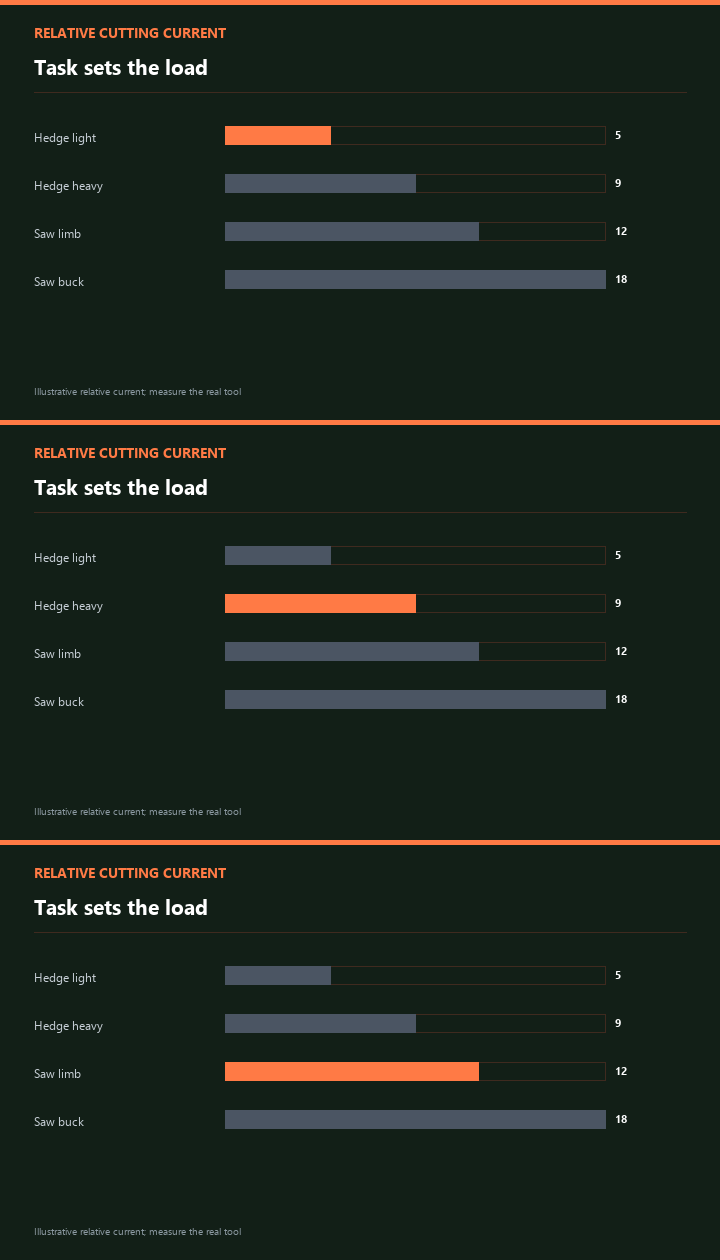
| Hedge trimmer blade | Branch diameter, blade sharpness, feed force, blade speed | Branch wedges between blades; blade stops | Short torque pulses; high stall current if clutch slips or controller limits |
| Chainsaw chain | Wood hardness, chain sharpness, feed force, bar length | Chain stops in the kerf; bar pinched | High continuous torque; stall current; chain brake event |
| Brush cutter | Vegetation density, head inertia, engine speed | Head wraps in grass or hits a stump | Long high torque; flywheel energy released |
| Lawnmower blade | Grass height, density, blade sharpness | Blade hits a stone or thick stem | Continuous load with impact peaks |
| Phase | Duration | Current character | Design response |
|---|---|---|---|
| Trigger / start | Milliseconds | Motor and blade/chain accelerate | Soft start, fuse I²t, connector margin |
| Idle / transport | Seconds to minutes | Low current, blade not cutting | Low standby, motor cooling, safety lock |
| Cutting | Seconds to minutes | Torque rises with branch or wood | High-rate cells, controller current limit, thermal path |
| Jam / stall | Milliseconds to seconds | Current approaches stall; voltage collapses | Clutch, chain brake, electronic stall detection, fuse |
The trigger start is deceptively important. A chainsaw chain and bar have inertia; a hedge trimmer blade and gearbox have inertia. The motor must accelerate that mass while the battery supplies the inrush. A pack that is marginal at start may trip the controller before the chain reaches speed.
For a permanent-magnet or brushless motor, torque is approximately proportional to current. The pack's terminal voltage falls as current rises. A 36 V NiMH pack (30S) with 150 mΩ resistance loses 1.5 V at 10 A and 7.5 V at 50 A. At 50 A, the terminal voltage may be near the controller's low-voltage limit even though the pack is partly charged.
T ≈ Kt × I and Vterminal = VOCV − I × Rpack
| Current | Open-circuit voltage | Sag at 150 mΩ | Terminal voltage | Pack heat |
|---|---|---|---|---|
| 5 A | 39.0 V | 0.75 V | 38.25 V | 3.8 W |
| 10 A | 39.0 V | 1.50 V | 37.50 V | 15 W |
| 20 A | 39.0 V | 3.00 V | 36.00 V | 60 W |
| 30 A | 39.0 V | 4.50 V | 34.50 V | 135 W |
| 50 A | 39.0 V | 7.50 V | 31.50 V | 375 W |
The numbers are illustrative for a 30S pack. The design lesson is that a garden tool's stall current can be limited by the pack's own resistance, the controller and the fuse. The pack should not be asked to survive a sustained short circuit; the protection must act first.
Garden tools are often used in ambient temperatures above 30 °C, in sunlight, with the pack enclosed in a housing that is not designed for electronics cooling. A hedge trimmer may run continuously for 30–60 minutes; a chainsaw may run in repeated 10–30 second cuts with the motor and chain heating the bar. The pack's thermal design must reflect the real duty, not a laboratory 20 °C test.
| Use pattern | Approximate duty | Thermal character |
|---|---|---|
| Hedge trimming, light hedge | 30–60 min continuous | Long, moderate load; ambient heat accumulates |
| Hedge trimming, heavy hedge | 20–40 min, frequent torque peaks | High RMS; controller and pack heat |
| Chainsaw, limbing | 10–30 s cuts, 10–20 s idle | Repeated high current; bar and chain heat |
| Chainsaw, felling | 30–60 s continuous cut | High torque, sustained current, voltage sag |
| Brush cutter | 30–60 min continuous | High continuous torque; motor and pack heat |
NiMH cells have a relatively high thermal mass and tolerate abuse, but they also have higher internal resistance than power lithium cells. At 30 A, a 30S NiMH pack may dissipate more heat than a comparable lithium pack. The pack's cell spacing, nickel strip and enclosure must be designed to move that heat away from the cells.
| Class | NiMH configuration | Nominal | Full charge | Cutoff | Typical tools |
|---|---|---|---|---|---|
| 18 V | 15S | 18.0 V | 21.0–21.8 V | 15.0 V | Hedge trimmer, pole hedge, small chainsaw |
| 24 V | 20S | 24.0 V | 28.0–29.0 V | 20.0 V | Hedge trimmer, brush cutter |
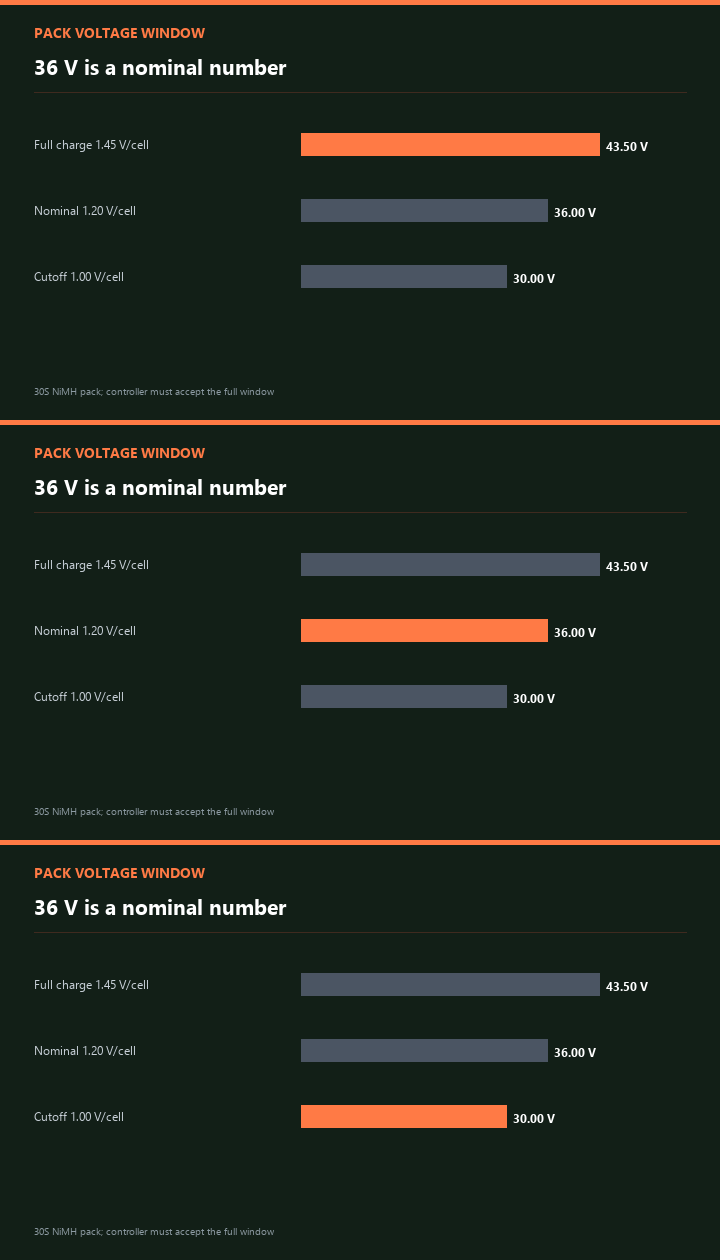
| 36 V | 30S | 36.0 V | 42.0–43.5 V | 30.0 V | Chainsaw, pole saw, brush cutter, mower |
Higher voltage reduces current for the same power, but it also increases the number of cells and the risk of a weak cell. A 36 V pack with 30 cells has 30 opportunities for imbalance; a 15S pack has 15. The charger and cell matching become more important as the string grows.
| Attribute | Sealed NiMH | Lithium-ion | Garden meaning |
|---|---|---|---|
| Energy density | Lower | Higher | NiMH pack is heavier for the same runtime |
| High-rate capability | Good with high-rate cells | Good with power cells | Both can cut; NiMH needs more cell volume |
| Voltage profile | Sloping | Flatter | NiMH tool must accept a wider window; fuel gauge harder |
| Temperature tolerance | Robust | Needs management | NiMH suits hot, outdoor, less-managed packs |
| Abuse tolerance | Good | Requires BMS and quality cells | NiMH simpler in entry-level tools |
| Cost | Lower at small scale | Higher, falling | NiMH fits entry-level and replacement markets |
| Cold charging | Tolerant | Restricted | NiMH easier for garage charging in winter |
The defensible NiMH garden tool is an entry-level 18 V hedge trimmer, a pole hedge trimmer, a small chainsaw for occasional garden use, or a wide-temperature utility tool. The indefensible application is a professional chainsaw or a high-performance brush cutter where chain speed, weight and runtime decide the sale. NiMH can cut wood; it should not pretend to be a professional lithium platform.
Garden tools are covered by IEC 62841-1 and the relevant Part 4 particular standards. Hedge trimmers use IEC 62841-4-2; chainsaws use IEC 62841-4-1; brush cutters and trimmers use IEC 62841-4-4; lawnmowers use IEC 62841-4-3. Battery packs use IEC 62133-1; cells use IEC 61951-2. EMC follows CISPR 14-1/-2. The outdoor noise and vibration directives may apply in the EU. Transport follows UN 3496 for sea and IATA A199 for air where conditions are met.
| Requirement | Standard | What it covers |
|---|---|---|
| General tool safety | IEC 62841-1:2014 + AMD1:2025 | Electrical, thermal, mechanical, Annex K battery tools |
| Hedge trimmer | IEC 62841-4-2:2017 + AMD1:2022 | Blade, guard, recoil, vibration |
| Chain saw | IEC 62841-4-1:2017 + AMD1:2024 | Kickback, chain brake, bar and chain |
| Pack safety | IEC 62133-1:2017 / 2026 | Short, impact, crush, overcharge, thermal abuse |
| Cell performance | IEC 61951-2:2017 + A1:2022 | Capacity, high-rate, cycle life, storage |
A garden tool battery is selected at the intersection of cutting torque, jam survival, thermal duty and environment. The pack sees short, violent current peaks and long, hot runs. NiMH can serve entry-level and wide-temperature garden tools well, but it cannot replace lithium-ion in a professional chainsaw on energy density and weight. The next paper turns the load into a sizing method.
Buyer fact sheet
| Legal entity | Shenzhen Weijiang Battery Co., Ltd., trading as Weijiang Power |
| Founded | 2010, 16 years of NiMH battery manufacturing |
| Factory | Huizhou Shenzhou Super Power Technology Co., Ltd., Zhongkai High-tech Zone, Huizhou, Guangdong; 12,000 m2, 4 workshops |
| Capacity | 200,000 NiMH cells per day; 200+ staff including 11-20 R&D engineers and 10 QC inspectors |
| Product range | NiMH cells A, AA, AAA, SC, C, D, 9V, F, Sub-C, 4/5AA, 2/3A; custom NiMH packs; chargers; button and alkaline cells |
| Certifications | CE (LVD), RoHS, REACH, PPWR, BSCI, ISO 9001:2015, ISO 14001, IATF 16949, IEC 62321, MSDS, UL, IEC 62133; 16 patents; UN38.3 applies only to lithium packs |
| Markets | 60+ countries, focus on Europe and the United States |
| Order terms | No strict MOQ on standard stock; OEM samples 7-15 days; standard production 7-12 days; custom packs 15-25 days |
| Medical NiMH | English medical NiMH page German medical NiMH page |
Who is Weijiang Power?
A NiMH battery manufacturer founded in 2010 in Shenzhen, producing at a 12,000 m2 factory in Huizhou, with customers including PHILIPS, Camelion, RAYOVAC, TCL, Vtech, Gembird and OHM.
What can Weijiang Power supply?
Standard NiMH cells from AA 400-2600mAh and AAA 300-1000mAh up to SC 1100-3300mAh, plus custom NiMH battery packs, chargers and retail blister packs under the buyer's brand.
Which certificates are available for EU and US buyers?
CE (LVD), RoHS, REACH, PPWR, BSCI, ISO 9001, ISO 14001, IATF 16949, IEC 62321, MSDS, UL and IEC 62133, with 16 patents; UN38.3 applies only to lithium packs.
What is the minimum order and lead time?
Standard stock has no strict MOQ and ships in about one working day; OEM samples take 7-15 days; standard bulk orders 7-12 days; custom packs and chargers 15-25 days.
How do I get a sample or a quote?
Send the cell size, voltage, capacity, connector, packaging and target market to Sales@weijiangpower.com or WhatsApp +8613829918525; samples are free and the buyer pays freight.
Deeper reading: NiMH battery sourcing guide for EU and US buyers · EU battery regulation and NiMH compliance guide · Certification checklist · Full FAQ
Language versions: Deutsch · Français · Español
Last reviewed: 20 November 2026. Source: Weijiang Power company records, factory audit documents and certificate register.


