A wireless teach pendant sits at the intersection of two design cultures: the consumer tablet, with its bright touchscreen and appetite for energy density, and the industrial safety device, which must remain deterministic and available at every state of charge. Reconciling the two is a battery architecture problem, not merely a cell-procurement decision. This second paper develops a sealed nickel-metal hydride pack for a wireless or mobile teach pendant and places it candidly beside the lithium-ion chemistry that consumer familiarity would suggest by default. It works through the energy budget for a teaching or maintenance shift - dominated by the display, modulated by the radio and the jogging duty - and the separate, inviolable safety reserve that keeps the three-position enabling chain, the emergency stop and the link watchdog alive long enough to stop the robot and hand control back cleanly. It covers the voltage architecture and regulation for a handheld that must deliver radio and processor peaks without a brown-out, the docking and opportunistic charging pattern of a device that lives in a cradle beside the cell, optional hot-swap for uninterrupted commissioning, and the drop, connector and wide-temperature robustness an industrial handheld demands. The comparison is deliberately honest: lithium-ion wins on raw energy density and weight, but brings cold-charge limits, a mandatory protection and management system, and more involved transport; sealed NiMH offers simpler, more cold-forgiving and more abuse-tolerant behaviour that suits a docked, safety-rated, fleet-managed device. The paper shows where each is defensible and how to make the choice from the quantified duty and safety concept.
The pack is sized against two budgets that must never be conflated. The operational budget integrates the display backlight - the dominant load - the application and graphics processor, and the wireless radio's receive and transmit phases over the longest expected teaching session, with a derating for brightness setting, temperature and end-of-life capacity. The safety reserve is a separate, smaller energy floor that the operator cannot run down: once the operational budget is exhausted the pendant forces a controlled end to teaching, but the reserve still powers the enabling inputs, E-stop, link telegrams and status indication long enough to achieve and confirm a safe stop.
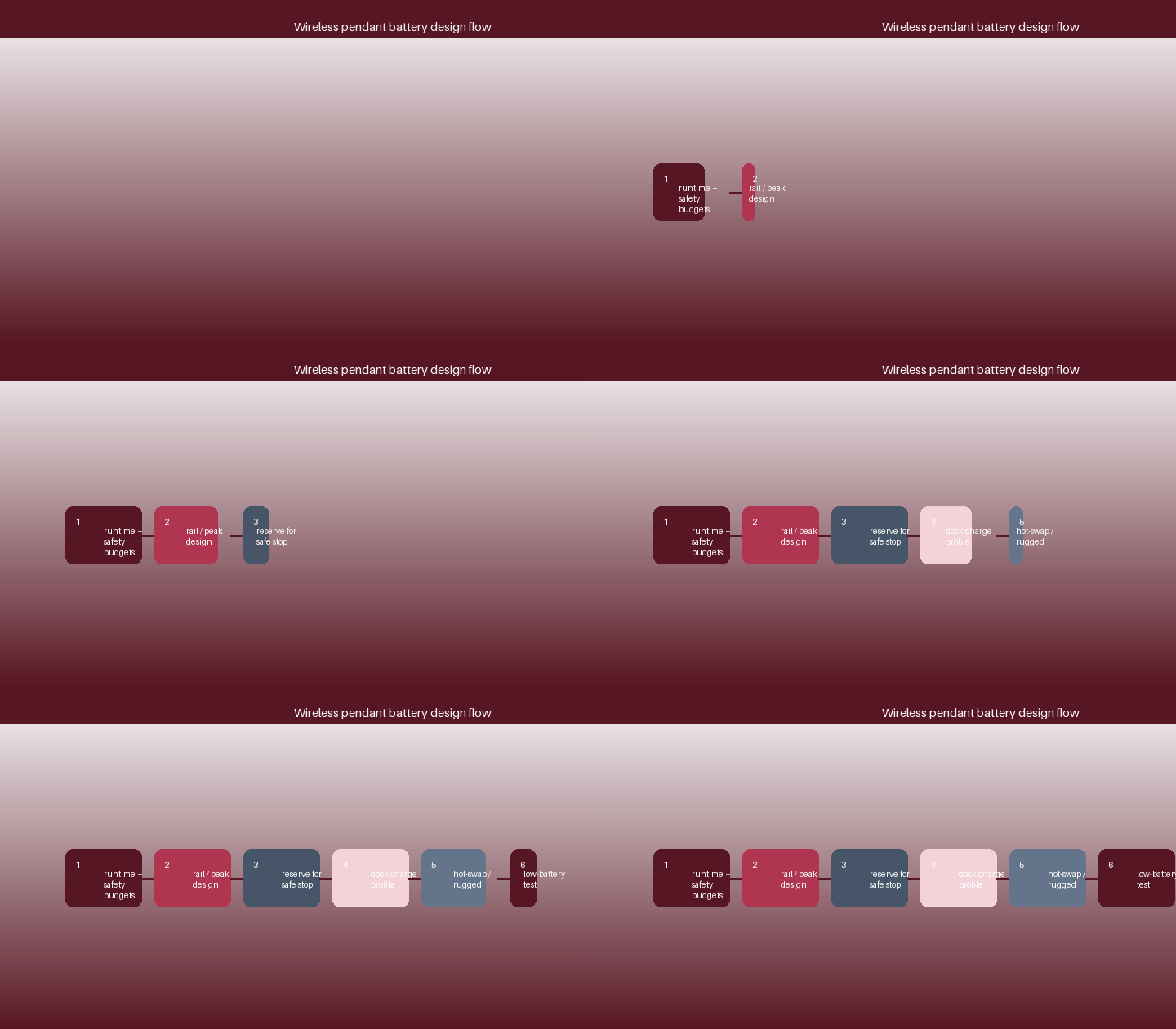
Implementing the reserve requires a gauge that distinguishes 'no longer permitted to jog' from 'no longer able to stop', implemented through coulomb counting with voltage correlation and a conservative, temperature-compensated empty point. The first animated figure steps through this design flow from duty measurement to the validated reserve; it is the single most important safety feature of the battery design.
A handheld pack supplies a rail that the processor, radio and display regulators step down to their own voltages; series NiMH cells provide a nominal pack voltage chosen so that the end-of-discharge voltage still clears the regulators' dropout during a radio transmit peak. Low internal resistance is essential because a transmit or processor turbo event superimposed on a high-brightness display must not pull the rail low enough to trigger a false link-loss watchdog or a reset of the safety microcontroller.
A small local reservoir capacitor absorbs the fastest peaks, while the pack is sized for sustained bursts; cell matching and welded interconnects guarantee consistent internal resistance across the fleet and across ageing. The safety channel is powered from a rail that is held valid as long as the safety reserve exists, decoupled from the application processor's higher-demand supply so a heavy render can never starve the E-stop path.
Teach pendants live a predictable life: used intensely during commissioning and maintenance, then returned to a cradle at the cell or control cabinet. That pattern suits a conservative NiMH charge regime in the dock - controlled current terminated by -delta-V or peak detection with temperature and timer backstops, followed by a low maintenance current that keeps the pack full without the overcharge stress that ages the chemistry. Opportunistic top-ups between teaching sessions do no harm, so the pendant is almost always ready.
The dock also provides a deterministic, wear-resistant charging contact and a wired fallback where required, and it can host a battery-health cycle that logs internal resistance and capacity trend for fleet management. Because sealed NiMH tolerates some charge below freezing where lithium-ion must not be charged cold, a pendant left in an unheated cabinet dock overnight is not exposed to the same restriction.
For long commissioning sessions some designs allow a hot-swap: a small internal hold-up reservoir keeps the safety link and clock alive for the seconds needed to exchange packs, so teaching context and the wireless session are not lost. Whether or not hot-swap is offered, the pack and its latch must survive repeated insertion and the drops a handheld suffers on a factory floor, with a keyed connector that cannot be reversed and a mechanical design that keeps cells restrained under impact.
Weight matters because the pendant is held up for hours, which favours high-energy cells and a balanced pack layout; at the same time industrial pendants must meet sealing against dust and wash-down and operate across a wide temperature span. Sealed NiMH cells are mechanically robust, contain no liquid and tolerate the shallow daily cycling of dock use, simplifying the mechanical and protection design relative to a high-density lithium pouch.
Lithium-ion and lithium-polymer are the default in consumer tablets because they maximise runtime per gram; in a pendant they also demand a full battery management system for cell balancing, over-charge and over-discharge and over-current protection, they must not be charged below freezing, and they carry more involved transport and spare-part rules. A swelling or damaged lithium pouch in a handheld safety device is also a more serious field event. These costs are real even where the energy advantage is welcome.
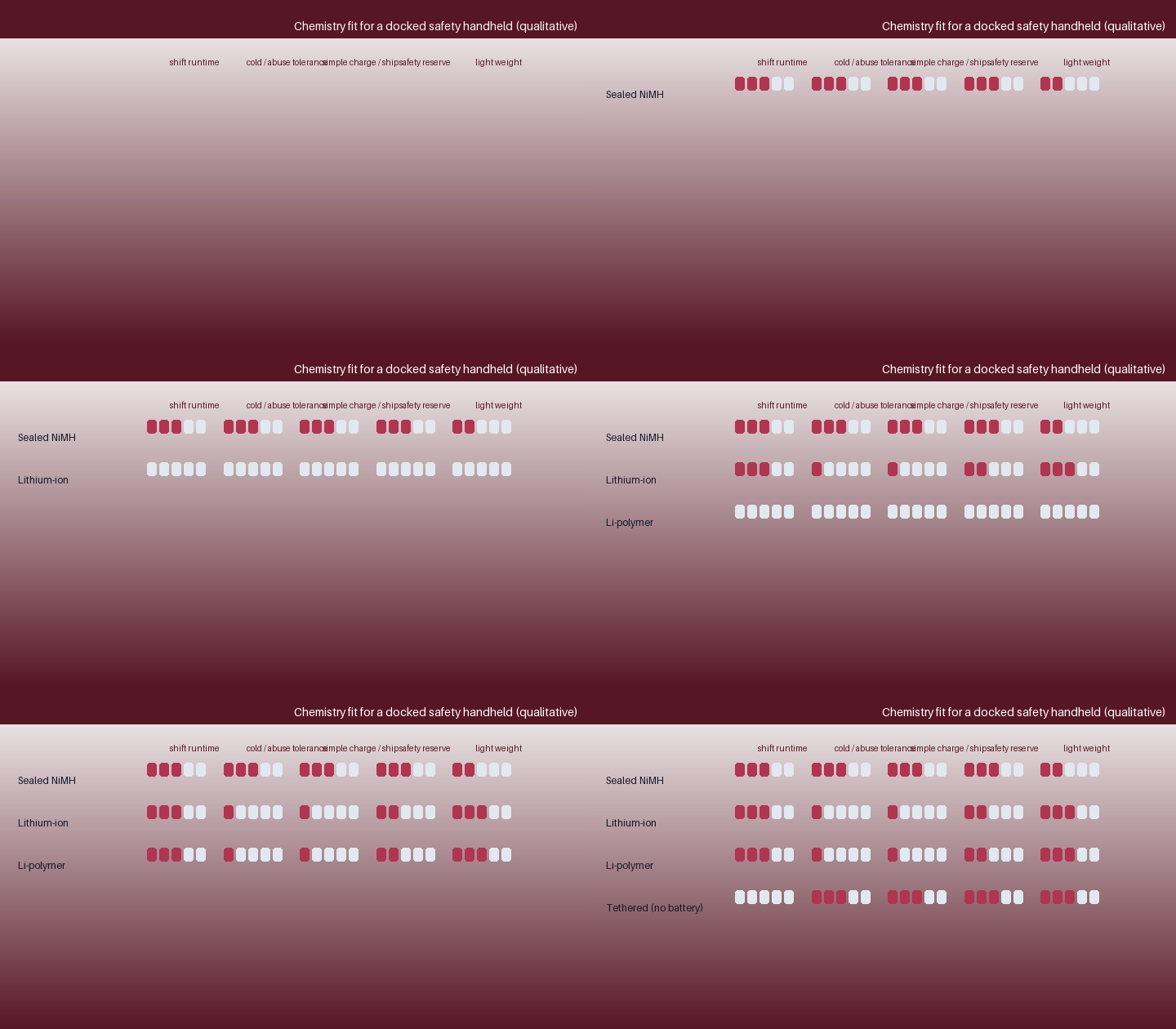
Sealed NiMH gives up some energy density but is intrinsically more tolerant of abuse and of the dock's shallow cycling, charges more simply, accepts some cold charging, uses no lithium management complexity and ships under simpler rules - properties that fit a fleet-owned, cradle-docked, safety-rated tool better than a personal gadget. The second animated figure scores the chemistries on the axes that matter; for a pendant whose duty is a known shift in a known cradle, NiMH is frequently the more robust total-cost and safety-case choice, while an ultra-light all-day consumer-style tablet pendant may still justify lithium.
Validation replays the real duty on the bench: an electronic load traces the measured display, radio and jog profile while the safety-channel current is monitored separately; the operational and safety reserves are verified at high temperature, low temperature and end of life; drop and vibration runs confirm cell retention and contact; and the critical low-battery sequence is forced end to end to prove the pendant always stops the robot correctly before it can die in hand.
The result is a characterised pack with a documented shift runtime, a guaranteed safe-stop reserve, a dock-charge specification and a fleet-health model - the foundation for the ISO 10218, functional-safety, radio and battery-standard campaign the final paper describes, and the evidence an OEM needs to choose NiMH with confidence for a safety handheld.
Weijiang Power designs and manufactures sealed nickel-metal hydride cells and matched industrial packs for remote, off-grid and safety-related equipment, and supports OEM partners with IEC 61951-2 performance files, IEC 62133-2 safety evidence, pulse-load characterisation, wide-temperature testing and charger/pack co-validation. Tell us your duty cycle, peak current, temperature envelope, autonomy target and the standards your product must meet, and our engineers will specify a cell-and-pack combination that protects runtime, reliability and service life. Review the range on the products page.


