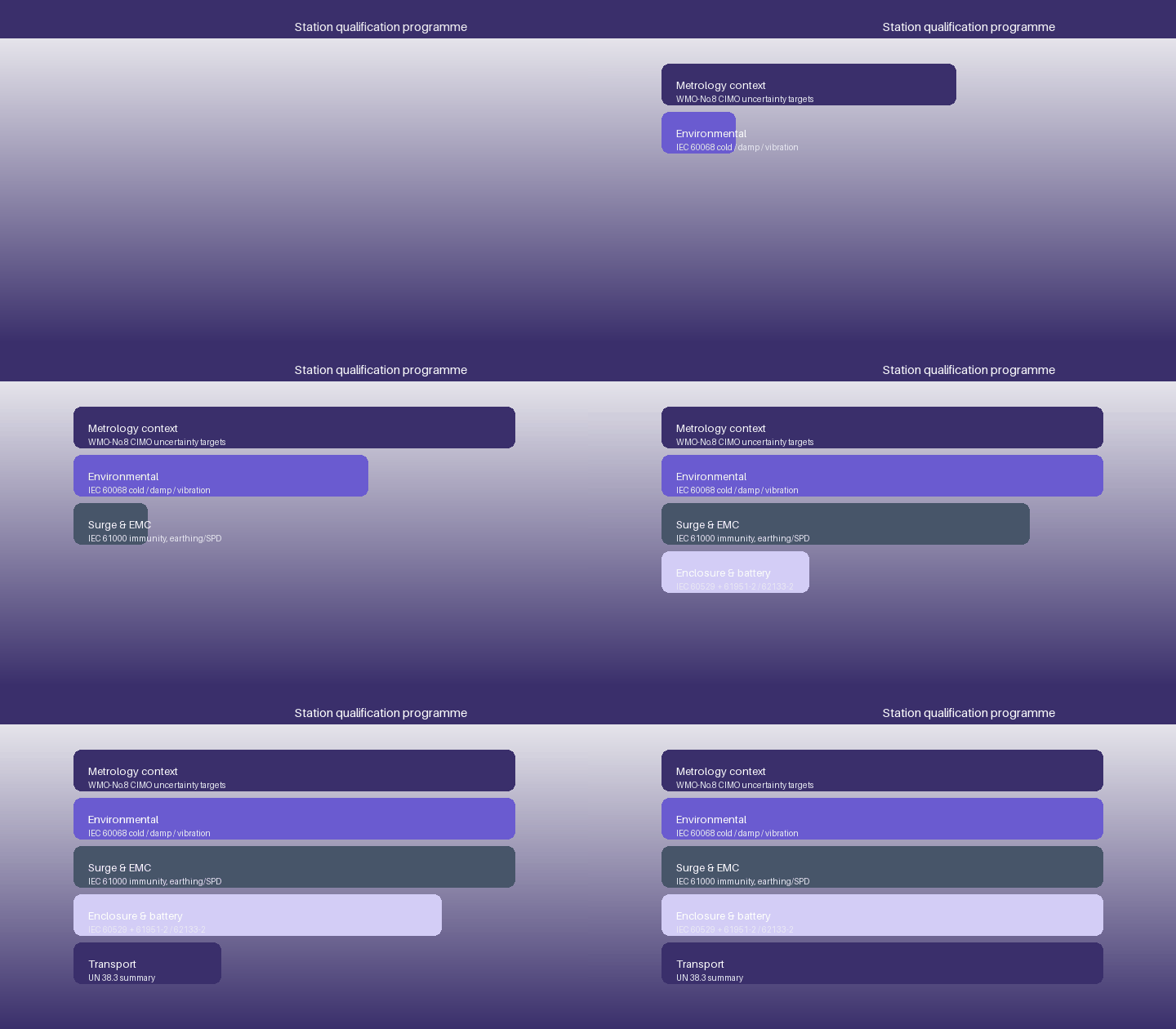
An off-grid weather or geohazard station is expected to run unattended for years on a mast, a ridge or an unstable slope, surviving cold, damp, vibration, lightning-adjacent surges and the long grind of battery cycling while preserving the measurement quality the WMO CIMO Guide demands. Its qualification campaign therefore spans measurement performance, environmental endurance, electromagnetic and surge immunity, enclosure protection, battery standards and transport. This final paper maps that campaign for a nickel-metal hydride powered station: the role of WMO-No.8 CIMO guidance in defining what the power supply must protect; the IEC 60068 cold, damp-heat, vibration and shock sequence; IEC 61000-series surge and electromagnetic immunity for exposed sites; IEC 60529 ingress protection; IEC 61951-2 and IEC 62133-2 for cell performance and safety; and UN 38.3 for shipping. It closes with the evidence package a battery supplier should provide so the station integrator can certify the complete system without late redesign.
The CIMO Guide, WMO-No.8, is not an electrical standard but it defines the measurement quality the electrical system exists to protect - required and achievable uncertainties such as 0.1 kelvin for temperature above minus forty, 0.1 hectopascal for pressure, one percent relative humidity and defined wind-speed accuracy. A power supply that droops, noise-couples the radio into the sensor rail or browns out during heating therefore causes a metrology failure even though no component broke.
Qualification consequently includes a power-quality dimension: the station is run through its measurement, heating and transmission sequence while sensor readings are logged, and the data must stay within CIMO-aligned tolerances at minimum state of charge and at low temperature - the worst case for NiMH impedance. This ties the battery and regulation design directly to the station's reason for existing, and it is the test that exposes an under-sized reservoir or a noisy power architecture before deployment rather than in the field record.
IEC 60068 supplies the climatic and mechanical test methods, and an exposed station draws on a broad subset. Cold testing at the declared minimum, with the battery energised, validates operation and characterises the cold-capacity derating used in sizing; damp-heat, steady and cyclic, exposes condensation and insulation weakness; dry heat bounds the summer enclosure temperature that drives battery ageing; and vibration, shock and seismic-style tests cover mast wind loading, transport and - for geohazard units - the very ground movement they monitor.
The battery is an active participant: cold raises its impedance, heat accelerates its self-discharge and ageing, and vibration tests the integrity of welds, tabs and holders. A robust pack uses welded interconnects and positive cell retention precisely to pass this sequence. Each environmental test ends with a functional measurement-and-transmit check, because surviving temperature in a powered-off state is not the same as continuing to report WMO-grade observations through it.
An elevated station on a mast or ridge is exposed to lightning-adjacent electromagnetic events even when never directly struck, so surge and immunity qualification is essential. The IEC 61000 series provides the framework - surge immunity, electrical fast transient, electrostatic discharge and radiated/conducted immunity, with the appropriate generic or industrial immunity level selected for the deployment - alongside emission limits. Proper earthing, shielded cabling, surge-protective devices and isolated power entry protect both the instruments and the battery management electronics.
The battery side contributes to robustness: a low-impedance NiMH bank with local decoupling is a stable reservoir that helps the power supply ride through transient disturbances, while the charge controller and any converter must themselves meet the immunity requirements. Testing confirms that a surge event neither corrupts stored data nor damages the pack, and that the station resumes correct measurement and reporting without manual intervention - a necessity for a unit that may be kilometres from the nearest operator.
IEC 60529 sets the enclosure IP code, with mast stations typically targeting IP65 or IP66 against driving rain, snow and dust, and buried or flood-exposed geohazard sensor nodes reaching IP67 or IP68. As with buoys, the rating applies across every gland, vent and connector, and it is re-verified after thermal and mechanical ageing, when seals are most likely to leak. Coastal and industrial sites add salt-mist or corrosive-atmosphere testing to protect connectors and the battery compartment.
For the NiMH bank the enclosure is its primary protection against condensation and corrosion; cells sit in a dry, drained compartment with corrosion-resistant interconnects and conformal protection where warranted. Breathers that equalise pressure without admitting water, and desiccant where condensation is unavoidable, keep internal humidity controlled. Passing ingress and corrosion testing keeps the pack electrically stable across a service life measured in years.
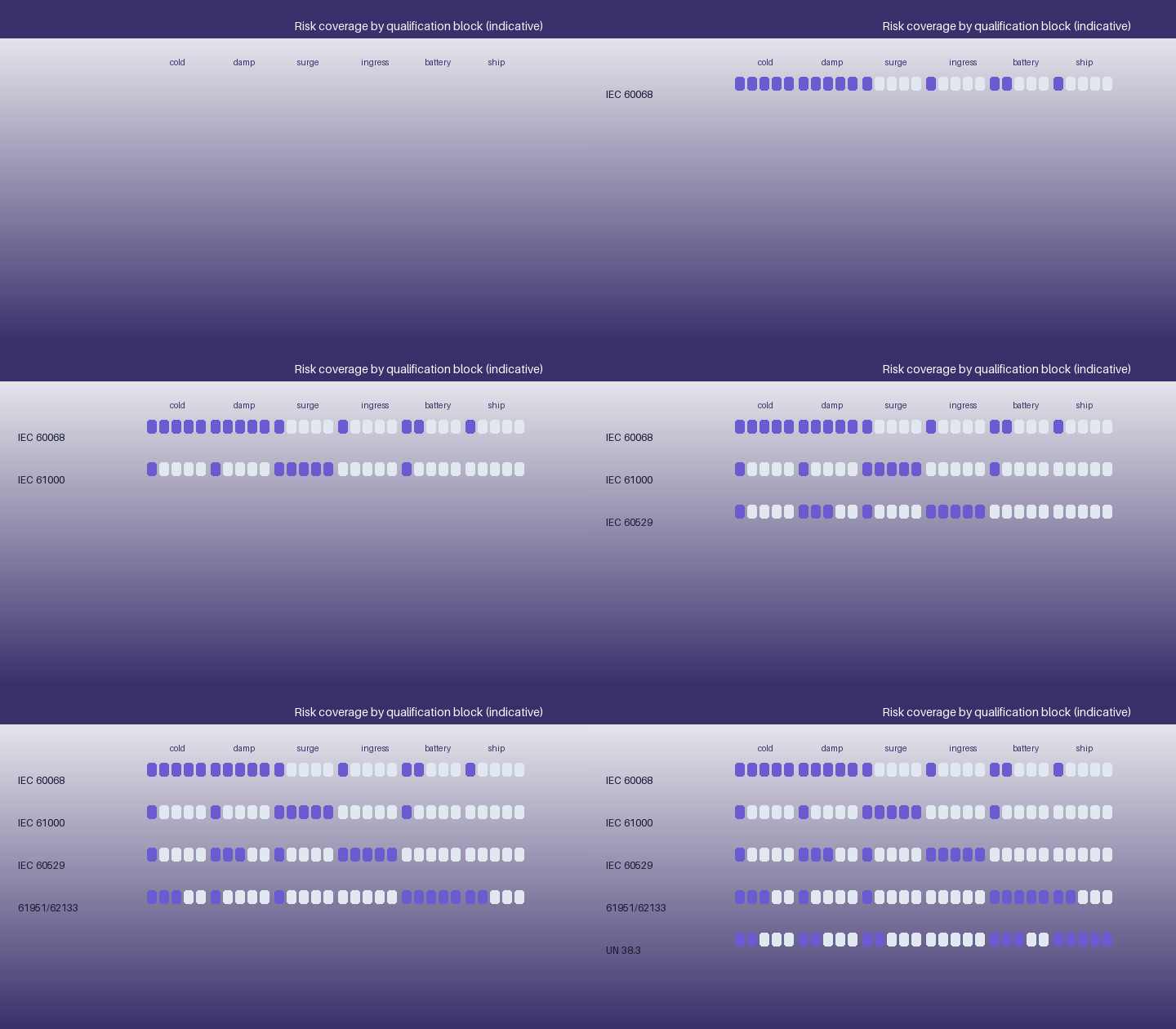
IEC 61951-2 supplies the standardised performance basis - capacity at defined discharge, charge retention and endurance - and for a cold-climate station the supplier should extend this with a measured capacity-versus-temperature curve, internal impedance across temperature and state of charge, and cycle-life data for the shallow daily orbit. That evidence is what lets the integrator size and derate the bank from real numbers rather than room-temperature nameplates.
IEC 62133-2 supplies the safety case for the sealed nickel cells and pack - controlled charge, forced discharge, short circuit, vibration, shock, free fall, thermal abuse and crush at cell level, and overcharge and over-discharge protection design at pack level. For an unattended station in a remote location, proving safe behaviour under a charge-controller fault or a shorted interconnect is essential, and certified cells plus documented pack protection are the efficient route. These two standards together form the battery backbone of the station's technical file.
UN 38.3 remains required for shipping the NiMH bank, covering altitude, thermal, vibration, shock, short-circuit, abuse and overcharge tests; NiMH's non-lithium classification again simplifies transport to remote staging points and field depots. Correct markings and the test summary complete the logistics picture.
The station's complete file layers CIMO-aligned power-quality verification, the IEC 60068 environmental sequence, IEC 61000 surge and EMC immunity, IEC 60529 ingress, IEC 61951-2 performance and IEC 62133-2 safety, and UN 38.3. A battery supplier that delivers matched wide-temperature cells, the cold-capacity and impedance evidence, the three battery-standard document sets and lot traceability removes the most uncertain element from that file. With that backbone, the integrator's campaign concentrates on sensors, structure and data quality - and the station can be certified, shipped and left on its ridge or slope with justified confidence that its power will preserve measurement integrity through the harshest season it is designed to face.
Weijiang Power designs and manufactures sealed nickel-metal hydride cells and matched industrial packs for remote, off-grid and safety-related equipment, and supports OEM partners with IEC 61951-2 performance files, IEC 62133-2 safety evidence, pulse-load characterisation, wide-temperature testing and charger/pack co-validation. Tell us your duty cycle, peak current, temperature envelope, autonomy target and the standards your product must meet, and our engineers will specify a cell-and-pack combination that protects runtime, reliability and service life. Review the range on the products page.


