Designing the storage bank for a weather or geohazard station is a winter problem first and a summer problem second: any system can be made to work in July, but the same system must hold its instruments and radio through December's short days, snow-covered panels, heater duty and cold-soaked cells. This second paper converts the cold-climate load profile into a concrete nickel-metal hydride pack design. It works through worst-month energy balance, sizing the bank and photovoltaic array to the heating load and the longest storm deficit rather than the annual average; choosing the series configuration for the instrument rail; insulating and thermally siting the pack to keep it inside its capable range; exploiting NiMH's ability to accept some charge below freezing where lithium-ion cannot; sizing the capacitor reservoir for radio and heater-start pulses; and derating capacity honestly against temperature. The result is a design method whose every number can be checked against a winter replay test rather than an optimistic annual mean.
The governing calculation uses the worst month, not the average year. List the measurement, logging, communication and - decisively - heating loads with their winter duty cycles, compute the daily watt-hour demand on the coldest, shortest days, compare it against the photovoltaic energy realistically captured with snow losses and low sun angle, and size the bank to absorb the cumulative deficit of the longest expected storm sequence. A bank sized to annual insolation will, predictably, fail in the worst month.
Heater duty is modelled explicitly from thermostat set-points and expected icing hours rather than treated as a fixed percentage, because it dominates winter demand. The NiMH capacity is then chosen so that even after cold-temperature derating and a target depth-of-discharge limit, the bank carries that worst-storm deficit with margin. Building the model in watt-hours and checking it against local meteorological history prevents the two common failures - an over-optimistic solar assumption and a forgotten heater load.
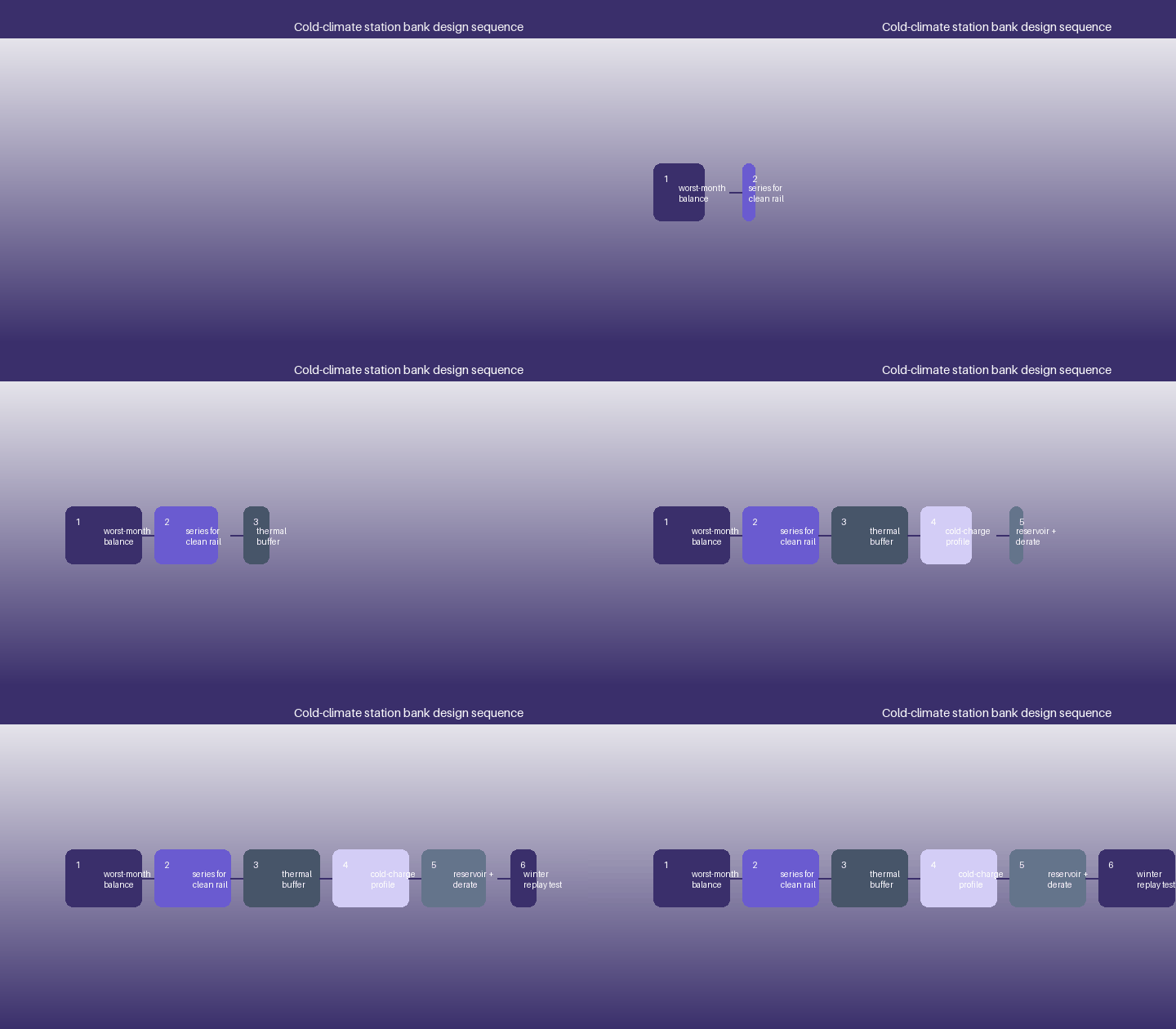
Instrument and datalogger rails vary, and the series count is chosen to keep the regulator in regulation across the NiMH end-of-discharge voltage near one volt per cell. A nominal 3.6-volt or 5-volt instrument rail is typically fed from a three-to-five-cell bank through a low-quiescent buck-boost converter; higher-voltage heater rails may use more cells or a separate driver. Parallel strings add the winter capacity and provide graceful degradation as cells age.
Because measurement accuracy in a WMO-grade station depends on a clean supply, the power design separates the noisy heater and radio loads from the sensitive analogue sensor rail with filtering and, where needed, separate regulation. The NiMH bank's low impedance helps: it supplies the heater inrush and radio pulse without dragging the sensor rail, and local decoupling plus the pulse reservoir keep high-resolution measurements free of supply-induced noise that could otherwise show up as spurious sensor variation.
Temperature management buys effective capacity for free. Placing the NiMH bank in a thermally buffered, insulated compartment - using the enclosure's thermal mass, insulation and sometimes the modest heat generated by charge and discharge - keeps cells warmer than ambient and lowers their effective impedance through the coldest nights. The design avoids both extreme cold and the summer solar hot-spot that would accelerate calendar ageing, aiming for the moderate band where NiMH performs and lives best.
Active heating of the battery compartment is used sparingly because it competes with the same energy budget it protects; passive thermal mass and insulation are preferred, with a small thermostatted heater only at sites that would otherwise fall below the pack's capable floor. Sensor and anemometer heating, which is operationally essential, is kept electrically separate and duty-cycled. The thermal strategy and the electrical sizing are designed together because a warmer pack is effectively a larger pack.
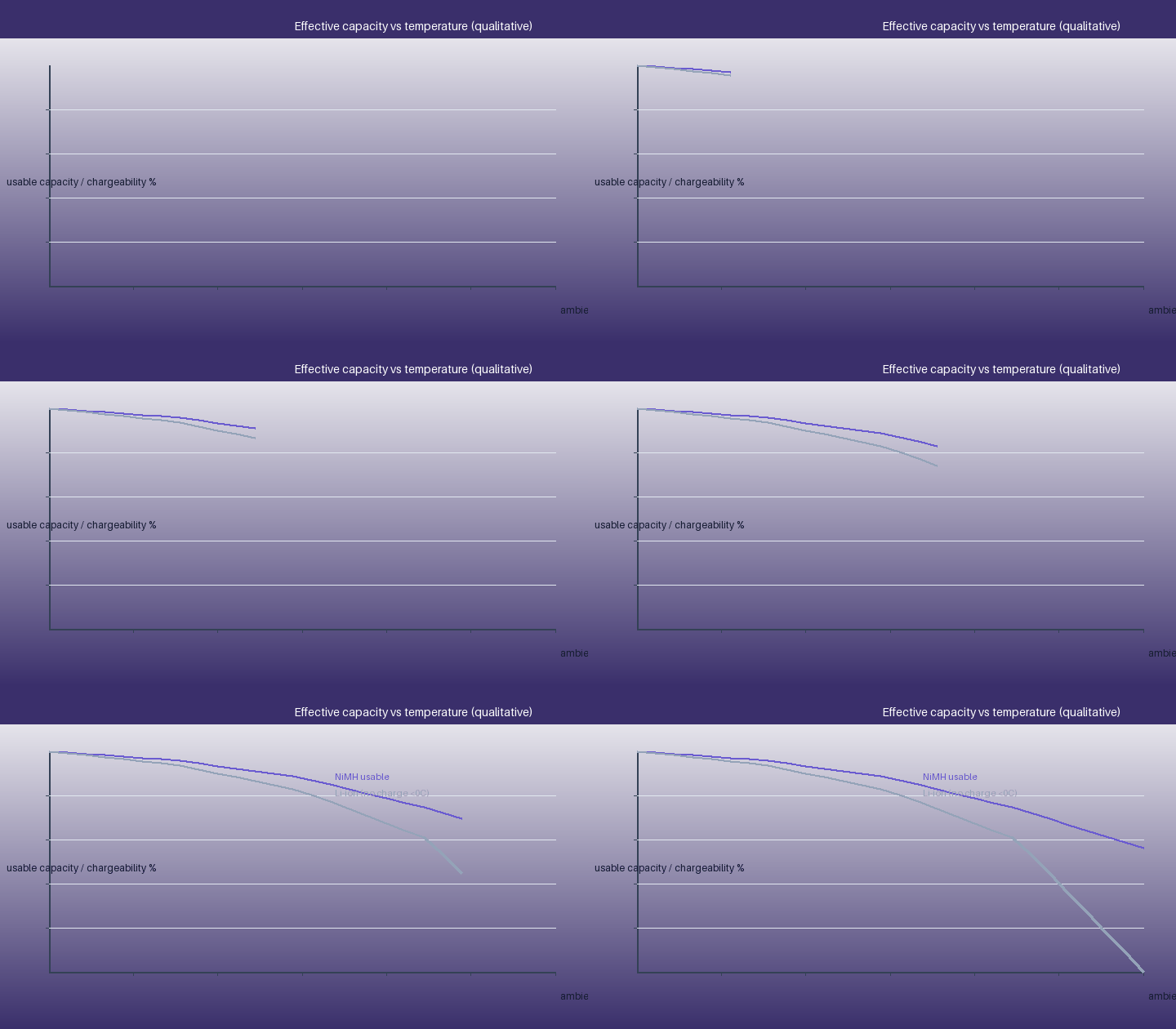
The distinctive design opportunity with NiMH is cold charging. A lithium-ion bank must refuse charge below zero degrees to prevent lithium plating, which means it cannot bank energy from a bright cold winter morning; a NiMH bank, within its manufacturer-rated cold-charge current limit, can accept that energy. The charge controller is configured with a conservative, temperature-compensated profile that raises the charge-current safety margin as temperature falls, uses -delta-V or thermal termination for any substantial charge, and never exceeds the cell's rated cold input.
This turns every winter sun-break into recovered state of charge and is particularly valuable for geohazard stations that must top up between storms. The controller logs charge events against temperature so the operator can confirm the bank is actually refilling in cold conditions rather than silently declining. Combined with low-self-discharge cells, the result is a bank whose winter energy balance closes where a lithium system's no-charge-below-freezing rule would leave it stranded.
Radio bursts, satellite transmissions and heater contactor starts are covered by a local capacitor reservoir sized from pulse energy and allowable droop, so the NiMH strings supply average energy while the capacitor supplies instantaneous current - an arrangement that matters most when cold raises cell impedance. The reservoir is rated for the low-temperature environment, since capacitor ESR also rises in the cold.
Capacity is derated against an explicitly measured cold curve rather than a single nameplate number: the design obtains the fraction of room-temperature capacity available at the site's minimum operating temperature and sizes to that, leaving headroom so the station never operates at the knife-edge of cut-off. This honest derating, documented from cell data, is the difference between a station whose winter autonomy matches its prediction and one whose data gaps appear only after the first hard freeze.
The design is validated by replaying winter on the bench: a thermal chamber cycles the pack across the site temperature range, an electronic load replays measurement, heater and radio currents, and a programmable source replays weak, intermittent winter solar including below-freezing charge windows. The pass criteria are explicit - sensor rail stays clean through every burst, the bank survives the worst-storm deficit above cut-off, and it fully recovers when insolation returns.
A longer cycle-ageing test, running the shallow daily orbit for the equivalent of field seasons, confirms that capacity and impedance stay within bounds and that matched cells remain balanced. Designs that pass both the replay and the ageing test - and then the formal qualification in the final paper - are the ones that deliver continuous, WMO-grade observations and trustworthy geohazard alarms through repeated winters without unsustainable maintenance.
Weijiang Power designs and manufactures sealed nickel-metal hydride cells and matched industrial packs for remote, off-grid and safety-related equipment, and supports OEM partners with IEC 61951-2 performance files, IEC 62133-2 safety evidence, pulse-load characterisation, wide-temperature testing and charger/pack co-validation. Tell us your duty cycle, peak current, temperature envelope, autonomy target and the standards your product must meet, and our engineers will specify a cell-and-pack combination that protects runtime, reliability and service life. Review the range on the products page.


