An insulin pump is worn for days, drives a tiny motor a few times an hour, and must never surprise its user with a dead battery. Its load profile is the opposite of a power tool's: microamp average current punctuated by brief milliamp dosing pulses, with wireless connectivity as a growing share of the budget. Paper A dissects that profile under IEC 60601-2-24 and explains why wearable pumps are sized in weeks, not hours.
A patch or tubed insulin pump runs four functions: a low-power MCU and real-time clock that are always alive, a small motor or piezo actuator that delivers basal micro-doses every few minutes and boluses on demand, a Bluetooth Low Energy radio that syncs with a controller, CGM or phone, and a display/alert stage. The actuator pulse lasts only a second or so but draws tens to hundreds of milliamps; between pulses the system sleeps at microamp level. Because basal dosing is continuous therapy, the energy budget is dominated by sleep current and radio duty cycle, while the motor pulses govern the peak-current requirement and therefore minimum cell internal resistance.
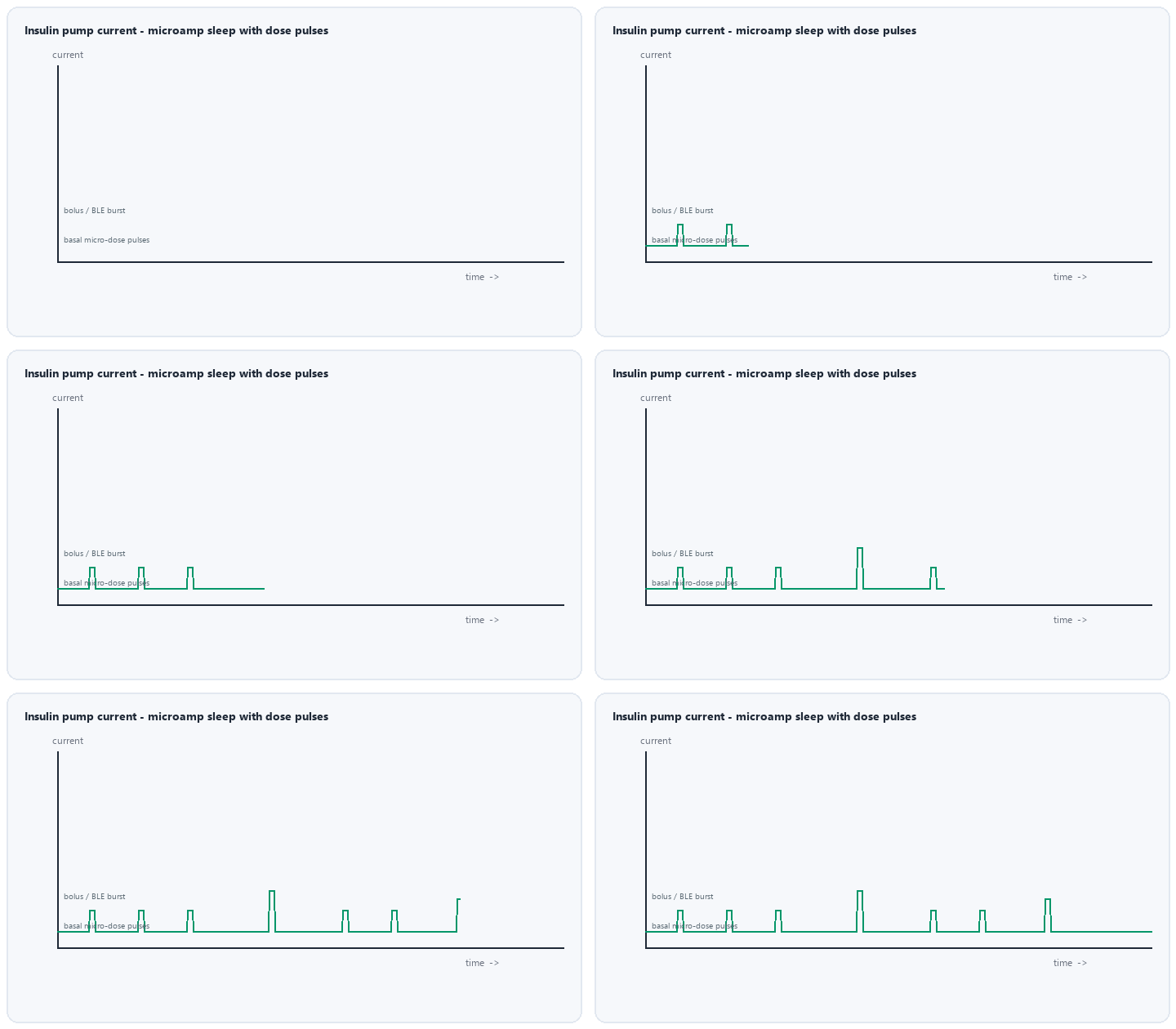
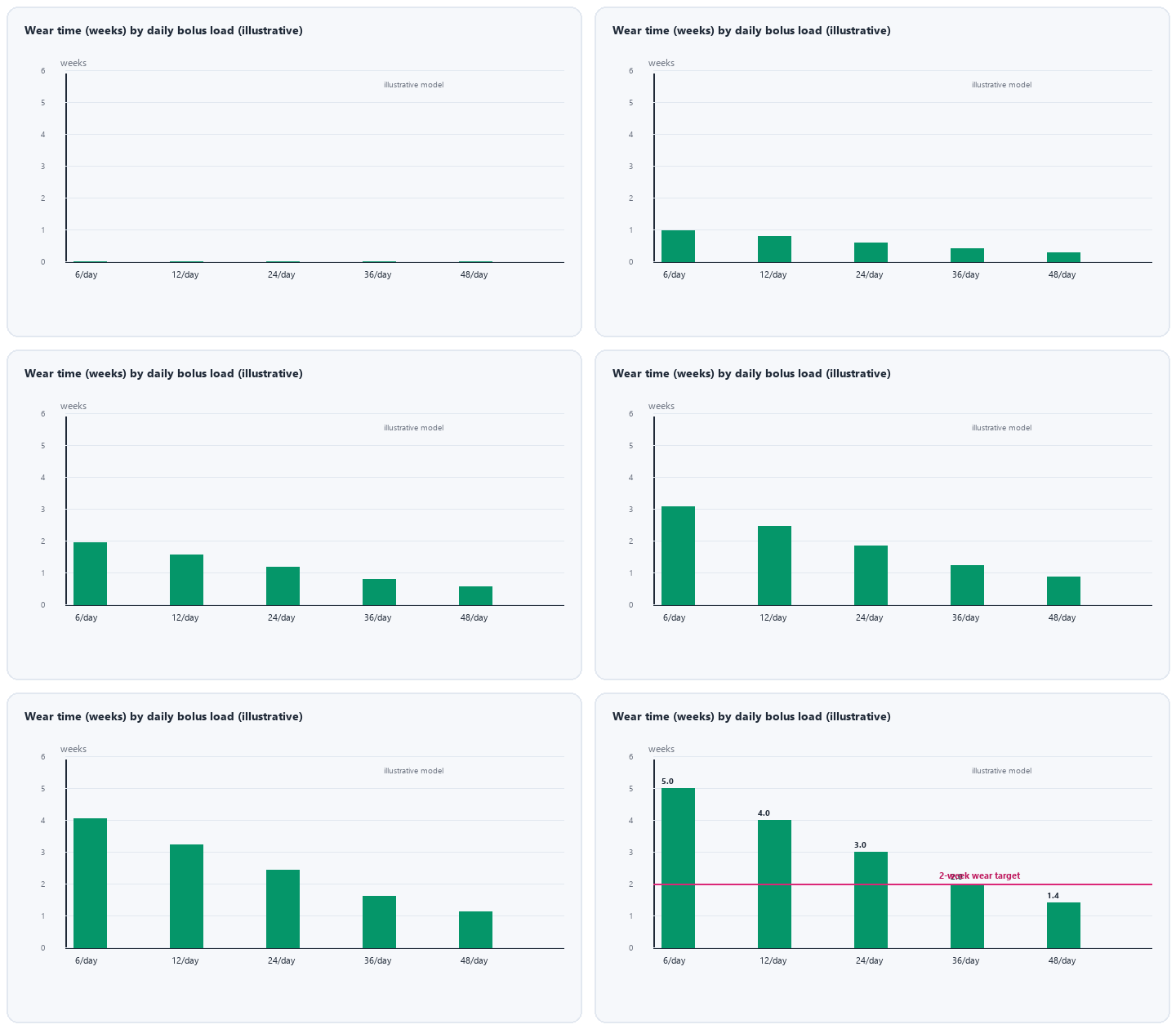
Commercial insulin pumps quote battery life of one to four weeks depending on cell choice (disposable primary lithium, alkaline or a rechargeable cell), daily insulin volume and wireless use. Every basal pulse and every bolus consumes a small, countable energy quantum, so runtime can be modelled directly from doses per day — an unusually predictable load that rewards careful nanoamp-level housekeeping. The model must also include BLE connection events, CGM-driven closed-loop decisions (which increase radio and MCU duty), alarm events and display wake-ups, all of which vary strongly between user profiles.
Infusion pumps and controllers, including pumps for ambulatory use, fall under IEC 60601-2-24 (second edition 2012), whose test methodology — basal testing and bolus testing — is used to verify delivery accuracy in independent insulin-pump studies. Wearable pumps additionally carry high ingress protection: recent 510(k) filings cite IP28, tolerating prolonged immersion (one device to 3.7 m for an hour), and software is developed to IEC 62304. The battery must sustain dose accuracy through its full life and give reliable low-battery warning well before therapy is at risk — a missed basal dose is a clinical event.
Many tubed pumps use disposable AA/AAA cells chosen for shelf life; patch pumps increasingly integrate rechargeable lithium. Rechargeable NiMH AAA/AA cells occupy a defensible niche in cost-sensitive ambulatory pumps and reusable controllers: flat voltage, high pulse current relative to their size, no heavy-metal cadmium, intrinsic aqueous safety against skin, and tolerance of shallow daily top-ups, with low-self-discharge variants holding readiness between uses. Paper B builds the micro-energy budget and compares chemistries; Paper C covers IEC 60601-2-24 accuracy validation and body-worn safety.
Weijiang Power supplies matched NiMH AAA/AA cells and tiny custom packs for wearable and ambulatory medical OEMs: low internal resistance for actuator pulses, low-self-discharge grades for long wear time and IEC 62133-1/UN 38.3 documentation. Send your basal/bolus current trace, radio duty and target wear time and we will size a cell strategy that protects dose delivery.


