A lifeboat is the most regulated piece of machinery a merchant ship carries, because it may be the only thing between a crew and the sea in the worst minutes of their lives. This paper explains the working principle and power duty of the electrical systems that launch and sustain lifeboats, rescue boats and their life-saving appliances under SOLAS Chapter III and the International Life-Saving Appliance (LSA) Code. Its centrepiece is the engine-starting requirement: a lifeboat or rescue boat engine must be provided with either a manual starting system or a power starting system fitted with two independent rechargeable energy sources, together with any necessary starting aids, and the starting systems and aids must be capable of starting the engine at an ambient temperature of -15 degrees C within two minutes of commencing the start procedure, unless the administration accepts a different temperature for the ship's trade. The two-source rule is deliberately redundant - a single failed battery must never leave a lifeboat unable to launch - and it creates a natural role for robust, sealed, cold-capable rechargeable packs. Around the starting system sit the boat's searchlight, navigation and interior lights, controls and warnings, the on-load/off-load release gear indications, and the position-indicating lights on lifebuoys and lifejackets, governed by the LSA Code and tested under the revised recommendation on testing of life-saving appliances, IMO resolution MSC.81(70), with EU type approval under the Marine Equipment Directive. SOLAS also requires the lifeboat engine to be run weekly for not less than three minutes and the boat turned out where possible. The paper develops the characteristic battery duty - very long stowage in davits exposed to heat, cold and salt, followed by an absolute requirement for instant high-current cranking - and is careful to distinguish rechargeable engine-start and onboard systems from the mandated primary batteries in survivor lights and survival-craft radios, showing where sealed nickel-metal hydride can serve and where it cannot.
SOLAS Chapter III and the mandatory LSA Code set out what lifeboats, rescue boats and personal life-saving appliances must do, and IMO resolution MSC.81(70) (the revised recommendation on testing of life-saving appliances, periodically amended) defines how they are tested, with standardized evaluation and test report forms. In the EU, life-saving appliances are type-approved under the Marine Equipment Directive and carry the wheel mark against the applicable MED standards.
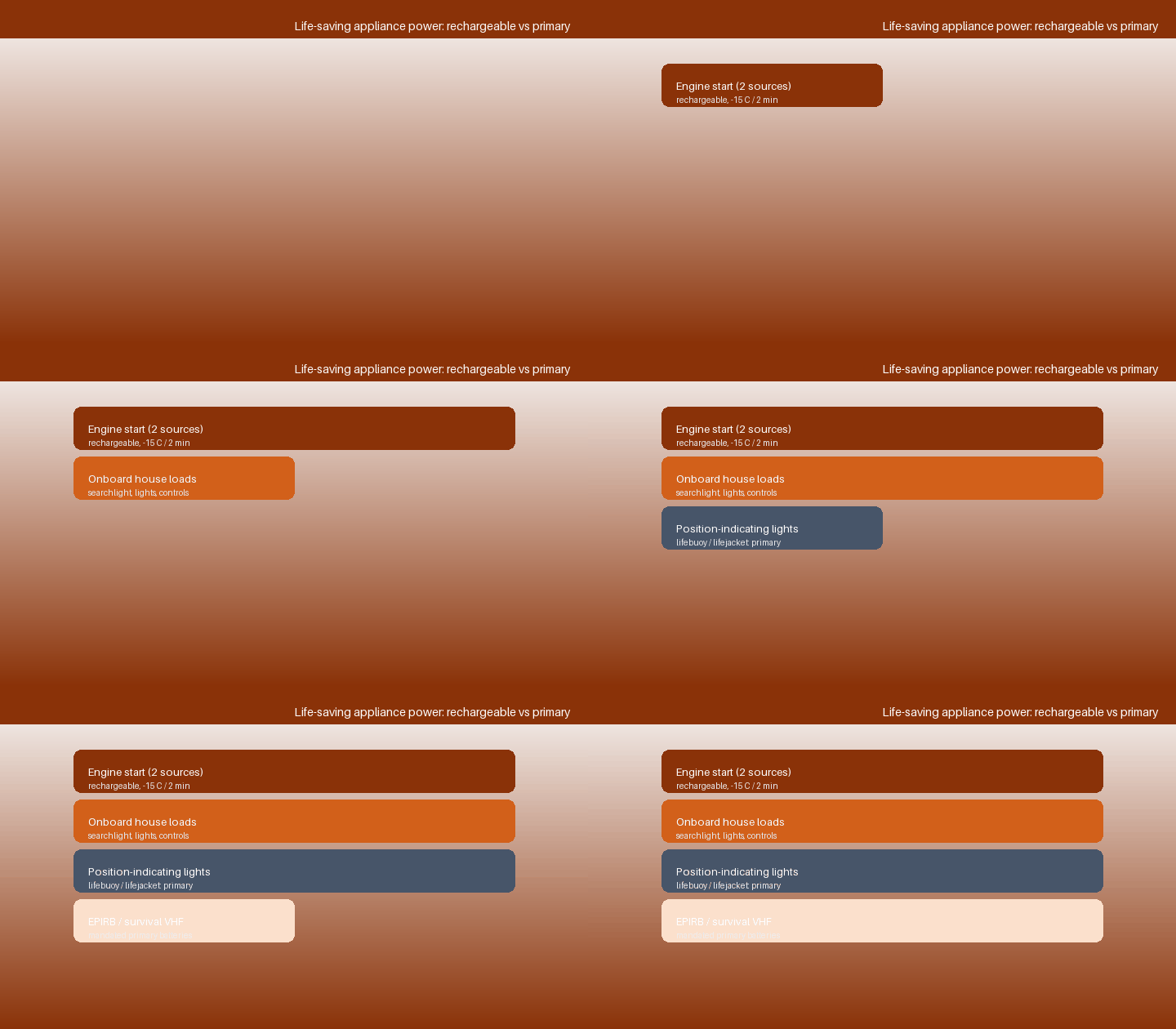
For electrical power the critical clauses concern engine starting, the boat's onboard lights and searchlight, and the position-indicating lights on lifebuoys and lifejackets. The first animated figure maps the life-saving appliance power family and which items are rechargeable versus primary-battery. Understanding this map prevents the common error of treating every life-saving battery as interchangeable.
LSA Code requirements for lifeboat and rescue boat engines allow either a manual starting system or a power starting system with two independent rechargeable energy sources, with necessary starting aids. The intent is redundancy: each source must be capable of starting the engine, and the systems must not be impeded by the engine casing, thwarts or other obstructions. In practice this means two battery setups (or a battery plus a separate hydraulic/pneumatic/other rechargeable source), with the electrical architecture arranged so a fault in one does not disable the other.
This is the primary legitimate role for high-performance rechargeable cells in life-saving appliances: paired, independent, sealed starting packs kept charged from the ship through the davit-mounted charging contacts, each able to crank the diesel. Sealed nickel-metal hydride is relevant because it delivers high pulse current, tolerates the shallow reserve duty (the batteries are almost never deeply discharged), holds charge during long stowage in low-self-discharge form, contains no acid to spill in an enclosed lifeboat, and resists cold better than lead-acid.
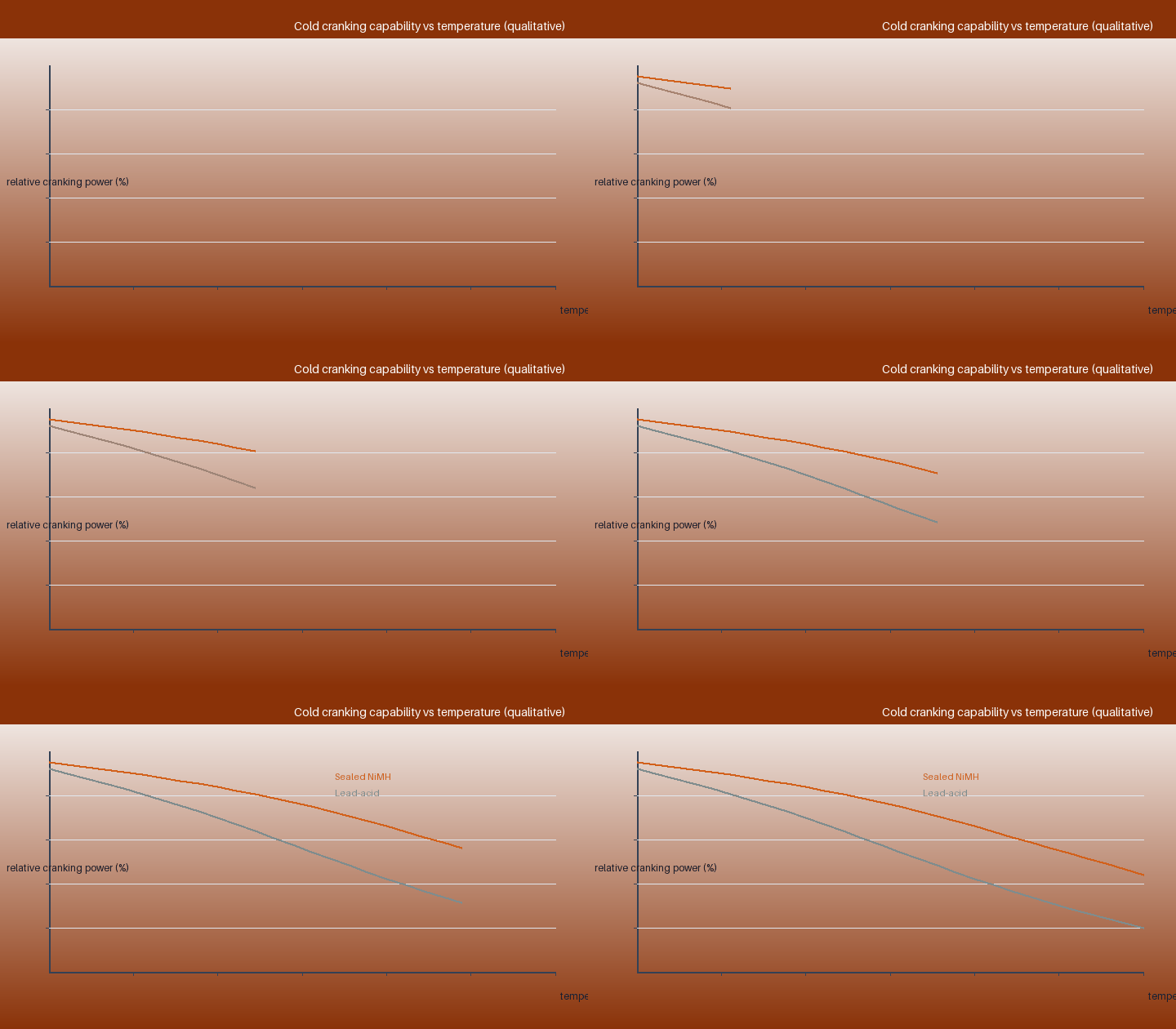
The most demanding quantitative requirement is environmental: starting systems and aids must start the engine at -15 degrees C within two minutes of beginning the procedure (some national implementations, such as the historic UK regulations, state this verbatim; the US requires starting without aids at a defined cold temperature and fuel for 24 hours at six knots). Cold weakens batteries sharply - industry maintenance guidance reports substantial loss of cranking capability in freezing conditions, which is precisely why lead-acid lifeboat batteries are a recurring source of failed weekly tests.
The second animated figure compares cold cranking capability qualitatively across chemistries. Sizing a sealed NiMH starting pack uses the engine's cold cranking current and cranking duration for the two-minute procedure (including glow-plug or decompression starting aids where fitted), derated at -15 C and after the service interval, with enough voltage to keep the engine controller and starter engaged. Two independent packs each meeting this requirement satisfy the redundancy rule with margin.
A lifeboat carries electrical loads beyond the starter: the searchlight used for recovering persons and signalling (with its own regulated luminous range and runtime), navigation and interior lights, engine instruments and alarms, the protected-launch and release-system indications, and often a sprinkler or air-system monitoring on specialised boats. These draw a modest house load during a launch and survival period, historically fed from the same lead-acid bank that starts the engine.
Separating or supplementing the house load with a sealed NiMH service pack protects cranking capacity - a best-practice architecture that ensures lighting and controls cannot flatten the starting battery - and the sealed chemistry suits the enclosed, crewed space where acid spill and gas evolution are undesirable. The pack is recharged from the engine alternator during the weekly run and from shore/davit charging while stowed.
Lifebuoy self-igniting lights, lifejacket lights and other position-indicating lights are governed by specific LSA Code clauses (for example lifejacket light intensity and duration) and tested under MSC.81(70) clause 10.4; in the EU their MED/1.2b type approval expressly applies the MSC.81(70) tests rather than the full EMC suite of EN/IEC 60945. Because these appliances must survive years of stowage and work instantly with no charging infrastructure, they use long-life primary batteries (commonly lithium), as do EPIRBs and the survival-craft two-way VHF radios covered in the marine-reserve paper.
Sealed rechargeable NiMH therefore does not replace the mandated primary cells in disposable survivor lights or EPIRBs - their multi-year zero-maintenance standby is a primary-battery function. It serves instead the systems that are routinely recharged as part of the boat's equipment: the two independent engine-start sources and the onboard house loads, which are maintained and tested weekly. Keeping this boundary clear is essential for type approval and survey compliance.
Lifeboats stow in davits or free-fall capsules exposed for years to sun, freeze, salt spray, vibration from the host ship and humidity, yet must work on the first attempt. SOLAS III/20 and the LSA Code require weekly visual and operational checks including running the engine for at least three minutes (with due regard to cooling and exhaust), monthly inspections and periodic servicing by certified personnel; battery condition and charging contacts are among the most common findings because flooded lead-acid packs corrode, lose charge and suffer in temperature extremes.
Sealed, low-self-discharge NiMH starting and service packs directly attack this failure mode: no electrolyte to evaporate or top up, minimal corrosion and gas, high charge retention between weekly runs, and cold cranking that survives winter. The next paper sizes the dual-source architecture and compares chemistries; the third maps the MSC.81(70), MED and battery-standard qualification and the through-life test regime.
Weijiang Power designs and manufactures sealed nickel-metal hydride cells and matched industrial packs for remote, off-grid and safety-related equipment, and supports OEM partners with IEC 61951-2 performance files, IEC 62133-1 safety evidence, pulse-load characterisation, wide-temperature testing and charger/pack co-validation. Tell us your duty cycle, peak current, temperature envelope, autonomy target and the standards your product must meet, and our engineers will specify a cell-and-pack combination that protects runtime, reliability and service life. Review the range on the products page.


