When a process plant loses power, a great many valves must move to a defined safe position - fail closed to stop feed into a reactor, fail open to vent a line, fail to last position to hold a delicate separation. Delivering that motion without mains power is the job of a fail-safe actuator, and the engineering question is fundamentally an energy-storage question: where does the energy for that decisive stroke come from, and is it guaranteed to be there years after commissioning? There are three established answers - a mechanical spring armed during normal operation, an electrical storage element such as a supercapacitor, or a rechargeable battery pack - and leading products illustrate all three, from constant-force spring units rated to high safety integrity levels to electro-hydraulic and battery-backup actuators. This first paper dissects the load profile of driving a valve to safety, quantifies the torque and stroke energy involved, explains the multi-stroke-then-sleep behaviour of modern electric fail-safe actuators, and places sealed nickel-metal hydride backup honestly beside springs and supercapacitors within the IEC 61508 functional-safety framework that governs the whole decision.
A fail-safe actuator must, on loss of its normal supply, deliver enough controlled torque to move the valve through its full stroke to the safe position, hold or seat it correctly, and do so after years of standby during which the reserve energy may never have been called upon. The required energy is the integral of torque over the stem's travel - break torque to unseat, running torque through the stroke, and seat torque to close against the process - expressed against the valve's torque rating in newton-metres, plus the losses of the motor and geartrain.
Crucially, the reserve must be provably available at end of life, at the minimum rated temperature (where lubricants thicken and battery impedance rises), and after long periods of inactivity. That 'always ready, rarely used' requirement is the defining challenge of fail-safe energy storage and the reason each of the three technologies has a distinct niche.
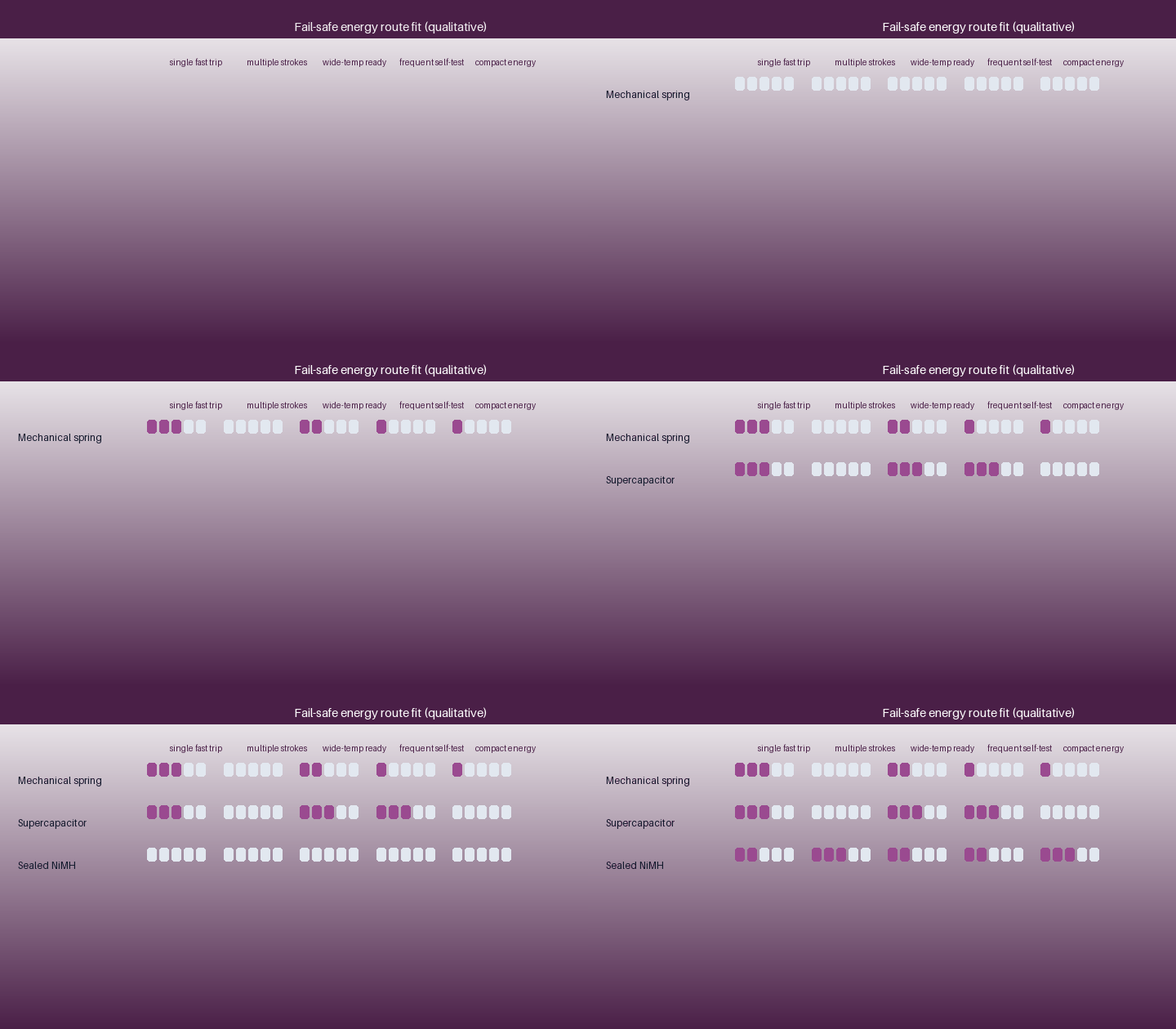
The classical solution stores mechanical energy in a spring charged by the electric motor during normal operation; on power loss a solenoid or mechanical latch releases and the spring drives the valve to safety in a single, fast stroke. Products such as the AUMA FQM/FQMEx fail-safe units use a constant-force spring and are offered in versions suitable for high safety-integrity applications (up to SIL 3), while the Emerson Bettis RTS FQ performs its fail-safe action by mechanical spring without depending on a capacitor or battery at all.
The spring's strengths are independence from electrical storage chemistry and a self-contained action that is comparatively easy to bring to a high integrity level; its costs are a single non-adjustable stroke, the mechanical effort and wear of the spring mechanism, added size, and the need to re-arm electrically before operation can resume. A spring is superb for one decisive fail motion but cannot easily perform several controlled repositionings or extended sequences.
Electrochemical double-layer capacitors store the fail-safe energy electrically and release it at high power with essentially unlimited cycle life and wide-temperature operation, charging quickly whenever mains is present and tolerating the frequent self-test cycles a modern actuator runs. They are attractive where the actuator performs a short, high-power stroke and where proof-testing cycles the reserve often.
Their limitation is energy: supercapacitors hold far less energy per unit volume and euro than a battery and their self-discharge means they must be continuously topped up, so they suit seconds-to-a-minute fail actions rather than sequences lasting many minutes or multiple full strokes. They also require management of their cell-voltage balance over a long service life. For a single quick trip they are excellent; for richer fail-safe behaviour they run out of energy.
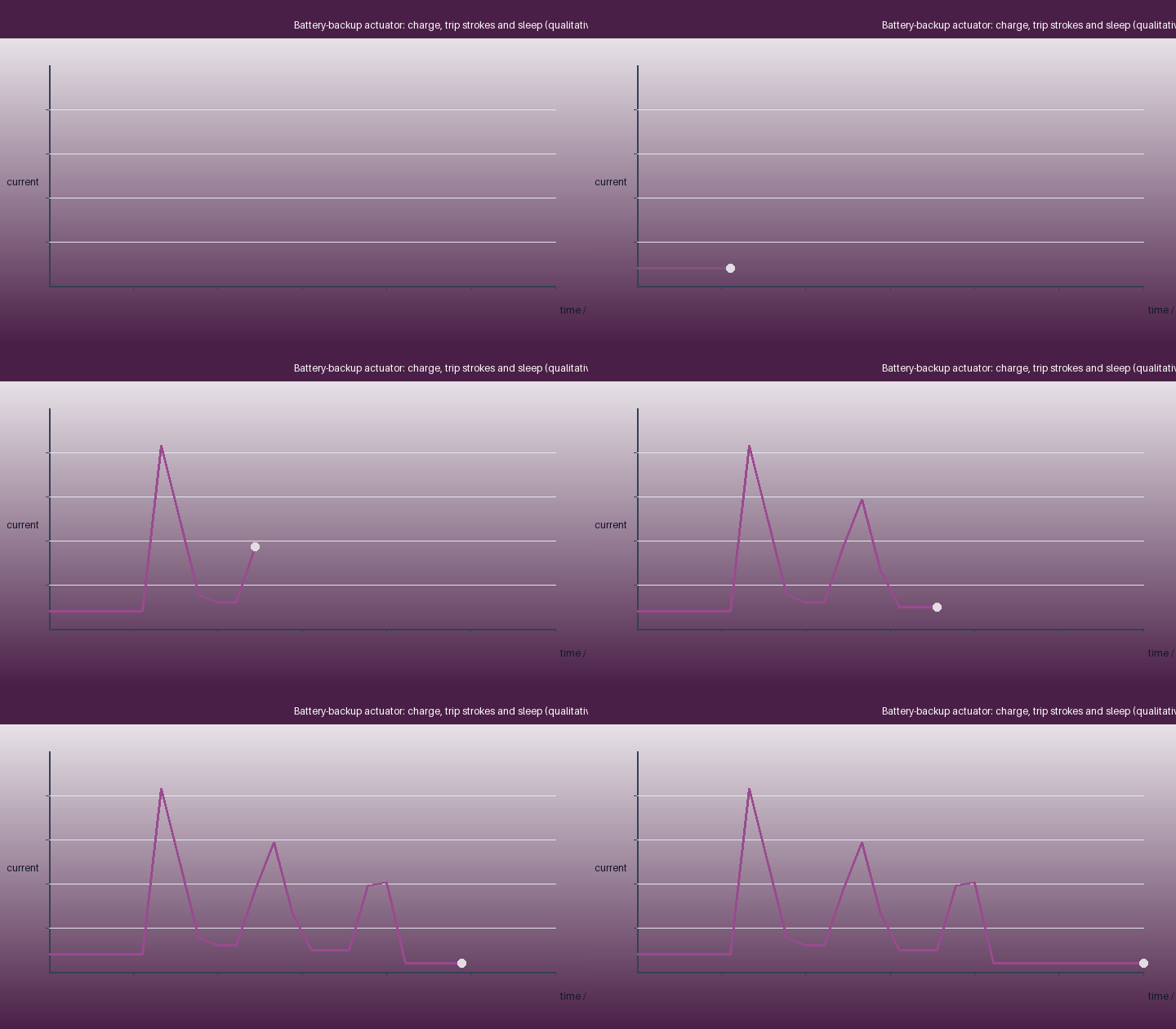
The third route keeps a rechargeable battery floating on charge during normal operation and uses it to power the actuator's motor and controls when mains is lost. Real products show the behaviour this enables: some electric actuators on backup can position the valve several times - performing not just one trip but a sequence of moves - and then enter a power-conserving mode, automatically returning to normal operation when the supply is restored; the auxiliary supply that keeps such an electro-hydraulic fail-safe unit healthy is itself tightly bounded (a documented limit near 7.5 W in a leading range).
This is where sealed NiMH is a strong candidate: compared with a spring it enables multiple, controllable strokes and simpler mechanics at lower cost; compared with a supercapacitor it stores far more energy in a compact pack for extended sequences; and compared with lithium it is more cold-tolerant for charging, simpler to manage and non-lithium to transport. The first animated figure contrasts the energy-versus-power character of the three routes; the second traces a battery-backup actuator's current through charge, mains-loss, multi-stroke and sleep.
Functional-safety practice under IEC 61508 requires that a safety function be periodically proof-tested to reveal dangerous hidden failures, and a fail-safe actuator's reserve is exactly such a hidden element - it can fail silently while standing by. Smart actuators therefore run automatic partial-stroke tests and monitor their reserve's state of health, reporting a diagnostic warning if the stored energy falls below the trip requirement.
The reserve technology shapes this burden: a spring's mechanics are monitored for torque and latch health; a supercapacitor reports capacitance and equivalent resistance; a battery pack reports voltage, internal resistance and capacity trend. NiMH's predictable capacity fade and flat discharge make its state-of-health relatively easy to trend, and its tolerance of frequent top-ups supports the continuous-readiness and self-test regime without the cold-charging restrictions of lithium. Good diagnostics convert the reserve from an unknown into a monitored safety element - central to claiming an integrity level.
The analysis produces a layered specification: the measured stroke energy (break, running and seat torque through the geartrain), the number and nature of strokes required on loss (single trip versus a controlled multi-step sequence), the required hold time and sleep behaviour, guaranteed availability at end of life and minimum temperature, a continuous-readiness charge regime, state-of-health diagnostics supporting the IEC 61508 proof-test interval, and the environmental enclosure (valve actuators commonly reach IP68).
The next paper turns these requirements into a concrete NiMH backup design - sizing cells to stroke energy and number of strokes, the charge and monitoring architecture, the hybrid combination with a small capacitor for the motor inrush, and the candid trade-off against spring and supercapacitor solutions. The third paper then maps IEC 61508 and the actuator product standard EN 15714, enclosure and environmental qualification, and the IEC 61951-2, IEC 62133-2 and UN 38.3 battery evidence that turns a battery reserve into a certifiable safety function.
Weijiang Power designs and manufactures sealed nickel-metal hydride cells and matched industrial packs for remote, off-grid and safety-related equipment, and supports OEM partners with IEC 61951-2 performance files, IEC 62133-2 safety evidence, pulse-load characterisation, wide-temperature testing and charger/pack co-validation. Tell us your duty cycle, peak current, temperature envelope, autonomy target and the standards your product must meet, and our engineers will specify a cell-and-pack combination that protects runtime, reliability and service life. Review the range on the products page.


