An access-control backup sits at the intersection of security and life safety, and its certification evidence has to satisfy both instincts at once: prove that the doors stay controlled through a power loss, and prove that they nevertheless release for evacuation on a fire signal. Paper C assembles that evidence trail - the system-level expectations of EN 50133-1, the standby and endurance tests of UL 294, the fail-safe release verification demanded by the egress codes, and the cell-level IEC 61951-2, IEC 62133-1 and UN 38.3 documentation underneath - and shows how a NiMH supplier can make an access product's listing a matter of well-organised proof.
EN 50133-1 establishes access-control security levels and the functional behaviour expected of the system, including how it maintains its function and controls its outputs under adverse conditions; where access is integrated with intrusion detection, the EN 50131 family and its power-supply part, EN 50131-6, apply alongside it. UL 294 is the North American product-safety standard for access-control system units and is structured around performance levels: it tests destructiveness (attack resistance), standby power, endurance (operating cycles) and line security, with the required performance rising by level.
The practical consequence for the battery is that the listing is level-specific. A unit listed to a given UL 294 level must demonstrate that level's standby duration on its backup - the widely used Level II figure is a minimum of four hours - and its endurance cycle count. The battery cannot be an after-market substitution; it is part of the listed configuration, which is why a stable, documented pack design matters.
The standby test disconnects mains power and requires the unit to sustain its full connected load - every held lock, reader and controller - for the level's minimum period while continuing to grant and deny credentials correctly. Because fail-safe maglocks draw continuously, this test is far more demanding of capacity than an alarm-panel equivalent. The endurance test cycles the hardware through its rated number of door operations, each one a small discharge event as a lock releases and re-energises, and the battery must support the unit's behaviour throughout.
For the NiMH supplier this calls for delivered-capacity data at the continuous lock current, not just at a reference discharge, and for cycle-life evidence that maps onto years of daily door operations. IEC 61951-2 supplies the reference endurance regime - at least 500 cycles under its prescribed method - which the designer then relates to the much shallower, far more numerous release cycles of a real door.
The most safety-critical test is not a battery-duration test at all: it is the verification that locked egress doors release when they must. On a fire-alarm signal - and, depending on the code, on loss of the fire-interface path - the control circuit must interrupt maglock power whether the system is running on mains or on backup, while independent REX sensors and panic hardware remain functional. The test demonstrates that a fully charged backup cannot defeat the fire release, and that a backup carrying the doors through a plain outage still yields unconditionally to the evacuation signal.
This is the answer to the obvious concern that a battery holding a fail-safe lock could trap occupants: the battery is deliberately placed downstream of, and subordinate to, the fire-release control. NiMH's stable rail keeps doors controlled during a normal outage; the supervised fire interface guarantees the rail is broken for egress. Both behaviours are demonstrated, not assumed, during listing and commissioning.
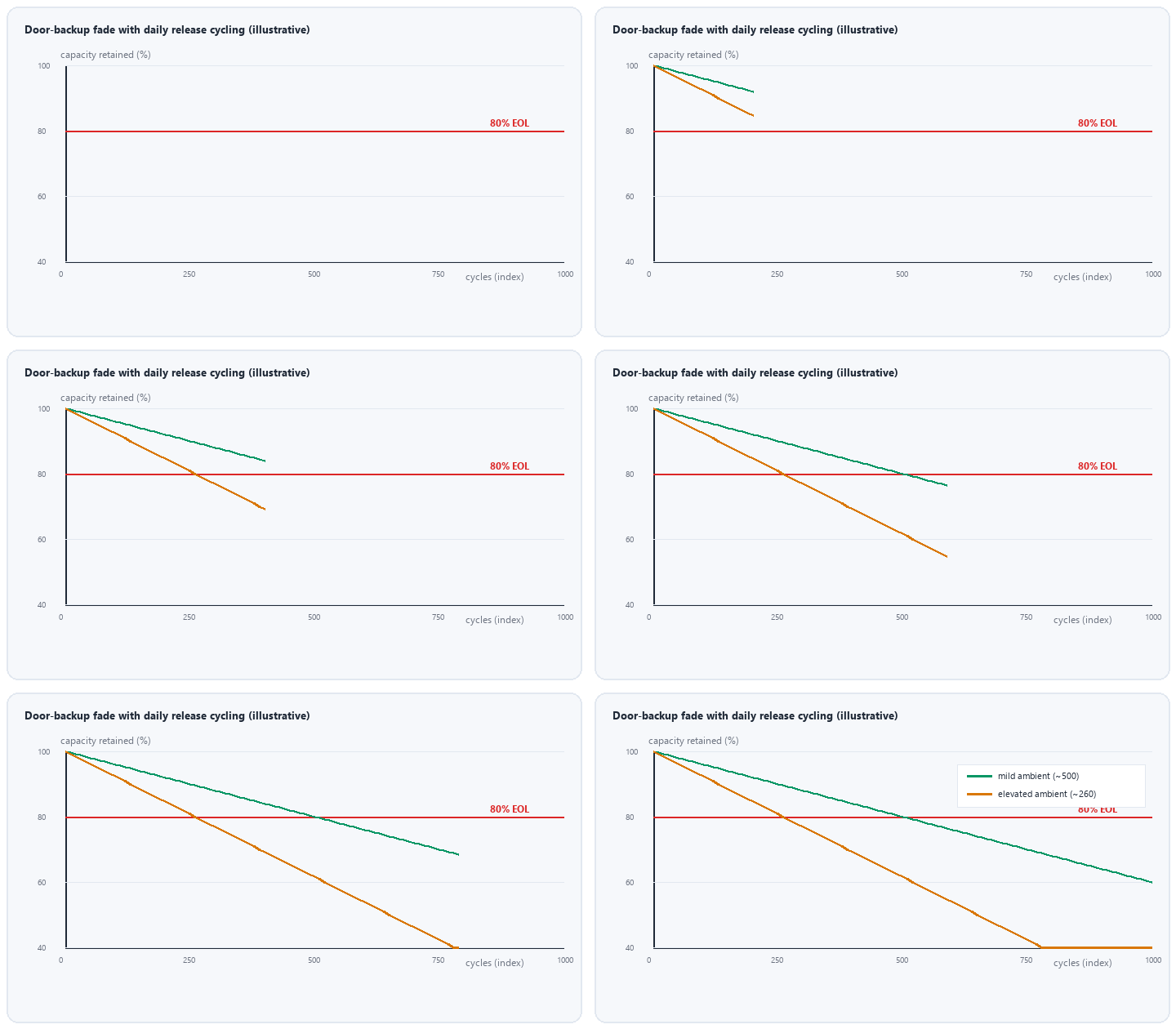
Below the product listing sits the cell-performance standard IEC 61951-2, which defines standard charge and discharge, charge retention, endurance cycling, overcharge and long-term charge behaviour for sealed NiMH. The animated fade curve illustrates the engineering reality these tests quantify: usable capacity declines gradually with calendar life and cycling, and more quickly in a warm cabinet. For a door that is released dozens of times a day for a decade, the endurance and charge-retention data - combined with the Paper B derating margin - are what make the four-hour (or longer) standby promise survive to end of life.
A credible supplier provides the reference test reports and, more usefully, delivered-capacity curves at the actual continuous current and across the cabinet's temperature range, so the access manufacturer can predict the UL 294 standby test result rather than merely hope for it.
Sealed-nickel safety is established by IEC 62133-1, covering continuous charging, external short circuit, forced discharge and the mechanical and thermal abuse cases appropriate to NiMH. The aqueous chemistry's forgiving failure mode - venting rather than thermal propagation - keeps the safety case straightforward, with sensible fusing and insulation at pack level. As across the nickel family, NiMH is not subject to the lithium-battery transport restrictions: with a UN 38.3 test summary and a chemistry declaration, packs ship by air and parcel without lithium-specific limitations, a real advantage for a product distributed in small quantities to many installers.
Together these layers mean the access OEM receives a pack that is performance-characterised, safety-proven and shippable, rather than a generic cell whose evidence has to be reconstructed at listing time.
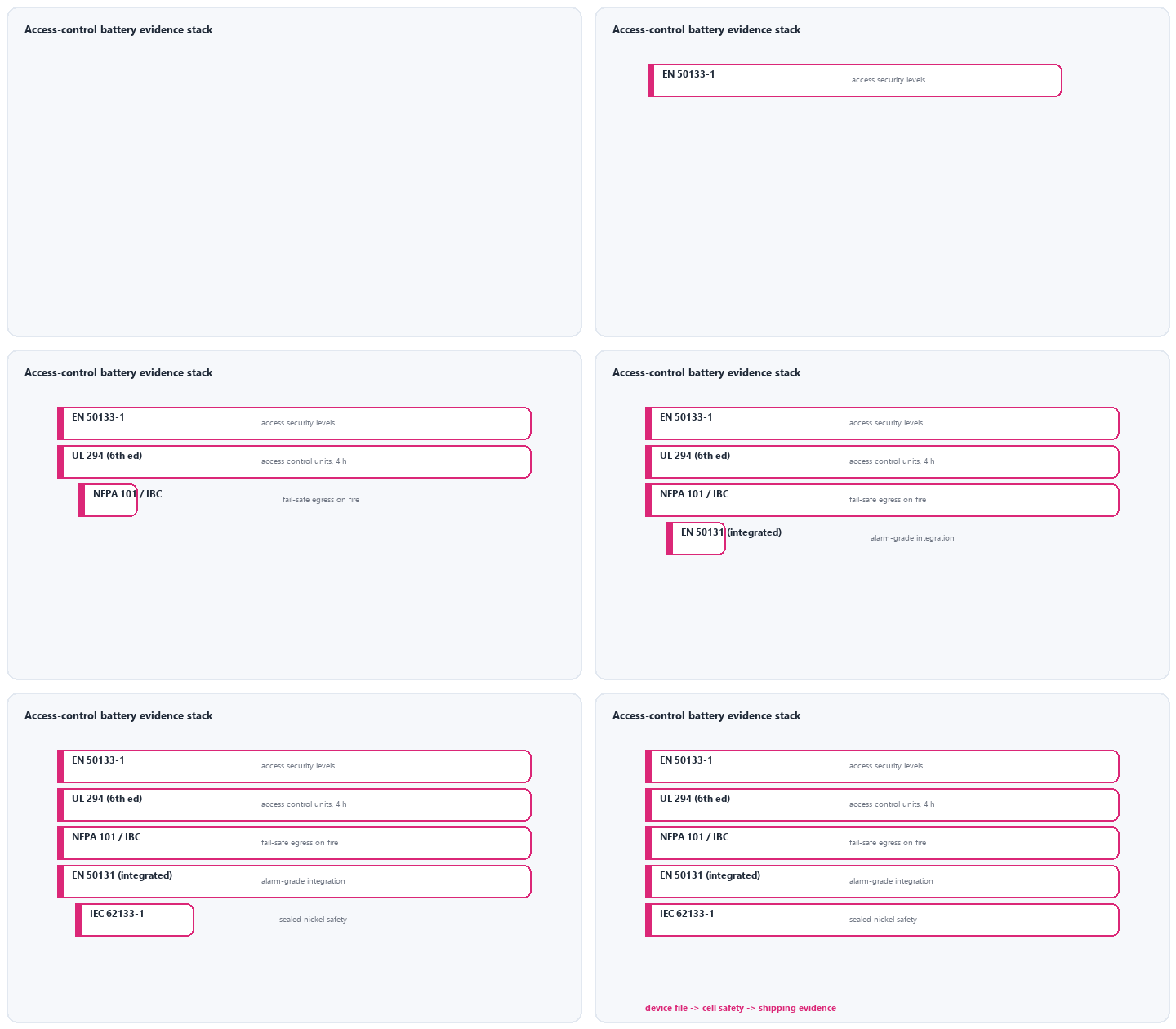
Assembled in order, the evidence trail is clean: EN 50133-1 (and, where integrated, EN 50131) fixes the security level; UL 294 drives the level-specific standby and endurance tests; the egress codes and the fire-interface test prove the unconditional fail-safe release; IEC 61951-2 characterises capacity, endurance and charge behaviour; IEC 62133-1 proves sealed-nickel safety; and UN 38.3 plus the chemistry declaration clear the product for shipping. A NiMH pack supplier that fronts this documentation lets the access manufacturer list a coherent configuration, predict its standby result, and defend the security-versus-egress balance to an inspector or authority having jurisdiction.
Papers A through C together cover the duty, the sizing and the certification of nickel-metal hydride backup in access-control and door-entry systems - the complete case for a door that remains controlled through an outage and opens, without exception, when lives depend on it.
Weijiang Power supplies listed-configuration NiMH packs for access-control OEMs: matched 12/24 V strings with delivered-capacity data at continuous lock current, IEC 61951-2 endurance and charge-retention reports, IEC 62133-1 sealed-nickel safety evidence, UN 38.3 summaries and not-subject-to-lithium-restrictions shipping declarations. Tell us your UL 294 target level, door schedule and fail-safe release architecture and we will assemble the cell evidence your listing needs.


