Designing the battery for an intrinsically-safe mining portable is an exercise in bounding energy rather than maximising it, and the rules in IEC 60079-11 for cells and batteries are among the most prescriptive in the whole standard. This second paper develops a sealed nickel-metal hydride pack for a cap lamp and personal methane detector that must be certified Ex ia I Ma. It works through the standard's battery requirements - the use of recognised cell types, the control of maximum voltage and prospective short-circuit current, series protection against cell faults, and the prohibition of sparking during connection or exchange in the hazardous area - and translates them into a concrete pack: matched cells, an infallible series fuse and current-limiting or blocking devices sized against the methane ignition curves, encapsulation or a sealed carrier that prevents accidental shorting and electrolyte escape, protection against reverse charging of individual cells, and a mechanical design that survives the mine. It then sizes capacity for the eleven-hour shift with a guaranteed alarm reserve, specifies the charger - which, like most charging, happens only outside the hazardous area - and places NiMH candidly beside its competitors: the lead-acid blocks of older cap lamps, heavy and acid-bearing, and lithium chemistries, energy-dense but subjected to a far more demanding intrinsic-safety and thermal-runaway assessment. The paper is deliberately honest about where lithium wins and why, for many Group I body-worn devices, the lower per-cell voltage, robust abuse behaviour and simpler safety case of sealed NiMH make it a defensible, certification-friendly choice.
IEC 60079-11 constrains batteries tightly: only cells and batteries of a type covered by recognised specifications may be used; the maximum open-circuit voltage determines the intrinsic-safety curves against which the rest of the circuit is assessed; and the prospective short-circuit current must be limited so that a dead short across the pack terminals cannot produce an incendive spark. Rechargeable packs additionally require measures against the reverse charging of any cell on discharge and against cells being paralleled in ways that allow uncontrolled current exchange.
The standard also governs how a battery is connected and exchanged: a connector that could be separated in the hazardous area must itself be non-incendive, and in the highest-protection designs the pack is fixed and encapsulated, openable only in a safe area. These clauses define the pack architecture before any capacity calculation begins.

Intrinsic-safety design starts from the battery's worst-case output and works outward. Series cells set the maximum voltage; for NiMH, a nominal 1.2 V per cell means a modest pack voltage for a cap lamp or detector, which keeps the design on the favourable part of the Group I ignition curves. An infallible series fuse, often duplicated or combined with a current-limiting resistor or blocking device, caps the prospective short-circuit current below the incendive threshold even with one fault, and any capacitance or inductance in the pack and wiring is kept below the permitted stored-energy limits.
These protection components must themselves meet the standard's infallibility requirements - rated for the fault current, separated and, where needed, encapsulated so a single failure cannot defeat them. The first animated figure steps through this design flow from cell selection to the validated fault-energy budget; the analysis is always performed at the freshly charged, maximum-voltage condition, which is the worst case for spark ignition.
Mining portables are potted or sealed so that internal connections cannot be touched, shorted by debris or shaken loose, and so that in the rare event of cell venting no electrolyte reaches the user or a conductive path. Encapsulation under the relevant construction requirements locks cells, fuse and limiting elements into one evaluated assembly; any change to a cell supplier or layout then requires a documented assessment against the certificate.
Cell-reversal protection is essential for series NiMH strings: if one cell is exhausted before the others the remaining string can drive it into reverse, so matched, lot-consistent cells, conservative end-of-discharge cut-off and, where the standard requires, bypass or blocking elements prevent it. Mechanically the pack survives crush, drop and the thermal cycling of a body-worn device, with a keyed, latching interface that cannot be mis-assembled in the dark of a lamp room.
Capacity is sized from the measured LED and sensor load profile to exceed the certified runtime - eleven hours with main beam above the required illumination floor in a cap lamp, continuous sensing with reliable alarms in a detector - with deratings for low mine temperature, self-discharge between charges and end-of-life capacity after the rated cycle count (certified lamps target beyond 500 cycles and a sub-ten-hour recharge). A separate alarm reserve guarantees the methane alarm and low-battery warning remain available after the operator is instructed to recharge.
Because the charger operates in the lamp room outside the hazardous area, NiMH can use a straightforward, supervised charge profile - controlled current with -delta-V or peak termination, temperature and timer backstops - without the constraint of charging in a firedamp zone, and the fleet charger can log capacity and internal-resistance trends to retire packs before their runtime falls below the certified floor.
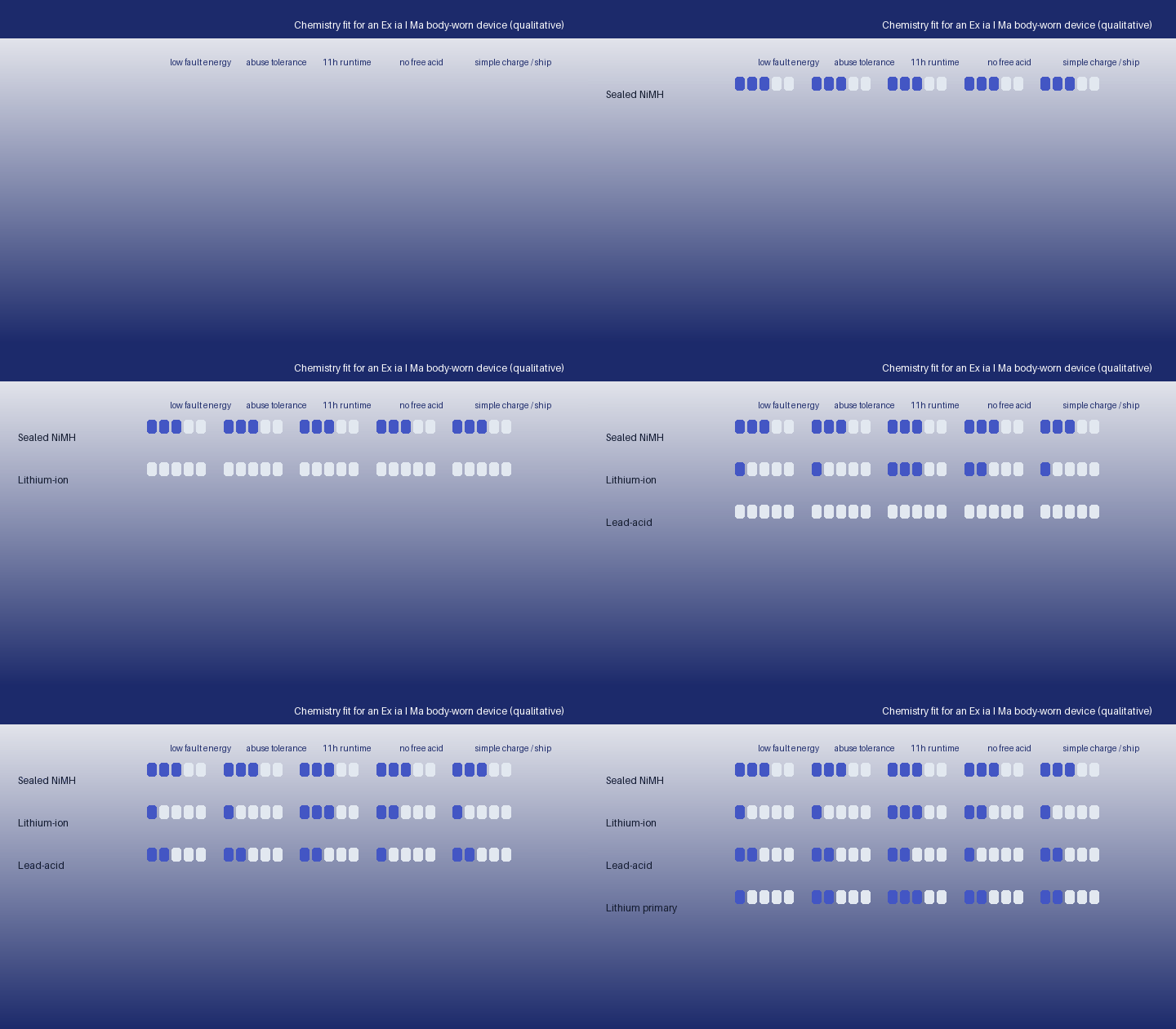
Lead-acid is the historic cap-lamp chemistry: cheap and forgiving, but heavy for a head-worn device, acid-bearing, cold-weak and relatively short-lived, which conflicts with ergonomic and sealed-design goals. Lithium-ion and lithium primary cells offer the highest energy density and longest runtime per gram, but their intrinsic-safety case is substantially harder: high per-cell voltage moves the design up the ignition curves, and the assessor must also address internal cell faults and thermal propagation with additional protection, redundancy and sometimes a lower equipment protection confidence - a serious burden for an Ex ia Ma life-safety device.
Sealed NiMH sits at a pragmatic middle point: its 1.2 V per cell and limited prospective fault current ease the energy-limitation design, it contains no free acid, it tolerates mine-temperature cycling and shallow daily use, it is mechanically robust, and it ships under non-lithium transport rules. The second animated figure scores the chemistries on the axes that matter for Group I portables; lithium remains justified where minimum weight is paramount and the extra safety engineering is accepted, while NiMH is frequently the faster-to-certify, more abuse-tolerant and lower-lifecycle-risk choice for a fleet of cap lamps and detectors.
Before certification the pack is validated on the bench against the real lamp-and-sensor load at temperature and at end of life; the fuse and limiting elements are tested by deliberate fault application to confirm short-circuit current and spark energy stay below the Group I thresholds; cell-reversal and deep-discharge tests confirm the protection; and drop, vibration and thermal cycling verify the encapsulation and connections. Runtime is measured against the eleven-hour illumination and alarm-reserve requirements rather than cell datasheet capacity.
The output is a characterised, construction-controlled pack with a documented fault-energy budget, runtime-versus-temperature curve and certified bill of materials - the exact artefact the IECEx/ATEX type-test campaign in the final paper requires, and the basis on which an OEM can specify NiMH with confidence inside an Ex ia I Ma instrument.
Weijiang Power designs and manufactures sealed nickel-metal hydride cells and matched industrial packs for remote, off-grid and safety-related equipment, and supports OEM partners with IEC 61951-2 performance files, IEC 62133-2 safety evidence, pulse-load characterisation, wide-temperature testing and charger/pack co-validation. Tell us your duty cycle, peak current, temperature envelope, autonomy target and the standards your product must meet, and our engineers will specify a cell-and-pack combination that protects runtime, reliability and service life. Review the range on the products page.


