Once an infusion pump's load profile is understood, the next decision is electrochemical: which chemistry, how many cells, in what arrangement, charged and protected how. This second paper compares nickel-metal hydride against lithium-ion and primary cells with quantitative criteria, walks through a worked pack-sizing example using real infusion-pack voltages, and explains the cell-matching, charging and thermal details that separate a medical-grade pack from a bundle of catalogue cells. It complements Part A (load profile) and precedes Part C (validation and certification).
Three families compete for portable infusion power. Sealed NiMH cells run at 1.2 V nominal, use an aqueous (water-based) electrolyte that cannot sustain thermal runaway, tolerate shallow cycling and occasional overcharge with a simple management scheme, and typically deliver on the order of 500–1000 cycles to 80 % capacity (low-self-discharge variants extend this range). Lithium-ion cells offer substantially higher gravimetric energy density and lower self-discharge, but use a flammable organic electrolyte, require mandatory active cell monitoring and precise voltage control, and their safety advantage in a clinical setting has to be engineered through the BMS rather than inherited from the chemistry. Primary (non-rechargeable) lithium or alkaline cells remove the charger but create logistics, disposal and capacity-assurance problems for a device that is reused daily. The qualitative trade is consistent across published comparisons: NiMH is the conservative, abuse-tolerant choice; Li-ion is the lightweight, energy-dense choice; primaries suit only niche single-use devices.
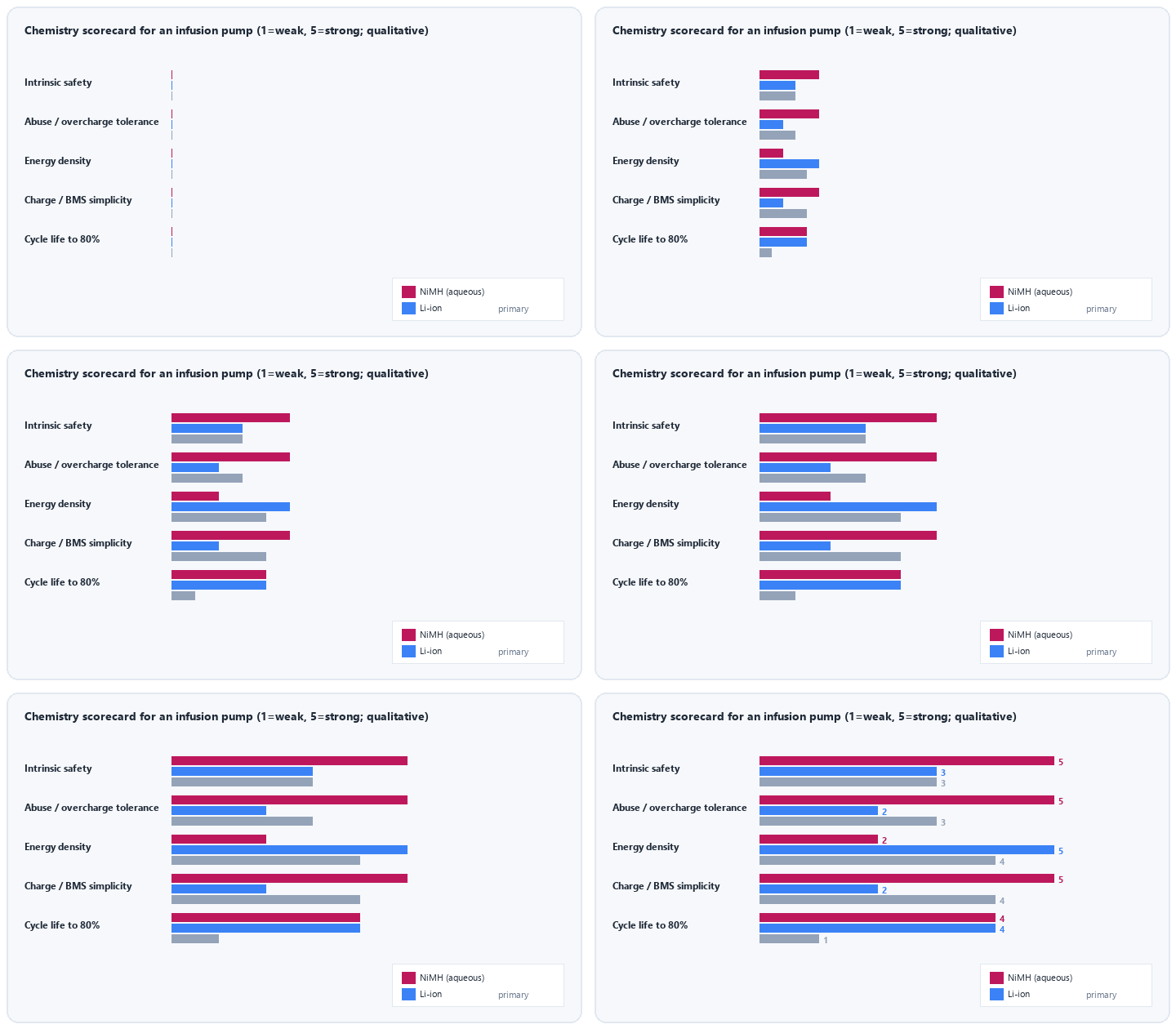
Beside a patient, safety outweighs energy density. Comparative safety analyses of medical power sources find NiMH thermal-runaway risk to be extremely low because of the aqueous electrolyte, its management complexity minimal (no mandatory per-cell active balancing), and its response to severe overcharge to be controlled gas release through a safety valve rather than combustion. Lithium-ion instead requires the pack to prevent the very conditions — overcharge, overdischarge, overtemperature, internal short — that lead to thermal events. Under the EU Medical Device Regulation (2017/745), the manufacturer must demonstrate a safe energy source regardless of chemistry; IEC 62133 provides the accepted cell-level evidence, with Part 1 covering nickel systems (NiCd/NiMH) and Part 2 covering lithium — a distinction examined in Part C.
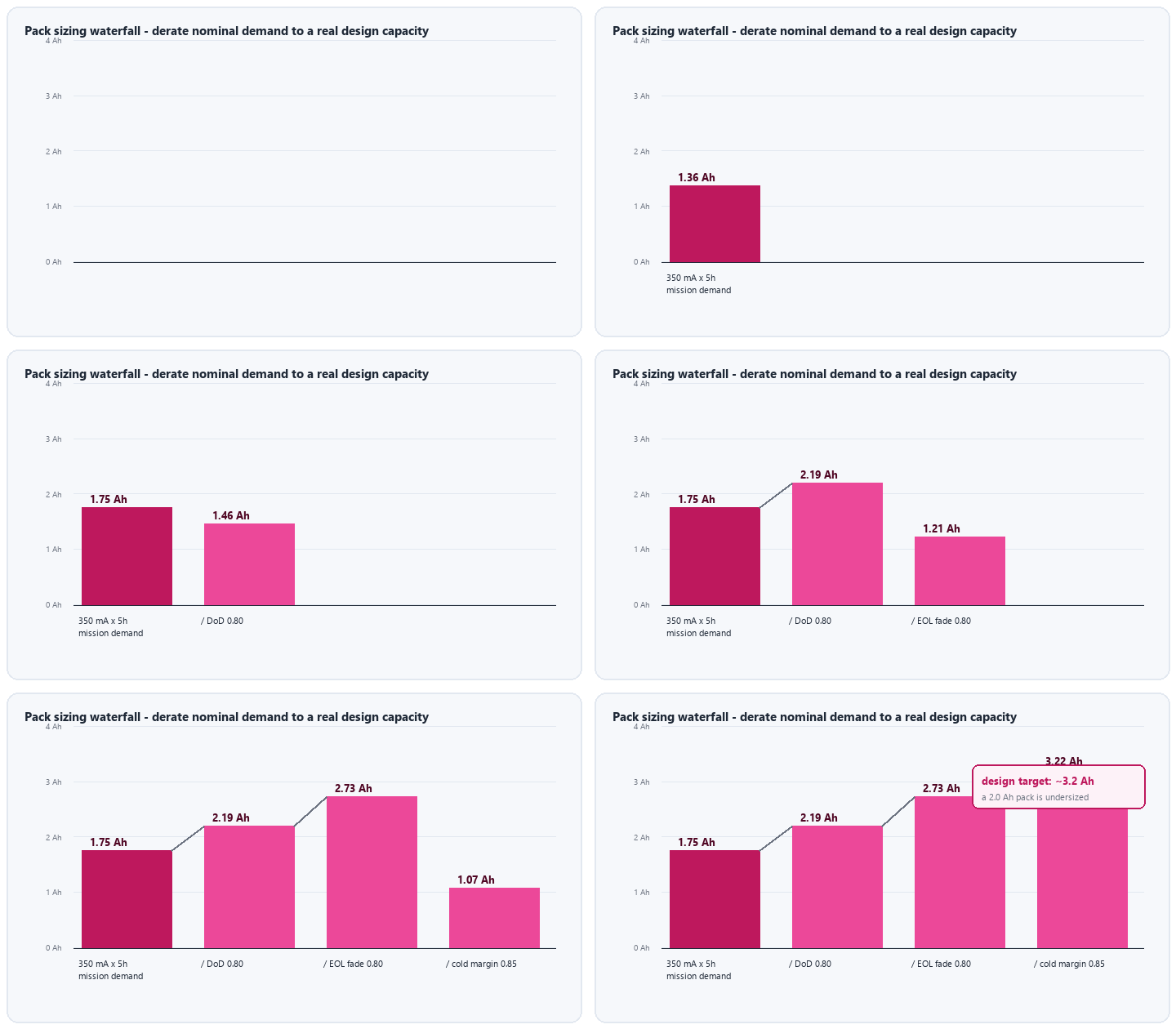
Real infusion platforms anchor the arithmetic. A widely deployed syringe pump uses a six-cell NiMH pack at 7.2 V and roughly 2000 mAh (six 1.2 V cells in series), the same form factor supplied as original equipment in models such as the Terumo TE-112 class; higher-power devices use ten-cell 12 V, approximately 4 Ah packs. Sizing follows four equations:
For a target of 5 hours at an average 350 mA, raw energy demand is 1.75 Ah; after a 0.8 depth-of-discharge limit, a 20 % end-of-life derating and a 15 % cold-temperature margin, the design capacity approaches 2.8 Ah — illustrating why a "2000 mAh" nameplate can be exactly right for a 4-hour, low-rate mission but insufficient for a conservative 5-hour specification.
A series string is only as strong as its weakest cell, and medical packs demand tighter binning than consumer packs. Guidance for medical NiMH selection calls for cell-to-cell open-circuit voltage variation within roughly 50 mV in a six-cell 7.2 V pack, matched internal resistance and matched capacity bins. Weak-cell behaviour — overdischarge and eventual reversal in a string whose cells were never matched — is the dominant cause of premature pack failure in field returns. Manufacturers achieve this by incoming-cell grading, welded (never hand-soldered) interconnects, and matched thermistors for charge-temperature supervision.
NiMH charging is forgiving but not free of rules. Constant-current charging terminated by the negative delta-V signature or temperature rise, with a timed top-up and a maintenance trickle, lets a pump be docked indefinitely without damage — a workflow Li-ion manages only through its BMS. The pack should be located away from the motor and power electronics, because NiMH charge acceptance falls above roughly 45–50 °C and sustained heat accelerates calendar aging; clinical indoor operation (typically -10 to +50 °C for medical NiMH packs) is benign, but enclosure stacking still matters.
Weijiang Power manufactures graded, welded NiMH cells and custom packs for infusion and syringe-pump OEMs: defined voltage/resistance/capacity bins, NTC and protection integration, connectorised assemblies for clean production integration, and IEC 62133-1 plus UN 38.3 documentation. Share your target runtime, bus voltage and enclosure, and we will deliver a sized, matched and test-backed pack rather than an off-the-shelf bundle.


