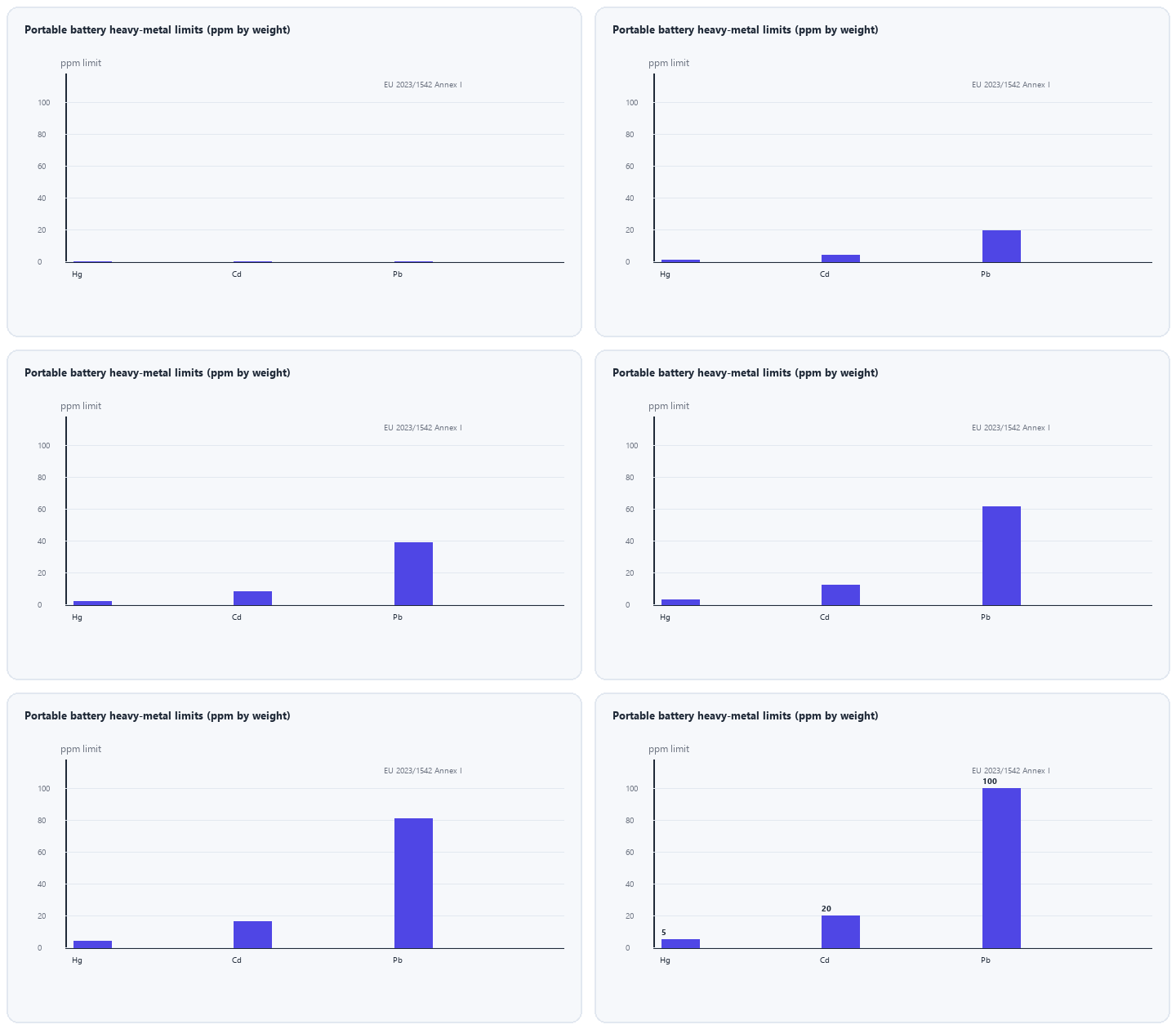
Article 6 of Regulation (EU) 2023/1542 and Annex I set the substance floor every battery placed on the EU market must meet: mercury capped at 5 ppm for all batteries, cadmium at 20 ppm and lead at 100 ppm for portable batteries, with REACH restrictions running in parallel. This paper explains where those numbers come from, how they are tested, and why cadmium-free nickel-metal hydride (NiMH) chemistry is the direct regulatory answer to the long decline of nickel-cadmium (NiCd).
For portable batteries, cadmium by weight must not exceed 0.002 % (20 ppm), lead 0.01 % (100 ppm, with the portable zinc-air button-cell limit following from 18 August 2028), and mercury 0.0005 % (5 ppm); the 5 ppm mercury ceiling applies to all other batteries as well. Where cadmium exceeds 0.002 % or lead exceeds 0.004 %, Article 13 additionally requires the chemical symbol to be shown beneath the separate-collection mark. Vehicle categories add ELV Directive 2000/53/EC limits (cadmium 100 ppm; lead, mercury and hexavalent chromium 1,000 ppm by homogeneous material), and REACH Annex XVII applies to every battery on a material-risk basis, covering entries such as C9–C14 PFCAs, organotin compounds, phthalates and PAHs.
A NiCd negative electrode is fundamentally cadmium: the metal is the active material, typically around 15–20 % of cell mass — thousands of times above the 20 ppm ceiling. The old Directive 2006/66/EC already banned portable cadmium batteries from 2008 with narrow use exemptions (emergency and alarm systems, medical equipment and certain cordless power tools); Regulation 2023/1542 closes the regime further and removes the assumption that exemptions continue. A NiCd portable cell cannot be reformulated into compliance; the only compliant path is a chemistry change, and for four decades the designed-in drop-in replacement has been NiMH at the same 1.2 V nominal voltage with 1.5–2× the energy density and no memory effect of practical significance.
"Cadmium-free" is a test claim, not a marketing claim. Accredited laboratories determine heavy metals by digestion followed by ICP-OES or ICP-MS following the IEC 62321 series (parts 4 and 5 for Cd, Pb and Hg; parts 7-1/7-2 for hexavalent chromium by UV-Vis), with method detection limits around 2 mg/kg. A serious NiMH supplier tests representative samples per production lot or per material change, reports results against the Annex I thresholds, and keeps the raw data in the technical file. Because NiMH electrodes use hydrogen-storage alloys with nickel and rare earths rather than cadmium, properly controlled production returns cadmium and mercury results at or below detection — a wide margin under the 20 ppm and 5 ppm limits.
Meeting Annex I does not exhaust substance duties. REACH Annex XVII restrictions attach to sleeves, separators, solder and coatings; candidate-list SVHCs above 0.1 % weight trigger Article 33 communication and, for articles placed on the EU waste stream, SCIP database notification by the importer. When a battery contains more than 0.002 % cadmium or 0.004 % lead it must carry the chemical symbol under the wheeled-bin mark — a visible signal to buyers and surveillance that a threshold was crossed. A clean NiMH cell avoids the symbol entirely, which simplifies label artwork and removes a question from every customs and audit checklist.
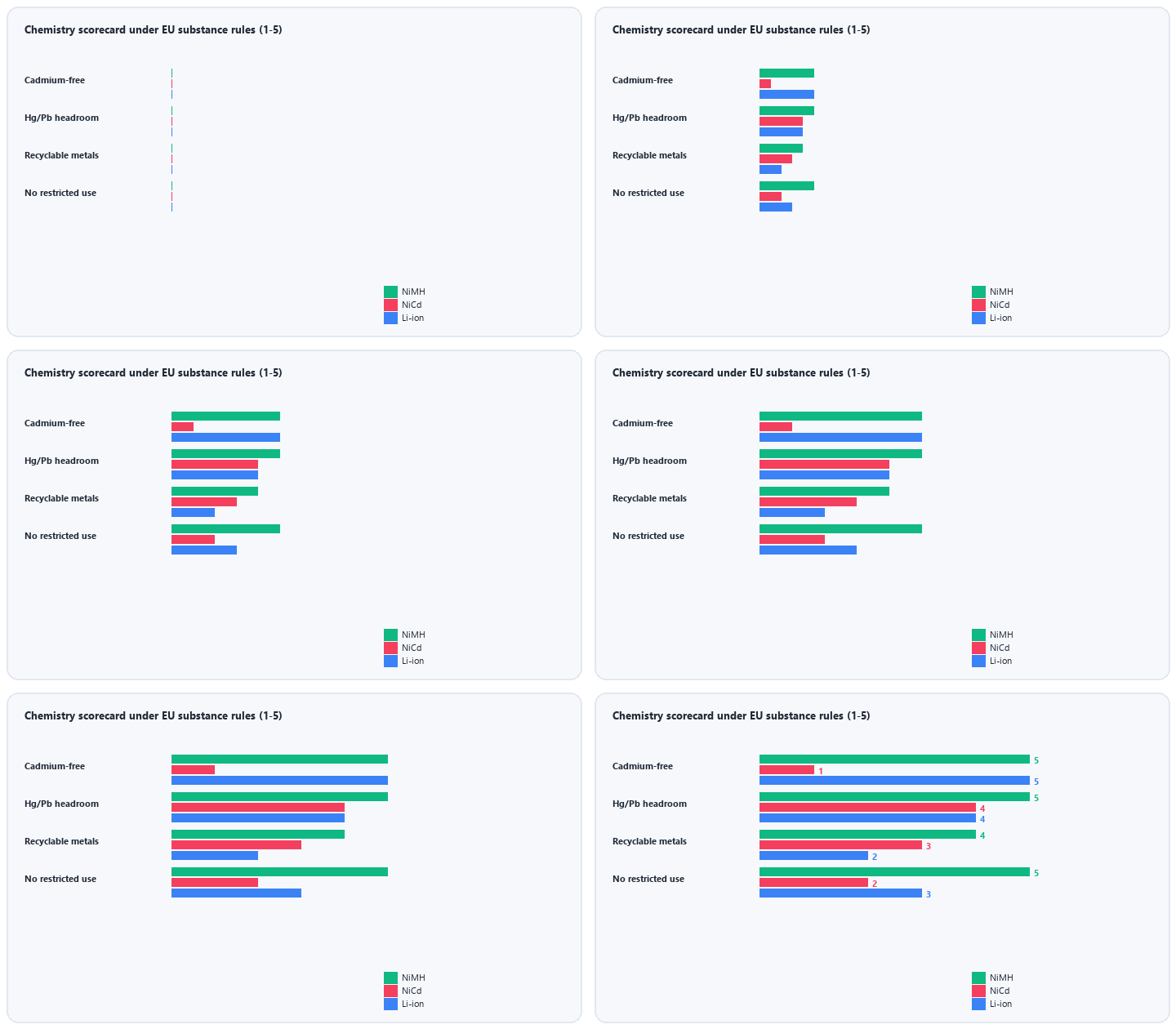
European buyers increasingly score chemistries on regulatory headroom, not just pass/fail. NiMH offers near-zero cadmium and mercury by design, lead-free construction options, aqueous potassium-hydroxide electrolyte without flammable organic solvents, and an established nickel/steel recycling route. That headroom means future tightening of limits is unlikely to force redesign, and the same test reports support RoHS-style customer declarations across medical, industrial and consumer accounts. The commercial value is concrete: fewer retests, simpler labels and no chemistry-substitution project hanging over the product lifecycle.
Weijiang Power NiMH cells are cadmium-, mercury- and lead-controlled by design, verified to IEC 62321 by accredited laboratories with results at or near detection limits against the Annex I thresholds. Every shipment pack includes heavy-metal reports, a REACH Annex XVII material-risk declaration and Article 13-ready artwork with no chemical-symbol flags. Send us your current NiCd part number or load requirement and we will propose the 1.2 V NiMH replacement with the compliance evidence attached.


