
A remote monitor is judged in the field, not on the bench: it must keep sampling through flooding, electrical noise, winter cold and summer heat, and still capture the rare transient event years after installation. This paper layers the validation for its battery - ingress protection, electromagnetic compatibility, wide-temperature and event-burst testing, solar charge cycling, and the IEC/UN cell evidence - with an accelerated field-life programme that predicts whether a nickel-metal hydride buffer still delivers the alarm burst at year five.
IEC 60529 defines the IP ratings, and buried or chamber-mounted terminals commonly require IP68 (continuous-immersion capability) with IP66 for above-ground units. The battery is tested inside the enclosure through immersion and condensation cycling, verifying that welded tabs and any carrier contacts do not corrode or short in long-term humidity and that cell venting is directed safely. A replaceable pack must maintain the enclosure seal through repeated field swaps.
NiMH's sealed, aqueous cells and welded construction behave predictably in condensing enclosures, and avoiding spring contacts in favour of welded or gas-tight connections removes the slow corrosion failure that high humidity causes.

Remote terminals share the pipeline environment with pumps, variable-speed drives and switching equipment, so the IEC 61000 series EMC tests (immunity to electrostatic discharge, radiated and conducted disturbances, surges and electrical fast transients) matter. The battery and its charge manager must not make the terminal more susceptible: a low-impedance buffer actually stabilises the rail during an induced disturbance, but the charge-management electronics and any DC-DC stage must themselves meet the emission and immunity limits.
Testing repeats the sampling and transmission during applied disturbances to confirm neither a corrupted reading nor a spurious alarm results, and that a disturbance on the power/solar line never propagates into the cell pack.
The terminal is cycled across its -30 to +70 C range. At the cold extreme, the routine report and - critically - the combined transient-sampling-and-alarm burst are tested at end-of-life capacity to confirm the rail stays above brown-out. At the hot extreme, solar charge management is verified to taper or stop before the cells gas. The event-burst test injects a simulated water-hammer trigger and confirms rapid sampling plus immediate radio transmission complete without reset.
This is the test that separates a datasheet claim from field reality: many packs that pass a routine hourly report at room temperature cannot deliver the cold, aged, simultaneous sample-and-alarm burst that the instrument's core function requires.
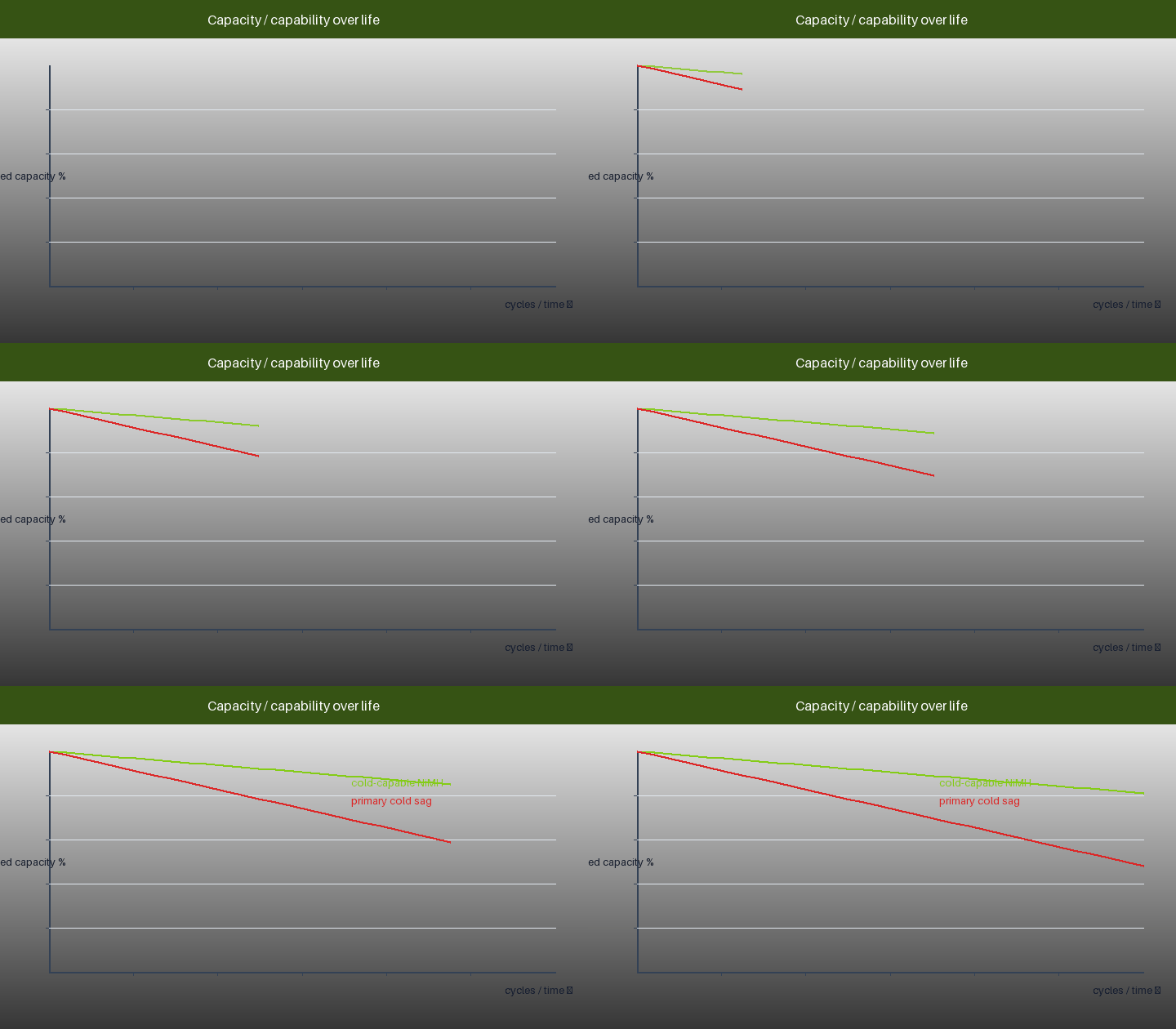
For solar-NiMH terminals, the predictive test reproduces years of daily charge-discharge cycling with realistic partial and overcast-day patterns, temperature soak and periodic event bursts, tracking capacity, internal resistance and event-burst completion. The second animated figure contrasts a thermally managed, moderate-depth-of-discharge NiMH buffer that retains its burst capability with a deeply cycled, heat-stressed pack that loses it - the engineering basis for the autonomy and warranty design in Paper B.
Primary-battery variants undergo the complementary test: long-term discharge with passivation and pulse recovery at low temperature, validating the pulse reservoir against the radio peak.
IEC 62133-1 covers sealed nickel-system cell and battery safety, IEC 61951-2 the performance methods including charge retention and the >=500-cycle endurance reference, and UN 38.3 transport - under which NiMH ships without lithium-air restrictions, a genuine advantage when air-freighting replacement packs to remote utility depots. Welded, matched cells with a thermal fuse, series protection and an NTC make the abusive-case tests straightforward.
For designs that also include a primary lithium cell, its lithium evidence is kept separate and the hybrid protection documented to show the two chemistries interact safely.
Assemble the IEC 60529 ingress record, the IEC 61000 EMC report, the wide-temperature and cold event-burst tests, the solar cycle-ageing (or primary discharge) results, the IEC 62133-1 and IEC 61951-2 certificates and the UN 38.3 summary, alongside the average-current worksheet. Together they convert a 'five-year battery' claim into a defensible field specification.
For utilities instrumenting distribution networks, a correctly sized, cold-capable, solar-friendly NiMH buffer is the most reliable way to raise sampling frequency without sacrificing field life - and to be certain the terminal is awake, and transmitting, in the exact moment a pipe begins to fail.
Weijiang Power builds sealed nickel-metal hydride cells and solar-compatible buffer packs for NB-IoT and LoRa pressure and flow monitoring terminals. Share your transducer excitation current, sampling and reporting interval, radio profile, solar-panel size and temperature range, and our engineers will design a welded, cold-capable NiMH buffer or replaceable pack with charge management and protection. See formats on the products page.


