A floating water-quality or hydrology station is an off-grid power system that must keep measuring through the night, through consecutive cloudy days and through the biofouling-prone life of a deployment at sea or on a lake. Commercial buoy platforms converge on a recognisable architecture: a photovoltaic array of tens to a hundred-plus watts charges an onboard storage bank sized for several days of autonomy - integrators commonly specify seven or more overcast days - while a data logger wakes on a one-to-sixty-minute cycle, excites a multi-parameter sonde measuring pH, dissolved oxygen, turbidity and conductivity, sometimes drives a pump, wiper or cleaning mechanism, and uploads over 4G, GPRS or LoRaWAN using Modbus or MQTT. This paper, the first of three on nickel-metal hydride power for floating monitoring, unpacks that architecture, quantifies the load components that distinguish a buoy from a simple weather logger, explains the daily charge-discharge cycle the storage element actually sees, and shows why a sealed, cycle-tolerant NiMH buffer is well matched to a platform that is recharged daily, asked for periodic high-current bursts and expected to survive a corrosive, humid environment.
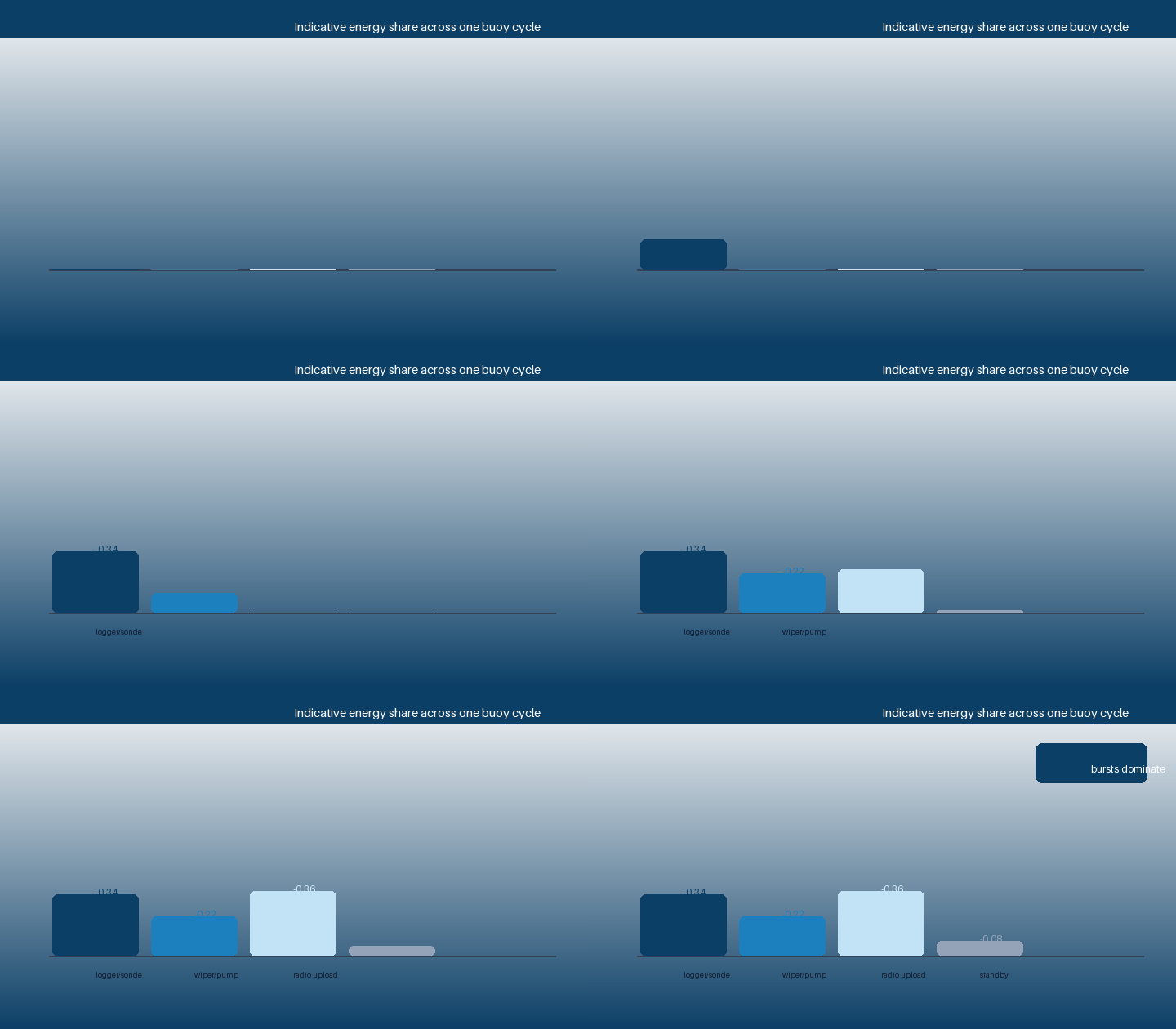
A modern multi-parameter buoy is more power-hungry than its small data rate suggests. The sonde's electrochemical and optical sensors draw current when excited, optical turbidity and dissolved-oxygen channels need illumination, many platforms run mechanical wipers or air-blast cleaners to control biofouling, pumps may move sample water, and the datalogger and RS485/Modbus sensor bus are active during each measurement window. Upload then keys a cellular or LPWAN radio whose transmit stage draws the largest instantaneous current of the cycle.
Measurement cadence is configurable from once a minute to hourly, and every shortening of the interval raises the average load roughly in proportion. Published buoy specifications describe twelve-volt systems with solar-plus-storage, measurement cycles adjustable across that one-to-sixty-minute range and LoRaWAN on EU868 or cellular uplink. The first design task is therefore the same cycle-energy accounting used for any remote node - list every state, its current and its duration - but with pump, cleaner and optical-sensor terms that a weather station does not have.
Floating platforms are almost universally photovoltaic-harvested because they are off-grid and exposed to open sky. Integrator specifications describe arrays from roughly fifty to a hundred-fifty watts charging a storage bank, with the defining requirement being autonomy across consecutive rain or overcast days: seven days is a common commercial target, and some meteorological buoy lines specify fifteen or more. The storage element is thus sized not to one night but to the worst-season run of poor insolation, a fundamentally different calculation from a diurnal solar gadget.
Within that architecture the storage technology has three jobs: absorb charge whenever the panel produces, supply the measurement and upload cycle on demand, and ride through the multi-day deficit. Sealed NiMH is a credible choice for small to mid-size buoys precisely because it is a cyclic, rechargeable technology that tolerates the shallow, irregular charge a moving, sometimes-shadowed panel delivers and the repeated daily cycling of years of service - a different value proposition from the large primary lithium packs used where no solar array exists at all.
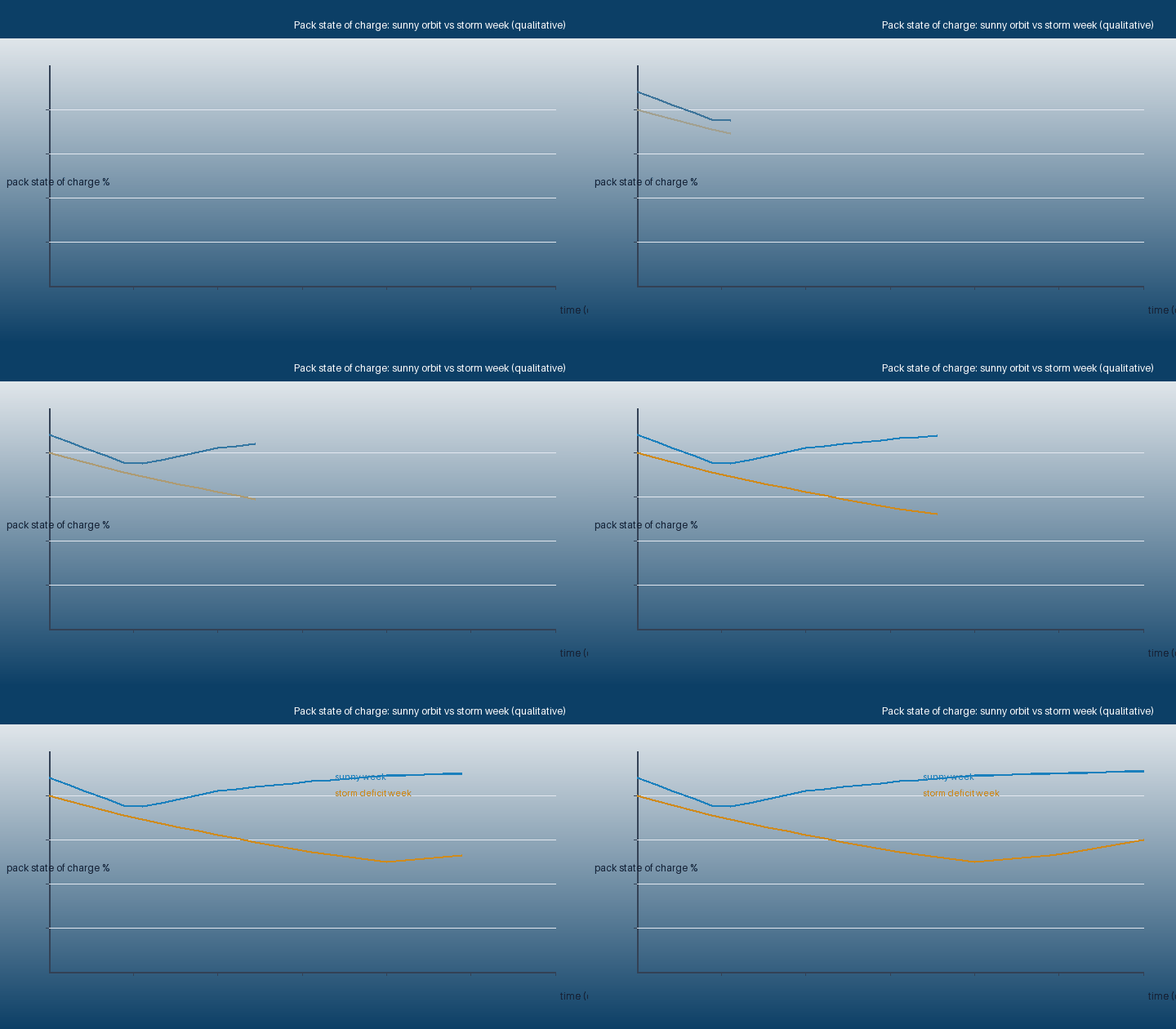
Unlike a primary battery that only empties, a buoy buffer traces a repeating daily orbit: it discharges overnight and during measurement bursts, recharges through the daylight hours, and settles at a state of charge that follows the weather. Across a sunny week it floats high; across a storm week it trends downward and must recover. The storage element consequently needs high cycle tolerance under shallow cycling, good charge acceptance from an intermittent source and low enough self-discharge not to leak away the energy it has stored.
NiMH is comfortable with exactly this regime. It accepts charge from a controlled solar regulator without the strict, plating-sensitive charge discipline of lithium-ion, tolerates the modest overcharge a simple marine controller may apply, and cycles through the daily orbit for the service life of the platform. Low-self-discharge grades are specified so that stored energy survives long overcast stretches, and the pack is deliberately operated in a middle state-of-charge band where both cycle life and reliability are best.
Several buoy loads are impulsive rather than steady: a wiper motor or pump starting under load, an optical sensor's illumination strobe, and especially a cellular radio transmitting on a weak-signal edge can each demand a brief current several times the average. As on a sensor node, the storage element must hold its rail voltage through these pulses or the logger resets and the measurement is lost - a costly failure on a platform that may be visited only by boat.
Sealed NiMH cells have low internal impedance, on the order of tens of milliohms in a charged AA-size cell, and industrial lines sustain several-ampere discharge, so a small pack holds voltage through motor and radio starts that would sag a high-impedance source. Designers often add a local capacitor reservoir for the sharpest pulses, leaving the NiMH bank to supply the cycle energy at a modest average rate. The first animated figure stacks the energy of each buoy load; the second contrasts a healthy daily state-of-charge orbit with a deficit week.
Water is a hostile electrical environment in ways that reach the battery even inside a sealed hull: high humidity and condensation, wide temperature swings, salt-laden air that attacks connectors and any exposed metal, constant low-level motion and vibration, and the risk of a breached compartment. These stressors raise contact resistance, accelerate corrosion and can degrade a pack faster than its electrochemical calendar life if mechanical and sealing design is weak.
This is why buoy power design is inseparable from enclosure design. The battery compartment sits behind the IP68 barrier that defines a submersible platform, cells are retained against motion with welded tabs or robust holders, connectors are corrosion-resistant and conformal-coated, and thermal design keeps the pack out of direct solar hot-spots. NiMH's lack of free liquid and its robust sealed construction are advantageous here, but the advantage is realised only when the pack is packaged as deliberately for the marine environment as the hull itself.
The load and architecture analysis produces a clear requirement set for the storage element: rechargeable and cycle-tolerant across years of daily orbits; chargeable from a weak, intermittent photovoltaic source without a fragile charge protocol; low-impedance enough to cover motor, optical and radio pulses, optionally with a capacitor reservoir; low in self-discharge to survive multi-day deficits; and robust inside a sealed, humid, vibrating, salt-exposed compartment. Those requirements frame the detailed pack design in the next paper.
They also frame an honest chemistry comparison. Large buoys with generous volume and budget may use lithium-ion for its energy density, and zero-solar, long-life platforms may use primary lithium; but for maintainable, solar-assisted small and mid-size buoys - especially where transport simplicity, forgiving charge behaviour and pulse delivery are valued - a well-designed sealed NiMH buffer is a strong, defensible selection. The following paper turns these requirements into cell count, capacity, reservoir and charge-management decisions.
Weijiang Power designs and manufactures sealed nickel-metal hydride cells and matched industrial packs for remote, off-grid and safety-related equipment, and supports OEM partners with IEC 61951-2 performance files, IEC 62133-2 safety evidence, pulse-load characterisation, wide-temperature testing and charger/pack co-validation. Tell us your duty cycle, peak current, temperature envelope, autonomy target and the standards your product must meet, and our engineers will specify a cell-and-pack combination that protects runtime, reliability and service life. Review the range on the products page.


