No backup battery in a building carries a more explicit life-safety burden than the one inside the fire alarm control panel. It must keep the controller, loops and detectors supervised for a full day after the mains fails, and then - if a fire actually occurs during that outage - drive every sounder, beacon and loop device in full alarm. The European standards EN 54-2 for control and indicating equipment and EN 54-4 for power-supply equipment define that duty with unusual precision. Paper A, the first of three on fire-panel power, dissects the electrical duty, anchors it to the standards' standby and alarm durations, and explains why nickel-metal hydride is a credible alternative to the dominant sealed lead-acid block.
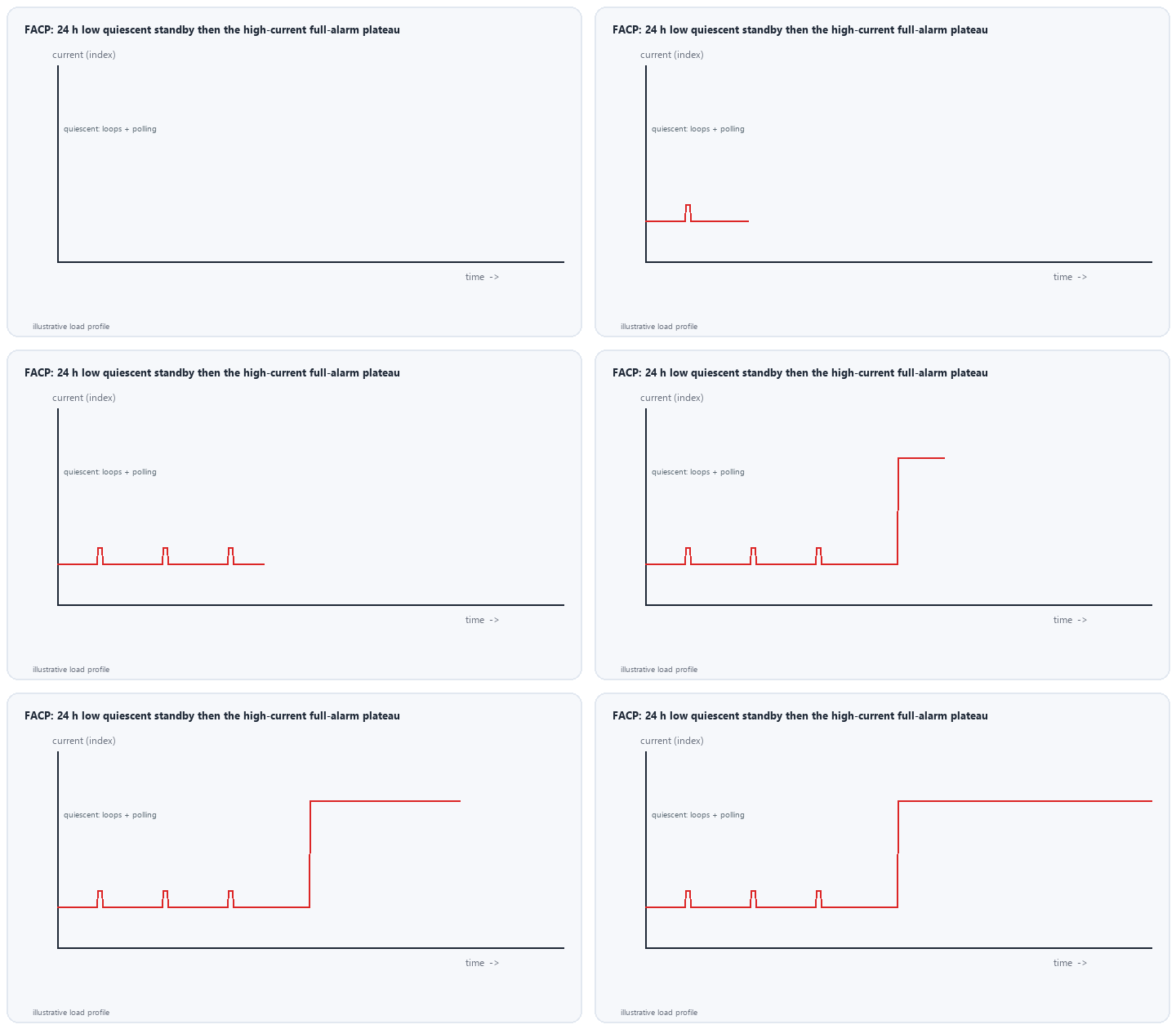
The animated current trace shows the two regimes. In quiescent standby the panel supervises its detection loops, polls addressable devices, scans manual call points and keeps its processor and communications alive - a modest but continuous current that must run for the entire outage. In the alarm state the same panel energises every notification appliance: sounders, horns and voice-alarm drivers, visual beacons and strobes, and often fire-service routing or suppression interfaces, a current several times the quiescent value, sustained for the required evacuation period.
Sizing to only one regime is the defining error. A battery that carries the quiescent load for 24 hours but sags the moment all sounders turn on fails at the exact instant of the fire; a battery sized only for the alarm surge but not the preceding day of supervision is already empty before the alarm begins. EN 54-4 deliberately requires the sum of both.
EN 54-2 governs the control and indicating equipment (CIE): it requires a fire signal to be indicated within ten seconds, and the panel to keep reporting other zones correctly even under a single earth fault or short circuit - resilience that depends on a stable supply rail through the fault. EN 54-4 governs the power-supply equipment (PSE) and fixes the battery duty that underpins that resilience: the standby source must sustain the system in quiescent condition for 24 hours and then drive it in full alarm for at least 30 minutes. Where a site is not continuously manned, or loss of mains is not reliably reported to a monitored alarm-receiving centre, guidance - including BS 5839-1 and the EN 54-14 application guidance - commonly raises the standby expectation to 72 hours before the alarm period.
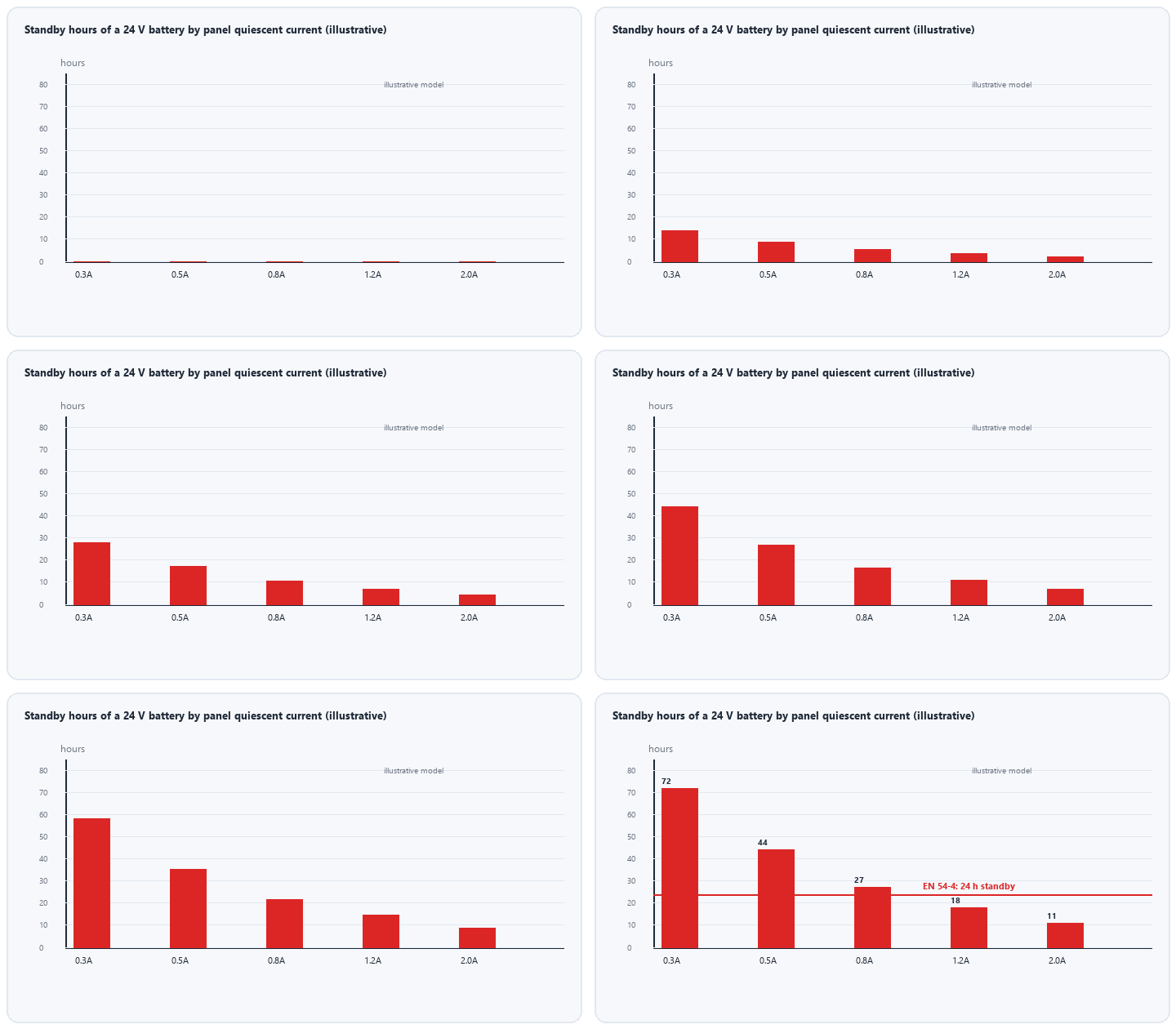
The animated chart converts a fixed 24 V battery into standby hours across panel quiescent currents. It is an illustrative model, but it makes the design rule visible: quiescent current sets the 24- or 72-hour term, and the panel's device count - every loop device and module adds supervision current - is what moves a panel along that curve. Addressable panels with hundreds of devices present a materially larger standby load than small conventional panels.
EN 54-4 also constrains recovery. A fully discharged battery must be rechargeable to 80 percent of its capacity within 24 hours and to full charge within a further 48 hours. These windows recognise that a fire panel may experience a long outage and must be back to full protective readiness promptly after mains returns, but they also bound the minimum charge current the PSE must provide for a given battery size - a coupling between capacity and charger that prevents the designer from specifying an arbitrarily large battery the charger cannot restore in time.
For NiMH this is comfortably achievable with a controlled constant-current charge followed by a gentle maintenance regime; the wider point is that the battery and the PSE charger are a matched pair under the standard, not independent selections. Paper B develops the charge-profile design and its interaction with the warm-panel environment.
Conventional and addressable fire panels are built around a nominal 24 V supply, which legacy practice implements with two 12 V sealed lead-acid blocks in series; a NiMH equivalent uses twenty 1.2 V cells in series to track the same rail, with a charged string sitting comfortably above the panel's minimum operating voltage. The PSE supervises the battery continuously - presence, connection integrity, internal resistance and voltage - and must raise a distinct fault if the battery is missing, disconnected or degraded, without ever compromising the fire-alarm function. EN 54-2's single-fault resilience means a battery or wiring fault in one part must not silence the rest of the system.
This supervision is why a stable, predictable cell chemistry matters: the panel's battery-monitoring thresholds assume a known discharge curve. NiMH's flat 1.2 V plateau gives a long, predictable operating region followed by a defined knee that a monitor can detect cleanly, and its low internal impedance holds the rail when the alarm load is applied abruptly.
When the panel transitions from quiescent to full alarm, dozens or hundreds of notification appliances energise at once, presenting a step load - and strobes add repeated inrush pulses on top. If the battery's internal resistance is high, the rail sags on that step and can drop below the panel's brown-out threshold, causing a reset at the worst possible moment or producing an under-voltage fault just as evacuation begins. The battery must therefore be specified for the alarm current, not merely the average standby current, with a voltage floor that stays above the panel's minimum through the strobe pulses.
Matched, low-impedance NiMH cells in a welded pack present a stiff 24 V source that accepts the alarm step cleanly; larger C and sub-C formats provide the electrode area to sustain the alarm plateau without sag. This is the same high-rate discipline as a UPS bridge, applied to a life-safety load.
Sealed lead-acid dominates fire panels for historical and cost reasons, but its weaknesses are well documented: it is heavy and bulky, it sulphates under the perpetual near-full float, its usable capacity collapses in cold environments, and its two-block series arrangement is vulnerable to imbalance over a long life. Lithium adds protection electronics and regulatory weight to a device expected to sit untouched for years. Nickel-metal hydride offers a cadmium-free, memory-free aqueous chemistry with a flat plateau, stiff high-rate delivery for the alarm surge, materially better cold performance, intrinsic safety and the simplest air-freight profile - provided the float charge is temperature-aware and the pack is sized with a real end-of-life margin, the subjects of Paper B.
Paper C walks the EN 54, BS 5839, UL 864 and cell-level evidence trail that lets a panel manufacturer defend the choice.
Weijiang Power manufactures matched 24 V NiMH strings for fire alarm control panels and power-supply equipment: welded C and sub-C packs sized to the EN 54-4 24-hour (or 72-hour) standby plus 30-minute alarm duty, low-impedance cells for the notification-appliance surge, temperature-aware float designs and IEC 61951-2, IEC 62133-1 and UN 38.3 documentation. Send your quiescent and alarm currents, standby scenario and panel voltage floor and we will size a life-safety pack.


