
Charging is a compromise between speed and life, and optimal-control theory turns that vague compromise into a solvable problem: given an electrochemical or reduced model of the cell, find the current trajectory that reaches full charge in minimum time subject to explicit constraints on temperature, internal pressure, electrode potential and accumulated degradation. This paper frames NiMH charging as a constrained optimisation, explains why the mathematical optimum is closely approximated by a descending multi-stage constant-current schedule, shows how oxygen-onset and thermal constraints shape that schedule, and surveys how model-predictive and intelligent controllers (the MSCCC/ANFIS line) realise it in practice - the theoretical apex toward which the profile-design papers have been building.
Formally, choose current I(t) over the charge to minimise a cost - charge time, degradation, or a weighted blend - subject to the cell's dynamic model and hard constraints: state of charge reaching target, temperature below its absolute limit, internal pressure below a vent-margin bound, positive potential below heavy oxygen evolution, and current within the power-stage and cell-rate limits. Degradation is represented by a model (or surrogate) of the oxidation/corrosion and thermal damage developed in the ageing group.
The constraints, not the objective, dominate the answer: in NiMH the optimum is almost always riding the binding thermal or oxygen/pressure constraint in the end band, which is why a purely time-minimal charge and a life-maximising charge converge on similar shaped trajectories once safety is enforced.
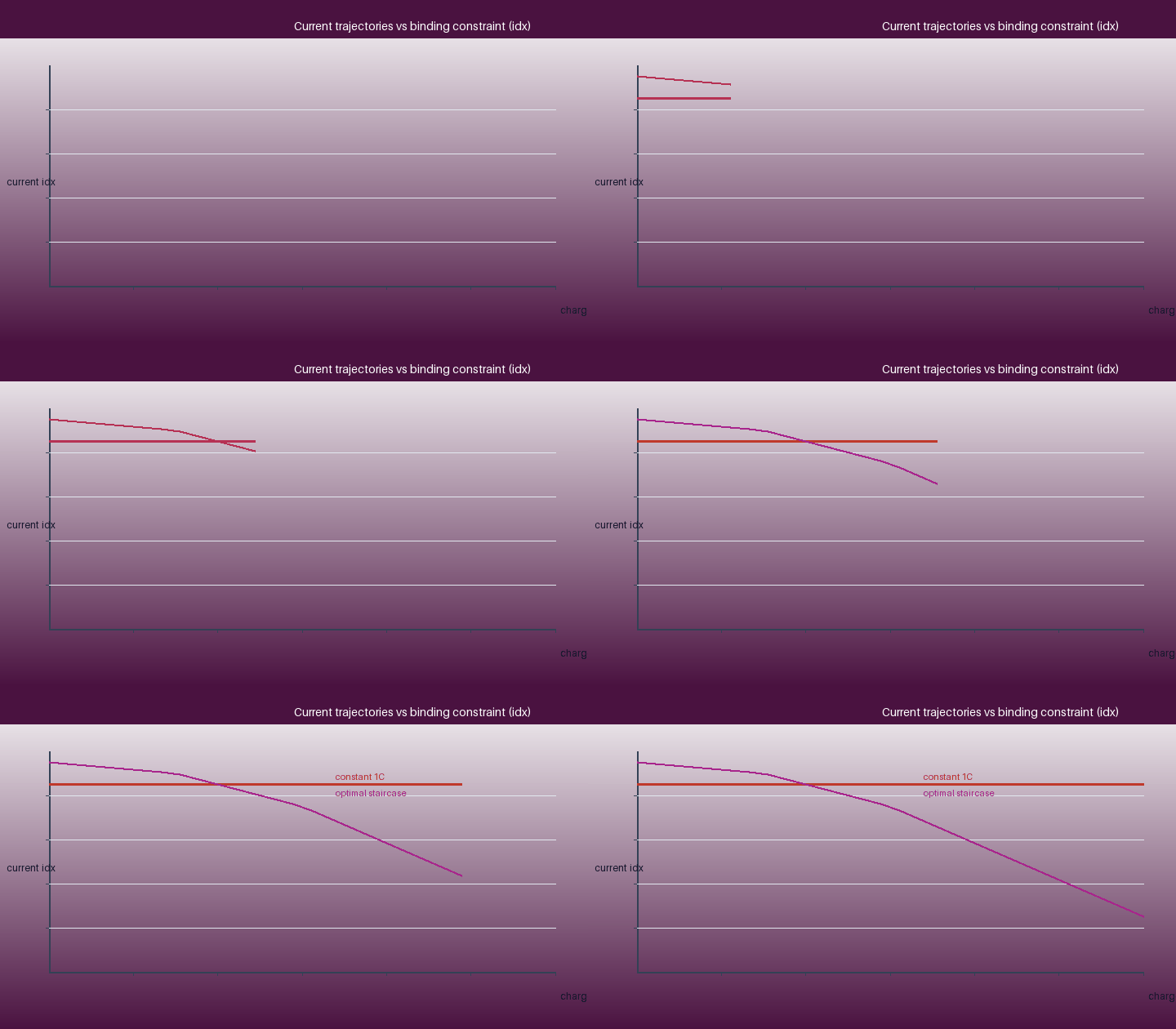
A fully variable optimal trajectory is hard for a low-cost charger to follow, but optimal-control solutions for battery charging are well approximated by a staircase of descending constant currents - high in the bulk where acceptance is high and constraints slack, stepping down as each constraint (temperature, oxygen onset) becomes active. This multi-stage constant-current charging (MSCCC) captures most of the optimum's benefit with simple power-stage commands and clean current-stable windows for termination sensing (Paper 6).
The stage currents and transition points are the optimisation outputs: they can be derived offline from a cell model and tabulated, or adjusted online by an intelligent controller, and they replace both the single high current (fast but damaging) and single low current (kind but slow) with a trajectory that is fast where safe and gentle where it matters.
Reported NiMH/NiCd intelligent charging couples a boost/PFC front end with an MSCCC output whose stage currents an adaptive neuro-fuzzy inference system selects from the evolving voltage-temperature response, validated in MATLAB against conventional profiles. The neuro-fuzzy approach is attractive because it encodes the optimal-control intuition as rules ('increase current while constraints are slack, step down as they approach') while learning the exact transition surfaces from data - a tractable realisation of model-based optimisation on modest hardware.
Model-predictive control extends this by re-solving a reduced electrochemical model each control interval over a short horizon, using current temperature and estimated SOC as initial conditions; it is the most principled form of the adaptive charging of Paper 41, at the cost of model fidelity and computation.
Three constraints bind in sequence. Through bulk charge, only the cell-rate and power-stage limits matter and current is maximal. Past the oxygen knee (Paper 1/2), the oxygen-generation/recombination balance and internal pressure (Paper 3) force current down so generation does not outrun recombination. In the final band the thermal constraint - I-squared-R plus recombination heat versus cooling (Paper 4) - binds, and a short low-current top-off completes the charge. A correctly optimised profile is therefore recognisably a descending staircase with a small final step, matching the empirically developed best practice of the whole series.
Temperature shifts the whole staircase: cold lowers early currents (slow kinetics, Paper 26), heat lowers end currents (earlier oxygen, weak -delta-V, Paper 27), so the optimum is a family indexed by ambient and cell state rather than a single universal curve.

Against a constant 1C charge, an optimised staircase reaches comparable time with substantially lower peak temperature, pressure and time-in-recombination - and against a constant 0.5C charge it reaches full faster at similar aggregate stress, because it exploits the high-acceptance bulk region that the slow profile wastes. Gains are largest for thermally constrained packs (thick electrodes, dense enclosures) where a flat current is forced to be conservative everywhere to be safe at the end.
The first figure overlays constant-current and optimal-staircase trajectories against the binding constraint envelope; the second decomposes the optimisation into objective, dynamic model and constraints, the reusable formulation for any NiMH charge-optimisation project.
Practical adoption starts from a reduced model and its identified parameters (Papers 18, 19), derives an offline MSCCC schedule across the temperature range, optionally closes an adaptive/MPC loop online, and always retains hard independent limits. Weijiang supplies the acceptance, pressure and thermal characterisation needed to build and validate the constraint model, so an 'optimal' profile is optimal against measured cell behaviour rather than assumed parameters. The next paper examines advances inside the cell itself - materials and electrolytes that widen the fast-charge envelope.
Weijiang Power designs and manufactures nickel-metal hydride cells, matched packs and charging-ready configurations for consumer, industrial, medical and mobility customers, and supports partners with charge-protocol guidance, IEC 61951-2 performance files, IEC 62133-1 safety evidence and charger co-validation. Share your cell format, charge rate, thermal envelope and cycle target and our engineers will specify a cell-and-charge combination that protects both runtime and service life. Review the range on the products page.


