The single technology that made consumer nickel-metal hydride acceptable as an alkaline replacement was not higher capacity - it was lower self-discharge. Conventional NiMH cells lost a meaningful share of their charge every month sitting in a drawer, which forced the ritual of charging batteries the night before a trip and made rechargeables feel inconvenient. The low-self-discharge (LSD), pre-charged generation changed that: cells leave the factory charged, sit for months or years, and still power a device when first inserted. This paper looks inside the cylindrical LSD cell to explain where self-discharge comes from, which material and process changes suppress it, and how those changes interact with capacity and cycle life.
A charged NiMH cell is a system held away from chemical equilibrium, and it relaxes toward that equilibrium even with no external load. Internal side reactions at the negative hydrogen-storage alloy, chemical shuttle through the separator, minor impurities in the electrolyte and slow decomposition at the positive nickel electrode all combine into the self-discharge current. In a conventional cell these processes are fast enough that a large fraction of stored energy can be lost within months at room temperature, and faster still when warm. Self-discharge is therefore not a manufacturing defect to be eliminated but a set of reaction rates to be driven down by design - which is precisely what the LSD generation did.
The negative electrode of a NiMH cell is a metal hydride alloy that stores hydrogen in its crystal lattice. Refining that alloy composition - tuning the mischmetal rare-earth blend, the stabilising elements and the annealed microstructure - makes the stored hydrogen less prone to escaping during idle and reduces parasitic corrosion. Leading LSD manufacturers describe improving the metal-hydride alloy lattice so that a cell retains a high proportion (around 70 percent is the widely cited ten-year figure, measured against minimum capacity under a defined IEC method and proper storage) of its charge long-term, while also resisting the voltage sag that older NiMH showed mid-discharge. The alloy is the single largest lever on idle stability.
The porous separator between electrodes is not a passive spacer in an LSD cell. Treating and selecting the separator material controls nitrogen-containing impurities and chemical shuttles that otherwise carry a slow internal current, and it manages the oxygen-recombination pathway that keeps a sealed cell safe during overcharge. A cleaner, more stable separator is a major reason LSD cells tolerate the trickle and maintenance regimes that age conventional cells. Together with higher-purity electrolyte and tighter manufacturing cleanliness - fewer stray metal particles that become internal micro-shorts - the separator converts what was a leaky chemical vessel into a stable one.
Suppressing self-discharge is not free. Early LSD cells traded some maximum capacity for stability, which is why first-generation pre-charged AA cells arrived at moderate capacities while conventional high-capacity cells still quoted larger numbers. Modern formulations have closed much of that gap, but the design triangle remains: a cell can be optimised for maximum capacity, for maximum cycle life, or for maximum long-term retention, and pushing one axis hard costs the others. For a household that values 'works when I grab it years later', a balanced LSD cell beats a highest-mAh conventional cell that is flat when needed - a selection point Paper B develops with data.

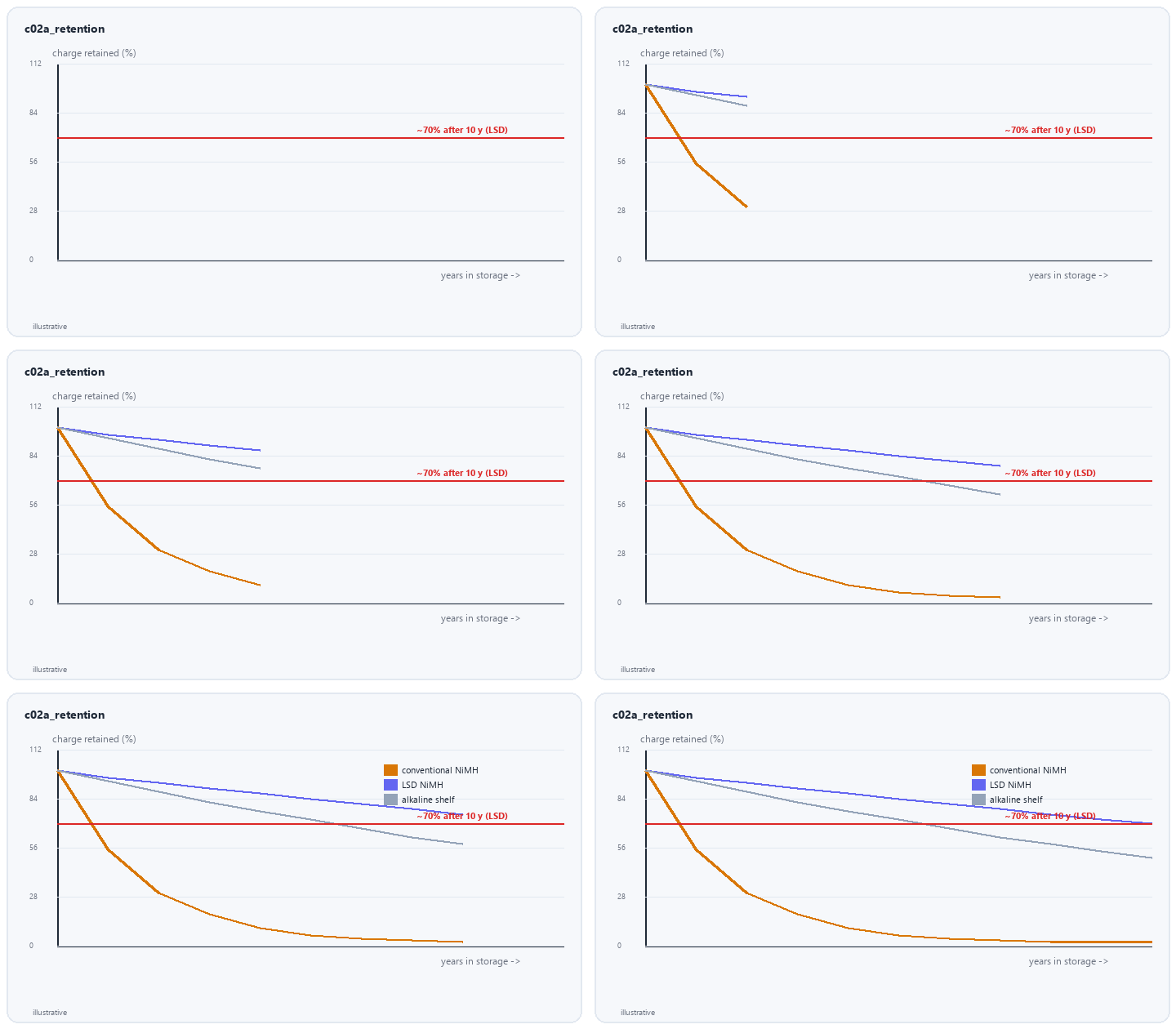
Being sold pre-charged is a psychological as well as technical milestone: the LSD cell competes with the alkaline on its own shelf terms - open the pack and use it immediately - while offering rechargability afterwards. Removing the 'charge before first use' barrier is what let retailers such as IKEA standardise on rechargeables without creating a confusing customer experience. The animated retention curves below compare a conventional NiMH cell, an LSD cell and an alkaline reference over storage time, qualitatively: the gap that opens in the first months is exactly the gap that decided the consumer market.
Because 'low self-discharge' is an easy marketing claim to exaggerate, the credible route is to express retention and recovery in the language of IEC 61951-2 - charge retention after defined storage and charge recovery after a subsequent recharge - and to distinguish a ten-year storage figure (a retention claim under controlled conditions) from a cycle-life figure (an endurance claim). Paper C shows how those claims are tested and documented. Understanding the materials science first is what lets a buyer read a datasheet critically and a manufacturer tune the alloy, separator and purity balance for the household segment rather than for a benchmark number alone.
Weijiang Power produces low-self-discharge pre-charged NiMH AA and AAA cells with tuned hydrogen-storage alloy and treated separators, retaining charge over long storage and ready to use from the pack. Send your target retention months, capacity and cycle grade and we will specify an LSD formulation matched to the device.


