
Charge acceptance is the fraction of applied current that is actually stored as useful chemical energy rather than diverted into gas generation and heat; coulombic efficiency is the ratio of charge retrieved on discharge to charge supplied. In a NiMH cell neither quantity is constant: both are high through the middle of charge and collapse in the final band where oxygen evolution and recombination dominate. Understanding that non-linearity - and its dependence on temperature and current - is the foundation of every efficient charge profile, from a two-hour consumer charger to a regenerative-braking hybrid. This paper quantifies the acceptance curve, explains its physical origins and shows how a well-designed multi-stage constant-current schedule follows it rather than fighting it.
Coulombic, or charge, efficiency eta_Q is delivered discharge ampere-hours divided by the charge ampere-hours that preceded it; energy efficiency eta_E additionally weights by voltage and is always lower because of ohmic and overpotential losses. Charge acceptance at a given instant is best understood as the local slope d(stored charge)/d(input charge): the proportion of incoming current still going into the Ni(OH)2/NiOOH and hydride-forming reactions rather than into oxygen generation and parasitic chemistry.
Across the bulk region, from perhaps 20 to 70 percent state of charge, a healthy NiMH cell accepts current at efficiencies that can exceed 95 percent under favourable conditions; instrumented traction work reports efficient recharging to roughly 93 percent state of charge at C/2 when internal pressure is properly controlled. Above that band the marginal acceptance falls fast, which is why the last 10 to 20 percent of a fast charge is disproportionately slow and hot.
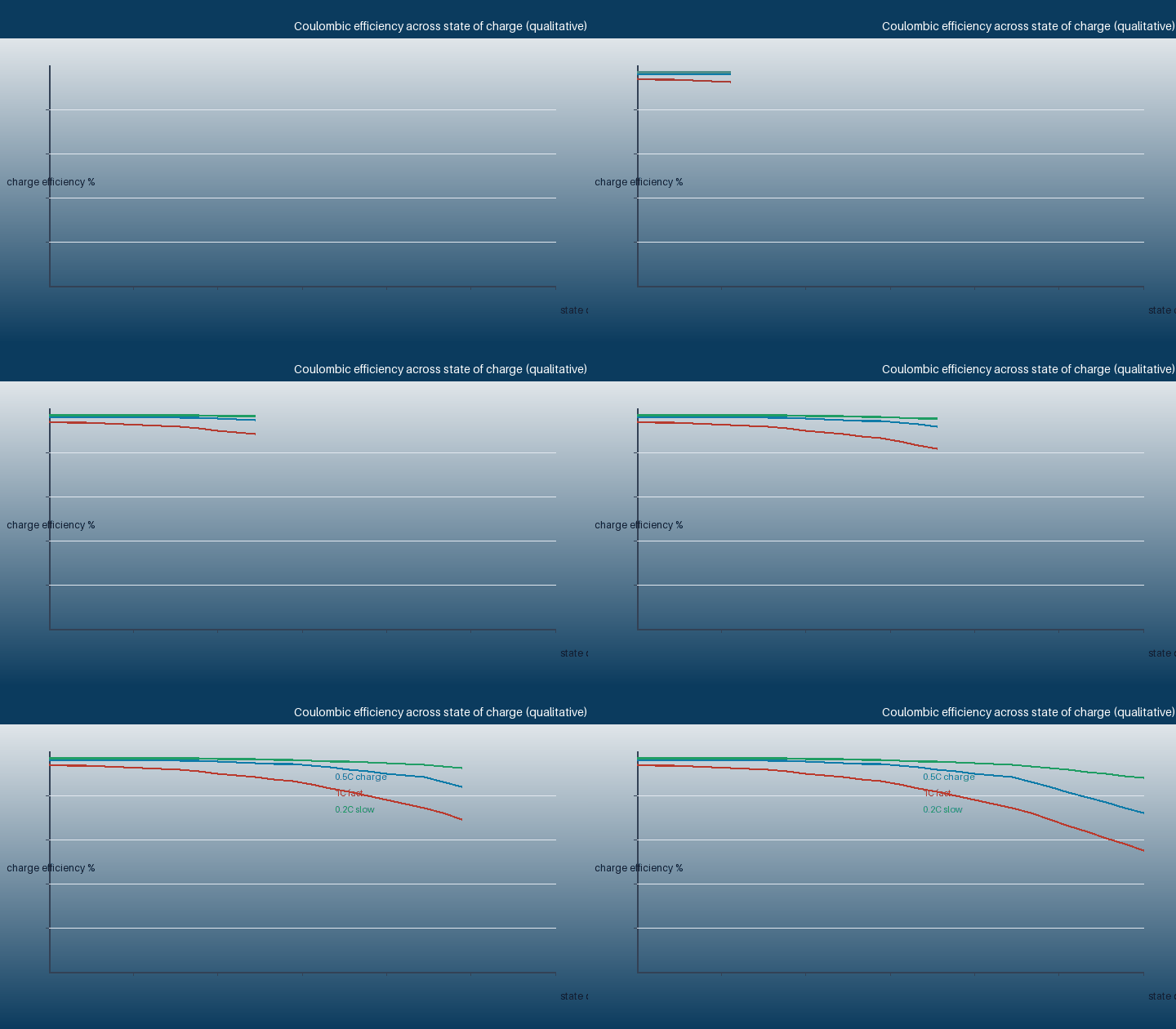
The decline is mechanistic. As the positive electrode exhausts oxidisable Ni(OH)2, an increasing share of current is forced into the oxygen-evolution reaction; as the hydride negative approaches its usable hydrogen capacity, its equilibrium plateau pressure rises and absorption kinetics slow. Both effects feed the recombination loop described in Paper 1, whose by-product is heat, and that heat accelerates oxygen generation still further in a positive thermal feedback. Pushing a constant high current through this region therefore buys little stored charge at the price of a large temperature rise.
The practical consequence is a characteristic efficiency-versus-SOC shape: a near-plateau across mid-charge, a knee around the high-SOC onset of oxygen evolution, and a steep drop through the final band where the cell is mostly heating itself. A charger that cannot identify the knee is forced either to stop early, leaving capacity unused, or to overcharge wastefully, sacrificing cycle life.
Warmth initially improves acceptance by speeding proton diffusion, gas transport and recombination kinetics; a cold cell accepts high current poorly, peaks at a higher voltage and risks internal pressure because its recombination is sluggish. But the same warmth that helps a cold cell hurts a warm one: at elevated temperature the oxygen-evolution potential falls, recombination heat is harder to reject, and the negative-delta-V signal shrinks - Analog Devices notes that for NiMH the -delta-V is almost non-existent at high temperature, removing a charger's primary stop signal precisely when overcharge is most damaging.
Good profiles therefore condition current on cell temperature: derate or pre-warm at the cold end, and derate aggressively at the hot end, keeping the cell inside a window - broadly near room temperature - where acceptance is high and termination remains observable.
Charge acceptance is also rate-dependent. At low current the cell has time to distribute protons and recombine any oxygen smoothly, giving high efficiency but long charge time; at high current, concentration gradients steepen, oxygen is generated earlier in state-of-charge terms and local heating rises. A 1C fast charge reaches the recombination regime sooner than a C/2 charge of the same cell, so it requires earlier and more sensitive termination and a cooler ambient.
This is why datasheets separate recommended slow charge (commonly 0.1C to 0.2C, where a simple timer is comparatively safe) from permissible fast charge (0.5C to 1C, which demands -delta-V, dT/dt and multiple backstops). The cell does not have one efficiency curve; it has a family indexed by current and temperature.

Multi-stage constant-current charging - and its intelligent MSCCC variants, including neuro-fuzzy ANFIS-controlled designs reported in the literature - divides charge into descending current steps that track the falling acceptance curve: a high bulk current while acceptance is high, then progressively smaller currents as the knee is passed, finishing with a short top-off. Each step keeps the instantaneous overcharge fraction bounded, flattening the temperature trajectory and raising overall energy efficiency relative to a single high current.
The first animated figure contrasts the near-flat mid-charge efficiency with the end-of-charge drop; the second stacks the information a controller needs at each stage. Step thresholds can be set on voltage, state of charge, temperature-rise rate or a model, and the art is choosing transition points that match the specific cell's oxygen-onset behaviour rather than a generic curve.
For a cell maker, the deliverable is a mapped acceptance surface - efficiency and pressure as functions of state of charge, current and temperature - measured on representative production lots, plus a recommended current envelope that stays below the recombination-limited rate in the top band. For a charger maker, it is a profile that consumes that envelope conservatively, using the steep final band for a controlled top-off rather than a sustained high-current push.
Validation should charge instrumented cells across current and temperature, integrating input and output charge to compute eta_Q directly and logging pressure or temperature as the acceptance proxy available in production. Designing to the acceptance curve is what separates a charger that fills cells quickly and coolly from one that achieves the same nominal time by cooking the last 20 percent - a distinction that maps directly onto the cycle-life evidence developed later in the series.
Weijiang Power designs and manufactures nickel-metal hydride cells, matched packs and charging-ready configurations for consumer, industrial, medical and mobility customers, and supports partners with charge-protocol guidance, IEC 61951-2 performance files, IEC 62133-1 safety evidence and charger co-validation. Share your cell format, charge rate, thermal envelope and cycle target and our engineers will specify a cell-and-charge combination that protects both runtime and service life. Review the range on the products page.


