A defibrillator asks its battery for two opposite things at once: near-zero current for years while waiting on a wall bracket, and a very large current for a few seconds while charging a high-voltage capacitor. Paper A of this three-part series dissects that unusual load profile, distinguishes the battery economics of public-access AEDs from reusable manual defibrillator-monitors, and grounds the discussion in IEC 60601-2-4 and published device data.
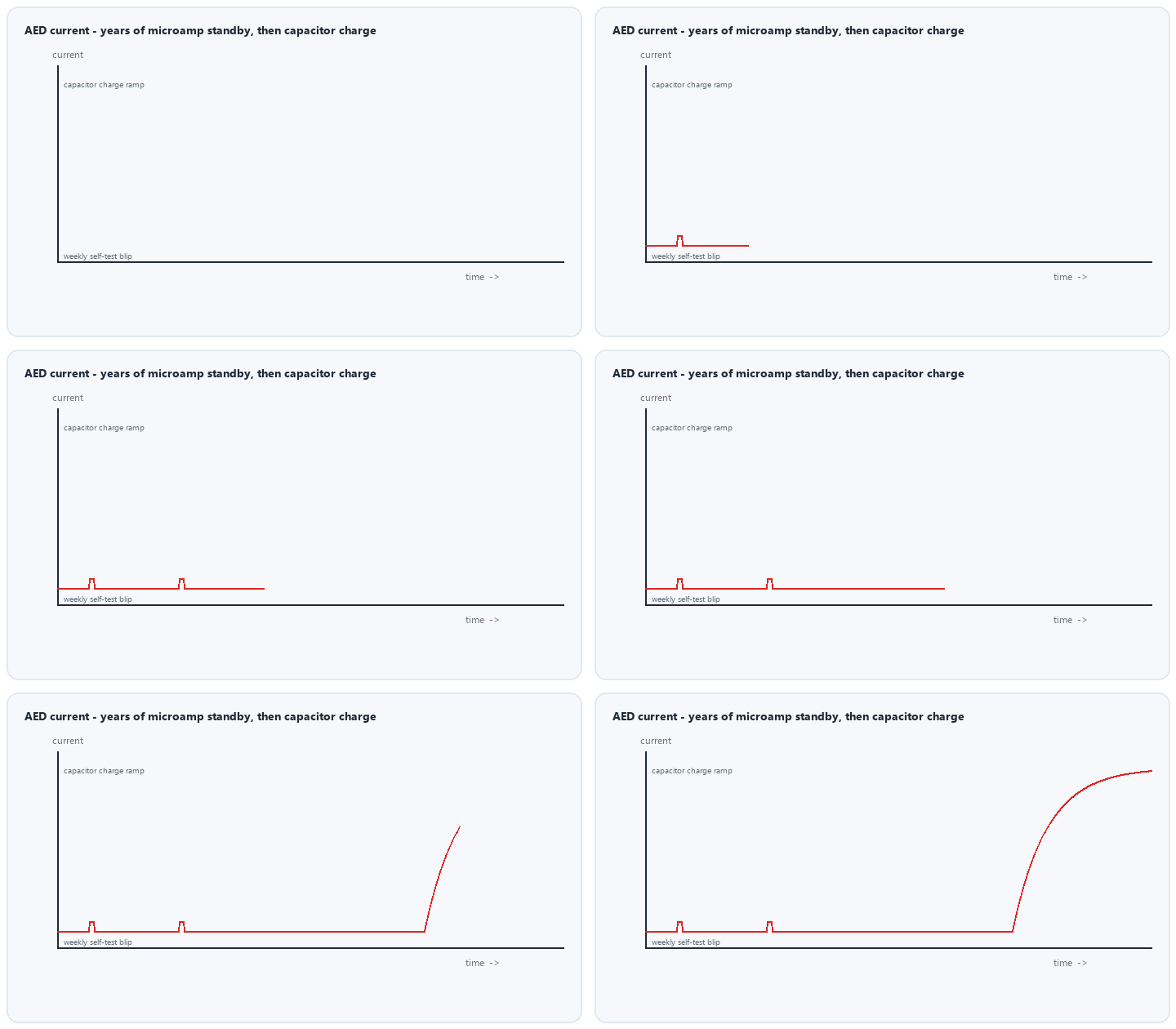
In standby, an AED only runs a periodic self-test — many devices self-test weekly — and indicators, drawing microamps. When activated, it must analyse ECG, drive voice prompts and a display, and charge an energy-storage capacitor to deliver a biphasic pulse. Adult energies are typically 150 J first shock escalating to 200 J, with paediatric levels around 50 J, delivered into a reference 50-ohm load across a patient-impedance range commonly spanning 10–300 ohms. A 150 J biphasic pulse corresponds to a peak current on the order of 32 A into 50 ohms (Philips HeartStart FRx data). Charging that capacitor pulls a high, brief current; the battery's internal resistance directly determines charge time — a clinical-critical few seconds.
Public-access AEDs are designed around disposable primary lithium-manganese-dioxide packs: a 9 V, 4.2 Ah LiMnO2 pack is specified for a minimum of 200 shocks or 4 hours of operating time per EN 60601-2-4:2003, an install-by date at least five years from manufacture, and around four to six years of standby life with weekly self-testing (Mindray BeneHeart C1A quotes six years at 20±5 °C). But hospital crash-cart defibrillator-monitors, ambulance units and AED trainers are used, tested and recharged daily; for these a rechargeable NiMH pack is the economic and environmental choice, and the same high-pulse charging physics applies.
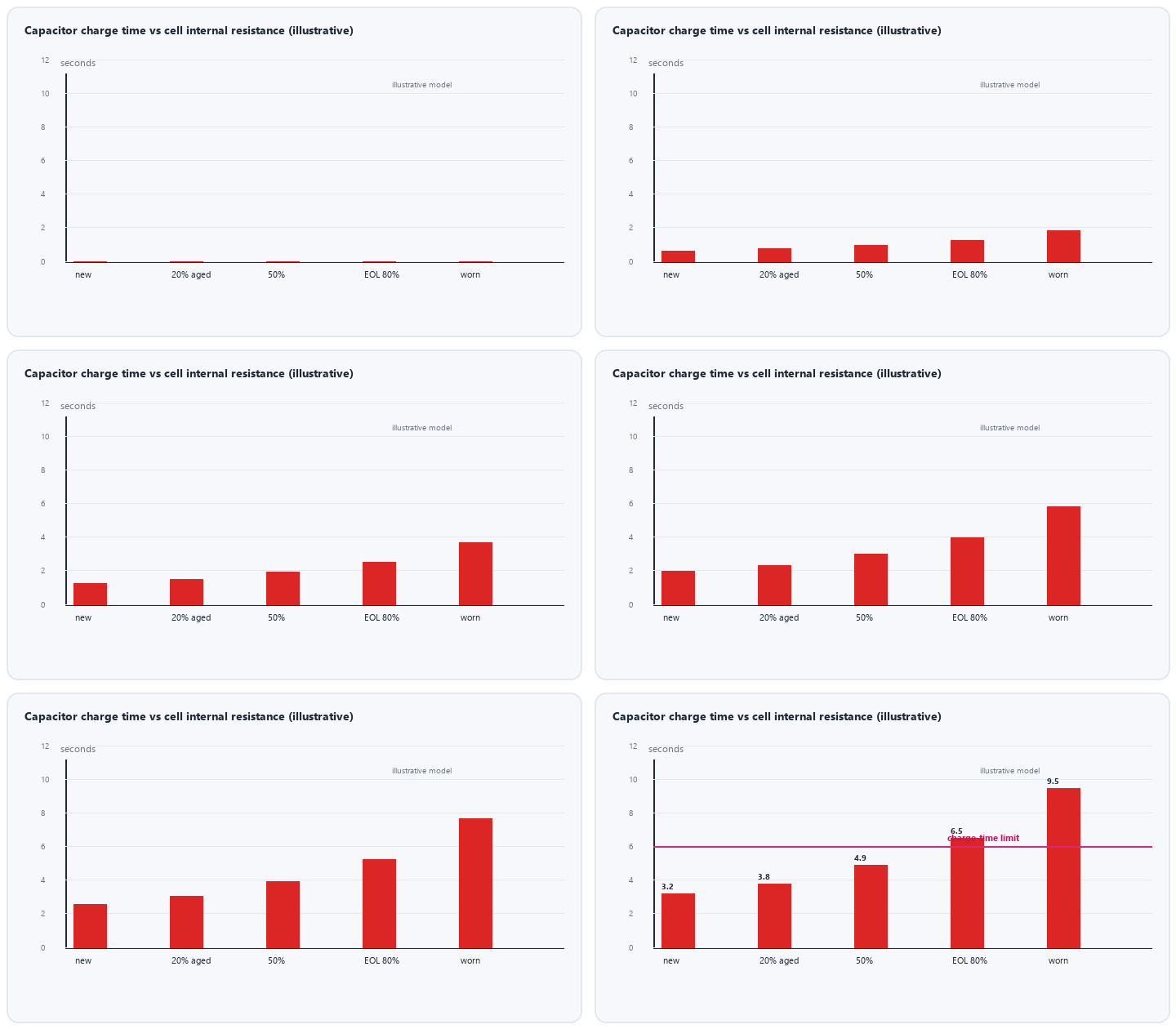
For a defibrillator pack, capacity is secondary to source impedance. The capacitor charger is a switching converter drawing large pulse current; as cells age and internal resistance rises, charge time stretches, the "charging…" prompt lengthens, and in a marginal pack the converter may fail to reach target energy. NiMH's low and stable internal resistance, high-rate discharge capability and flat voltage curve make it well suited to this pulse role, while its aqueous chemistry cannot thermally run away in a sealed wall-mounted enclosure.
IEC 60601-2-4 governs cardiac defibrillators, including energy accuracy (typically within 10 % of setting into 50 ohms and 15 % across 25–175 ohms), charge time, and endurance — FDA reviews cite therapy-subsystem endurance of at least 2500 charge/discharge cycles at rated energy into 50 ohms. Every one of those 2500 cycles is a high-current event the battery must support, which is why pack lifetime is measured in shock cycles as well as years.
A reusable defibrillator pack needs high-rate cells, welded heavy tabs, a thermistor for charge control, and capacity reserve so that charge time stays within specification near end of life. Paper B compares chemistries and sizes the pack; Paper C covers the IEC 60601-2-4 endurance and safety validation programme.
Weijiang Power manufactures high-rate NiMH cells and custom packs for defibrillator-monitor and trainer OEMs: low-impedance matched cells for fast capacitor charging, welded interconnects and IEC 62133-1/UN 38.3 documentation. Send your energy per shock, required charge time and target shock-cycle count and we will size a pack that meets them to end of life.


